Summary
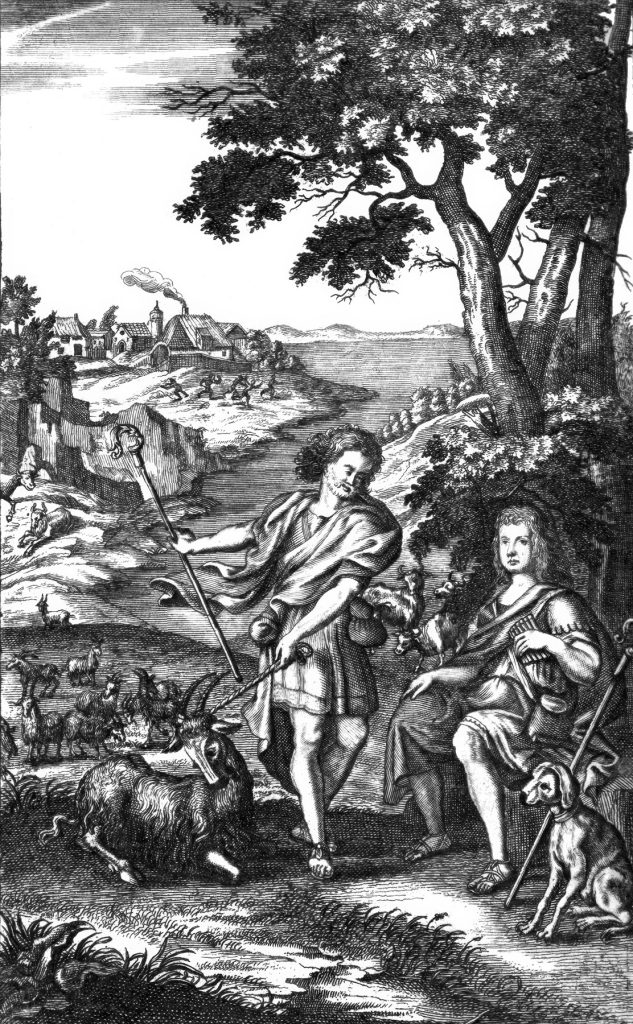
Nos patriae finis et dulcia linquimus arua. Nos patriam fugimus; tu, Tityre lentus in umbra formonsam resonare doces Amaryllida siluas. Vergil, Eclogues I.3-5
“We are leaving our country’s bounds and sweet fields. We are outcasts from our country; you, Tityrus, at ease beneath the shade, teach the woods to re-echo ‘fair Amaryllis.’”
The first Eclogue is a dialogue between two herdsmen, Meliboeus and Tityrus. Similar to Eclogue 9, it references the land confiscation in 41 BCE that occurred after the battle of Philippi for veterans of the civil war, that Vergil experienced in his hometown of Mantua. Meliboeus is to lose his property in the the redistribution while Tityrus, having visited Rome, has secured his property and will remain on his land.
Setting
To understand the backdrop of Mantua it is important to learn about the conflict behind first and ninth Eclogue. After the assassination of Julius Caesar, members of the second triumvirate, Mark Antony, and Octavian, sought to avenge him by attacking the forces of the lead conspirators, Gaius Cassius Longinus and Marcus Junius Brutus in the Liberator’ Civil War. After defeating the conspirators at the Battle of Philippi, Mark Antony stayed to calm the East while Octavian returned to Italy to settle veteran’s on confiscated land.
One of the areas that would be confiscated would be Vergil’s home near Mantua. The loss of his family plot then becomes the impetus for the composition of the Eclogues. This poem contrasts the harsh reality of land expropriations with the idyllic descriptions of the countryside common in bucolic poetry.
Geography
Rome
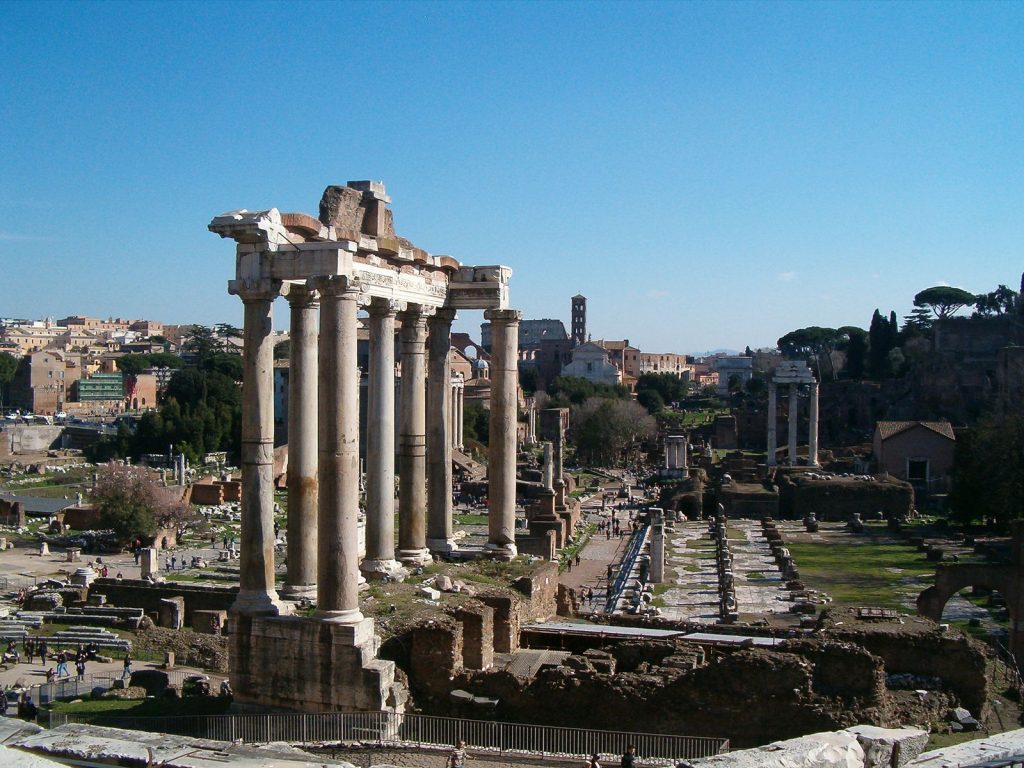
Et quae tanta fuit Romam tibi caussa uidendi? Libertas! Vergil, Eclogues I.26
“And what was the great occasion of your seeing Rome? Liberty!”
The first location mentioned in the Eclogues, and the capital of the Roman Republic. In Eclogue 1, Tityrus speaks of his journey to Rome for freedom. While there, he meets a young man, likely Octavian, whom he regards as close to a god.
Hic illum uidi iuuenem, Meliboee, quot annis bis senos quoi nostra dies altaria fumant. Vergil, Eclogues I.42-45
Here, Meliboeus, I saw that youth for whom our altars smoke twice six days a year.”
The location of the word in these lines of the poem is also notable. Eclogue 1, there are 83 lines, so by placing iuuenem in the middle of line 42, Vergil indicates the importance of Octavian making him literally the center of the poem.
Tityrus’ visit to Rome references events occurring in 41 BCE when land confiscations reached a boiling point. These events, described in Book 48 of Dio Cassius’ Roman History tell of both veterans, dissatisfied with the speed of the settlements, and threatened occupants, marched through Rome demanding compensation or for the latter, the return of their properties.
Megara Hyblaea
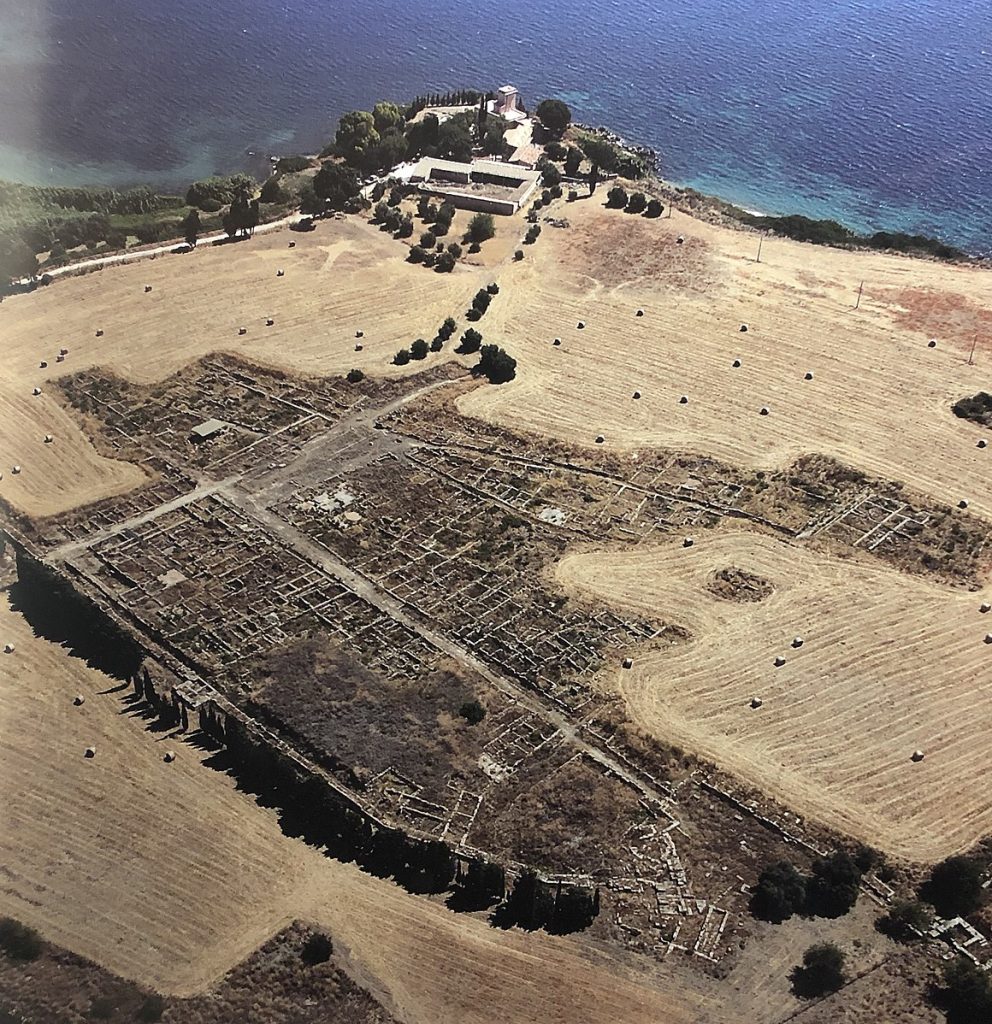
hinc tibi, quae semper, uicino ab limite saepes Hyblaeis apibus florem depasta salicti saepe leui somnum suadebit inire susurro Vergil, Eclogues I.53-55
“On this side, as of old, on your neighbour’s border, the hedge whose willow blossoms are sipped by Hybla’s bees shall often with its gentle hum soothe you to slumber”
Megara Hyblaea was an ancient Greek colony, located on the coast of Southeastern Sicily, founded around 726 BCE. Similar to other ancient cities in the region, it is named after the Sicilian chief and Siculian hero Ὕβλων (Hyblon.) Not much is known about Megara Hyblaea until its destruction by Gelon of Syracuse in 483 BCE.
αἱ μὲν οὖν πόλεις οὐκέτ᾽ εἰσί, τὸ δὲ τῆς Ὕβλης ὄνομα συμμένει διὰ τὴν ἀρετὴν τοῦ Ὑβλαίου μέλιτος. Strabo’s Geographica VI.2.2
“The cities no longer exist, it is true, but the name of Hybla still endures, because of the excellence of the Hyblaean honey.”
Megara Hyblaea’s inclusion here alongside bees in Eclogue 1 is likely influenced by the Theocritus’ Idylls. In antiquity, the bees of this region were well known as creators of high-quality honey, which were produced from the local thyme. In a quote from Strabo’s Geographica, shown above, the ancient Greek geographer attributes the endurance of the name to its delectable honey.
ἄειδον κόρυδοι καὶ ἀκανθίδες, ἔστενε τρυγών, πωτῶντο ξουθαὶ περὶ πίδακας ἀμφὶ μέλισσαι. Theocritus, Idylls VII.141-142
“Lark and goldfinch sang and the turtle moaned, and about the spring, the bees hummed and hovered to and fro.”
Theocritus’ Idylls reference the bees of the island frequently. Tityrus’ comparison of a bee’s buzz to a gentle lullaby is intended to evoke images of idyllic countryside depicted by Theocritus. This image, in turn, is contrasted with the harsh reality of land confiscation faced by Meliboeus.
Parthia, Germany, The Saône, and the Tigris
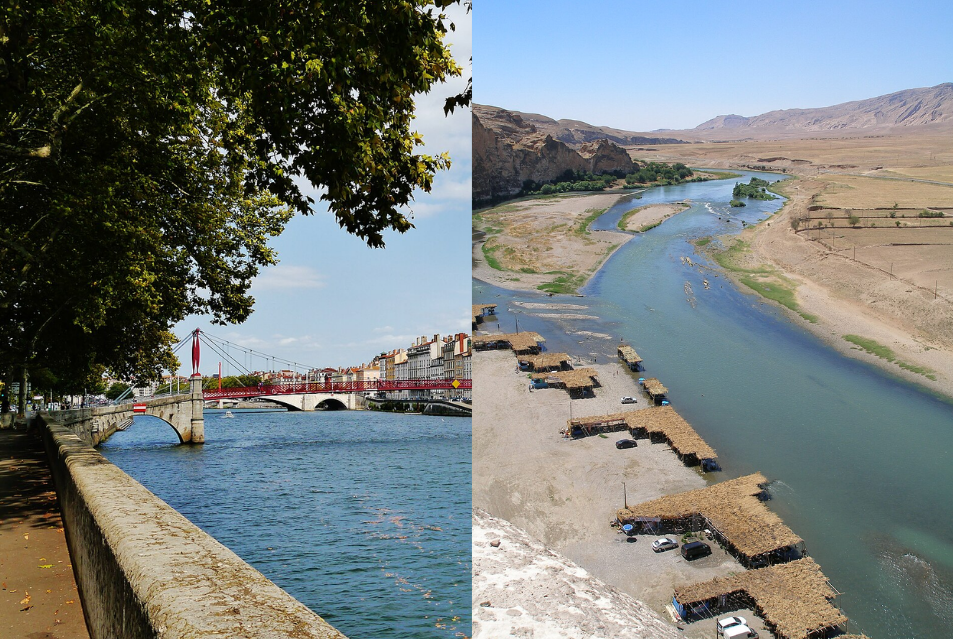
Htkava, CC BY-SA 3.0 https://creativecommons.org/licenses/by-sa/3.0, via Wikimedia Commons/Cropped from Original
Ante pererratis amborum finibus exsul aut ararim Parthus bibet aut Germania Tigrim quam nostro illius labatur pectore uoltus. Vergil, Eclogues I.61-63
“Sooner, both borders having been wandered, shall either the exiled Parthian drink the Arar, or the German drink the Tigris, than that countenance of his shall slip from my chest.”
The Arar, now more commonly known as the Saône, is a river in Eastern France and a tributary of the Rhône. The Tigris, along with the Euphrates, is one of the two notable rivers in Mesopotamia. The lines here continue to build upon the allusion of impossibilities introduced in lines 59-60 (pascentur in aethere cerui) as in antiquity a Parthian, hailing from what is now modern Iran, and German would have great difficulty reaching their respective rivers. Vergil here shows the irony of the land confiscations as it is not the nomadic German or Parthian, who at this point would have been located outside of imperial borders, losing land, but instead a Roman citizen, Meliboeus.
Britons, Libyans, Scythians, and the Oaxes
At nos hinc alii sitentis ibimus Afros, pars Scythiam et rapidum cretae ueniemus Oaxen et penitus toto diuissos orbe Britannos. Vergil, Eclogues I.64-66
“But we will go hence, some to the thirsty Libyans, a part will reach Scythia, the snatching-up-chalk Oaxes, and the Britons, thoroughly divided from the whole world.”
The four locations mentioned here by Meliboeus were all regarded as faraway lands. He suggests that after relinquishing his lands to veterans he will be forced to move to these remote locations, separated from the rest of the ancient world. In pastoral poetry, these long journeys were seen as equivalent to a curse or condemnation. These four toponyms are placed at the extremes of the cardinal directions, showing their distance and remoteness in the ancient world.
Three of the ancient peoples in this passage are easy to pinpoint. The “sitientis…Afros” in line 64 refer to the inhabitants of the inland regions of Libya as the coastline was both fertile and prosperous, Scythians were an eastern Iranian equestrian people who inhabited a region that encompassed the Pontic–Caspian steppe, and the Britons were a celtic peoples who inhabited what is now Great Britain. It is unclear, however, the location of the Oaxes. While there is a town in Crete called Oaxus, or Axus, it is unlikely that the adjective “cretae” refers to the island as it is not as remote as the other locations in this passage. It could refer to the river Oxus now known as the Amu Darya, which connects to the lake Zorkul. This river flows muddily and turbulently from the Hindu Kush to the Aral sea. However, the more likely choice here is that the name is intentionally ambiguous, with the name being an amalgamation of several Eastern rivers, yielding an remote, exotic, and even mythical sounding title.
The Full Map of Eclogue 1
Bibliographies
Parthia, Germany, The Saône, and the Tigris