For the Birds – Colorado Birding
My wife Bets went to Colorado a couple of weeks ago to attend a business conference. I flew to Denver afterward for a few days of birding with her. This column will describe some of our birding adventures in that beautiful state.
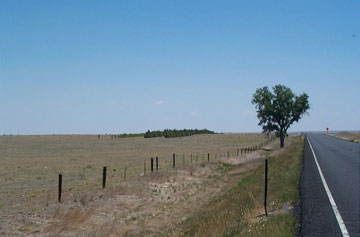 The latter third of July is not the optimal time for a birding excursion to Colorado. Most birds were tending fledged young so bird song was infrequent and birds were therefore harder to detect. Some birds like the Mountain Plover had finished breeding and departed for their wintering areas. Nevertheless, we managed to see many species of birds with a little effort.
Our destination for the first day was the Pawnee National Grassland, about 90 miles northeast of Denver and 30 miles east of Fort Collins. This national treasure includes some 193,000 acres of federal land interspersed with private farmland. The area is crisscrossed by north-south and east-west roads, making it easy to explore the area.
The Pawnee Grassland results from the climate of the area. Annual rainfall is only about 12 inches a year. Summer temperatures are usually high; it reached 109 degrees when we there. The low moisture means that trees are rare and virtually all of the habitat is shortgrass prairie. Despite the harsh climate, bird life is surprisingly abundant.
Horned Larks are everywhere. Driving along the roads, flocks of larks, sometimes 100 or more, flew up in front of the car. Western Meadowlarks were common as well.
 For most of the grasslands, the highest points are fence posts and wire fences. Birds often perch atop them. Checking these perches yielded lots of Western Kingbirds, Brewer’s Sparrows and Lark Buntings. We never tired of seeing male Lark Buntings with their bright white wing patches on otherwise black bodies and the associated females with their more muted plumage.
One of the specialties of the grasslands is McCown’s Longspur. One male gave us fantastic looks only ten feet away, allowing us to see the characteristic white and black pattern on the tail and the rufous patch in the wing.
We only saw five hawks on our trip but they represented five different species: Red-tailed Hawk, Swainson’s Hawk, Ferruginous Hawk, Northern Harrier and American Kestrel.
Prairie dogs are abundant on the Pawnee Grasslands. These rodents provide habitat for Burrowing Owls. We had no problem seeing many of these charming owls. In one small field, we saw nine at once!
A chat with a local farmer revealed some of the tension that occurs where agriculture and nature meet. This farmer indicated he did not like prairie dogs on his horse farm because they provided nesting sites for Burrowing Owls. The farmer indicated the owls were killing his barn cats, leading to too many mice in his horse barn.
A pronghorn antelope was a nice treat along with several species of ground squirrels and two rabbit species scurrying over the grasslands.
Two days later, we planned a trip into the Rocky Mountains to escape the heat wave that was plaguing the Denver area. We chose to explore Golden Gates State Park northwest of Denver.
We began our birding at the Visitors Center, quickly finding Mountain Chickadees, a Hammond’s Flycatcher and Dark-eyed Juncos. The juncos were the gray-headed forms, differing from out eastern slate-colored forms by the distinctive black lores in front of the eyes on the otherwise gray head and the rufous “backpack”.
From the Visitors Center, we drove up Mountain Base Road. This road has parking areas and picnic sites every half-mile or so, conveniently allowing birders to stop safely. We encountered several families of Western Bluebirds and Mountain Bluebirds, the parents working hard to feed their begging fledglings.
We did well with the crow family, finding Clark’s Nutcracker, Steller’s Jay, American Crow, Common Raven and Black-billed Magpie. Alas, no Gray Jays.
The bubbling song coming from a moist thicket gave away the presence of a Lincoln’s Sparrow. We heard the wonderful cascading song of a Canyon Wren, unseen from a cliff along the road. We found several Yellow-rumped Warblers, differing from our eastern yellow-rumps in having a yellow rather than white throat.
We ultimately reached the high point of the road at 9,200 feet at Panorama Pass. Here one could see over 100 miles of the Continental Divide with mountain after mountain in view. A flock of Red Crossbills called as they flew overhead.
Returning to the Visitors Center, we drove up Crawford Gulch Road. A short hike there yielded a Townsend’s Solitaire. We found a singing Warbling Vireo, whose song is buzzier than for our local birds. A stop at a feeding station on the way out of the park yield three hummingbird species: Broad-tailed, Rufous and Calliope for a nice flourish on a fine day of birding.
[First published on July 31, 2006]