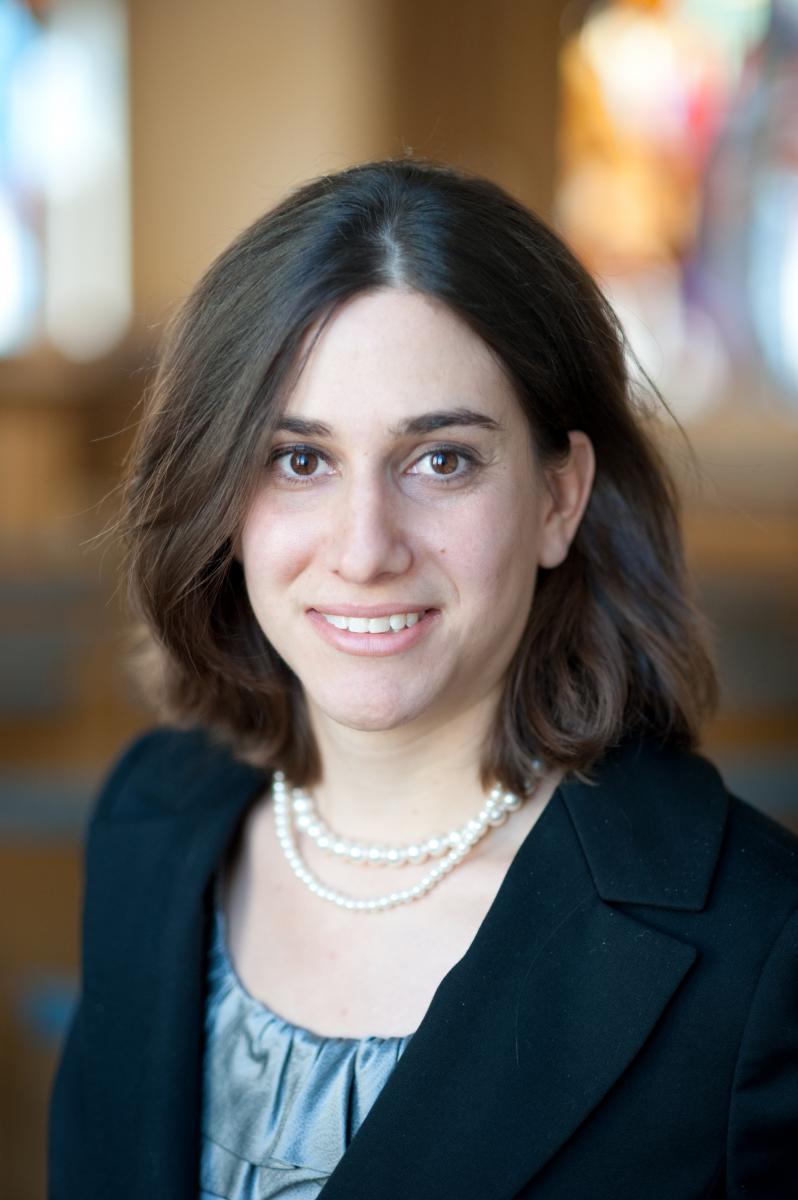
About the narrator:
Rachel Isaacs was born in New Jersey and raised in a conservative Jewish household, attending Hebrew school three days a week and regularly participating in services. Her Jewish identity strengthened over time—she served as president of Hillel at Wellesley College and spent three years living in Israel before attending rabbinical school. She now lives in Maine with her wife, Mel Weiss, and their two children. Rabbi Isaacs is the spiritual leader of Beth Israel Congregation in Waterville and the executive director of the Center for Small Town Jewish Life, where she works to support Jewish life in rural communities while balancing tradition and modernity.
In this excerpt in her interview with Abigail Stathis on January 23, 2025 at Colby College, Rabbi Isaacs emphasizes that in her view, making the mikvah at Beth Israel more accessible is not a break from tradition but a way to honor it.
Transcript:
“The innovative ways that we bring Jewish ritual to people’s lives – they think that this is a break with tradition. But for me and for Mel [Weiss], that is very much not the case. Our mikvah is totally kosher. We’re not saying any body of water, in any context, is a mikvah. An ocean is a mikvah, a lake is a mikvah. But that doesn’t mean that, from our perspective, a swimming pool is a mikvah.
Part of the reason we built [the mikvah] is that some people said to us, ‘There were other rabbis in Maine that used swimming pools as mikva’ot.’ And I said, ‘Now the Jewish identity of the people who went through that process is forever contested.’ And that’s not fair to those people. We put in the time, and the money, and the resources, and the political battles to build something that was kosher according to Jewish law.
The part that was innovative about it was that anybody could use it. But according to the Jewish tradition, you can’t impurify a mikvah. So, we weren’t breaking with tradition by opening it up, because a mikvah is always kosher. It’s just destigmatizing it and using it to all of its ability, so that mikvah could become a natural part of my community’s culture.” – Rabbi Rachel Isaacs
Rabbi Rachel Isaacs’ full oral history interview is available through Colby’s Special Collections & Archives.
About the interviewer:
Abigail “Abby” Stathis was born in Savannah, Georgia, and moved to Wellesley, Massachusetts, where she attended public school. At the time of this interview, she was a sophomore at Colby College, double majoring in Biochemistry and English, and active in endurance sports, rowing crew at Colby and participating in the dance department. In her spare time, she enjoyed reading and furthering her understanding of Jewish traditions through her work on the Maine Mikvah Oral History Project.
After participating in a mock immersion in the Waterville mikvah herself, “I looked back, and the water rippled where I had once been,” Stathis wrote. “After a few seconds, it became still; I began to walk away. Much like my dunk in the mikvah, this course was bracing yet rewarding, an invitation into learning without reservation about a special and evolving ritual for Jews.”