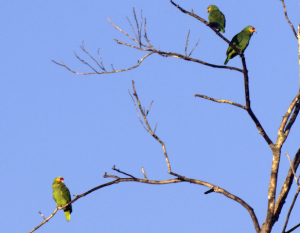
Red-lored parrots chatter in the branches of a dead tree. Photo by Sarabeth George.
Today was another bustling day filled with new and exciting experiences in the Belizean rainforest, and was also our last full day at this field station. We roused ourselves early to go bird watching, and saw several new species bringing us closer to meeting our goal of 75 species in the four days we will spend at Hill Bank Field Station. One such species was the red-lored parrot, which chattered away in the branches of a tree while we watched through our binoculars.
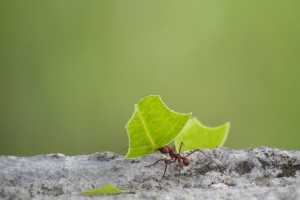
Leaf cutter ants hard at work.
Photo by Sarabeth George.
As we returned from our birding walk, the leaf cutter ants were hard at work carrying leaves back to their nest, which was about 50 feet from the tree where they were cutting the leaves. In the nest, they use them as substrate for the species of fungus that is their only food. The ants are so determined in their mission to return the leaves to their nest that if you pick up one of the leaves as they are carrying it, the ant will come too! Following this observation, we picked up a few ants (along with their leaves) and gave them a lift closer to their nest. When we set them back down, they happily rejoined their comrades in the march towards home.
After breakfast, we all boarded the bus for a long ride down the rough, muddy roads to learn about sustainable logging and carbon sequestration in Belize. After a bumpy journey down the road, including a few bird sightings, we hopped off the air-conditioned bus into the bright sun and humid air. On the left side of the road, a small, slightly overgrown road disappeared into the trees. We followed our guides down the path, and learned about the process of sustainably logging the rainforest. Plots are marked for logging throughout the Rio Bravo Reserve, and these can be logged every 40 years. Each tree in a plot is checked for size and species and then mapped. Specific trees will then be chosen to be logged, and this information must go through higher authorities before any logging can be done. It is an amazing amount of work to go through tree by tree, but the reserve is setting an example for the world that wood harvesting can be done while maintaining the forest. Our next stop was at a sight that the reserve maintains for carbon sequestration. These plots are round, and again trees are marked by their size, along with dead trees, fallen trees, and brush on the ground to measure the carbon held by the area. High carbon emitting companies around the world can then buy an offset from Programme for Belize to theoretically improve their carbon footprint.
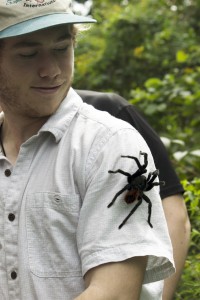
The Mexican red-rumped tarantula checks out Alex’s sleeve.
Photo by Sarabeth George.
On the ride back, one of our guides spotted a Mexican red-rumped tarantula in the road and we all had fun looking at the gigantic spider. It was surprisingly slow moving, though, so it wasn’t too intimidating. A few brave souls invited it to walk on them, as seen in the photographic evidence.
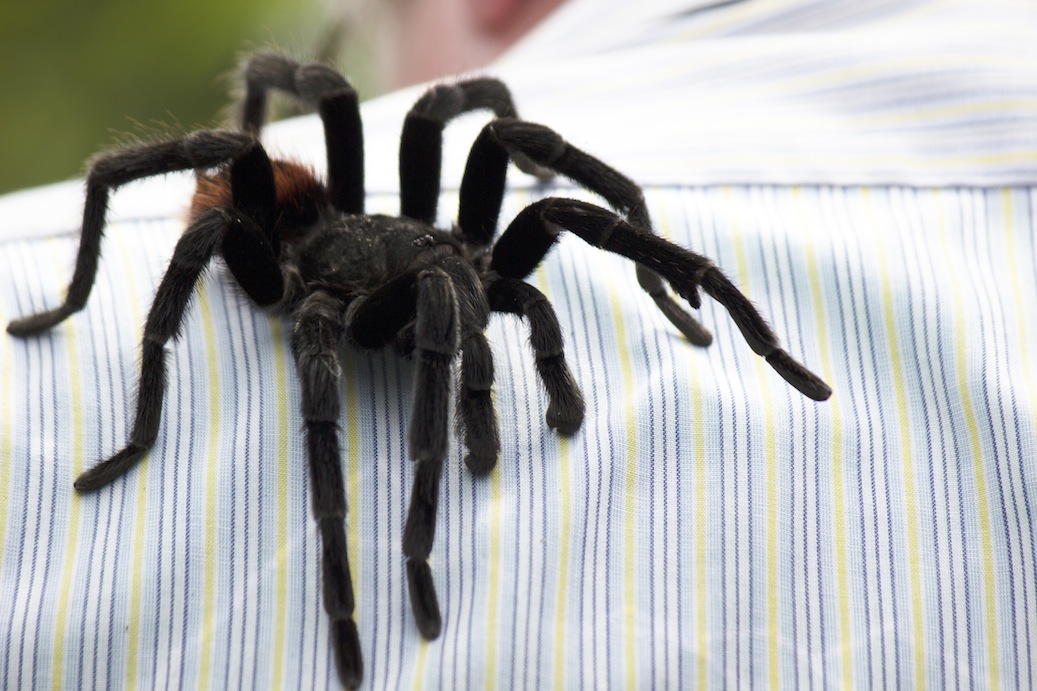
Mexican red-rumped tarantula.
Photo by Sarabeth George.
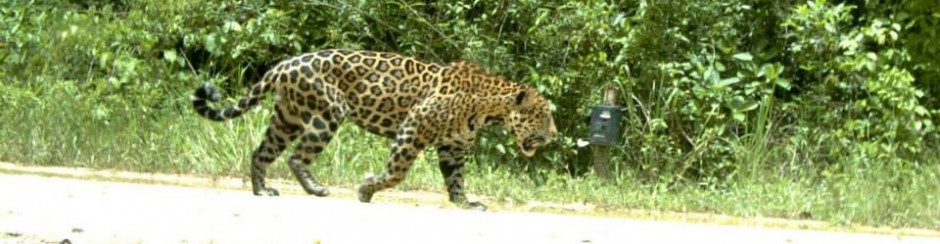
In the afternoon we split into two groups and headed out to the Motmot Trail (where we did our solo hours on our first full morning). On our walk down the road to get there, a mud splattered jeep pulled up full of jaguar researchers, who come back year after year to study the unique cats we hope to see a glimpse of. Yet another cool encounter in Belize.