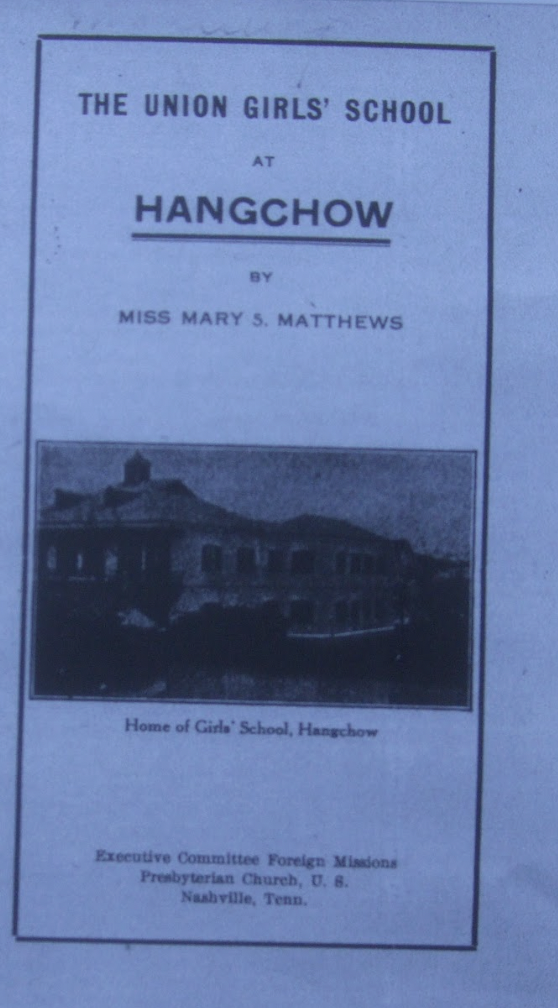
In a former article it was my privilege to tell the story of our Southern Presbyterian Mission’s Girls’ School at Hangchow Dr. Chester has now asked me to give the history of its union with the Girls’ School of the Northern Presbyterian Mission and the Wayland Girls’ School of the Northern Baptist Mission of this city, and to tell something of its hopes and plans for the future.
FIRST BEGINNINGS.
Hangchow is the very first Mission station established by our Church, and the Hangchow Girls’ School was the pioneer educational institution of our foreign mission work. The beginnings of things are always difficult and hazardous. With the very full mission literature of the present day it is difficult for us to realize how many unsolved problems faced those earlier missionaries, and in looking back on the history of those times one cannot but admire the courage and wisdom which was brought to the solution of these problems.
In at least the second year of its existence our station had a boys’ school, a dispensary, and a school for girls, while the street chapel had been opened from the first days. Thus, while from the beginning in Hangchow,
we have recognized the three-fold plan of our Lord in giving His message to the world, the preaching of the Word has always been stressed.
The station had strong and successful evangelists who were inclined to look askance at all forms of institutional work. After Dr. Fishburne’s failure in health and his return to the homeland, no further attempt was made to build a hospital. While Miss Kirkland continued to dispense medicines, and Miss French’s remarkable talent for medical work bore rich fruit over many years, organized medical work passed into the hands of the English Church Missionary Society.
The boys’ school prospered for several years, and some of the station’s best preachers began their education there. However, the work proved too demanding for Mr. Painter’s consistently fragile health, and the school was eventually closed.
With the closure of the boys’ school, responsibility for educating the boys of the Chinese constituency was transferred to the Northern Presbyterians, while this mission agreed to educate their girls. At that time, the Northern Presbyterians operated a successful boys’ school in Hangchow, which has since developed into the Presbyterian Union College.
EARLY. STRUGGLES.
The advisability of closing the girls’ school was discussed on more than one occasion. During a period of over a year when no foreign lady was stationed there, the school continued only through the persistent efforts and management of the native teacher, Mrs. Chow.
Despite its many struggles, the school remained firmly committed to the physical, mental, and moral uplift of Chinese women. Thirty years earlier, the most pressing injustices faced by women in China were footbinding and childhood betrothals. The school adopted a clear stance: it refused admission to girls whose feet could not be unbound, and it declined to enter into educational agreements unless parents or guardians granted the girls the right to choose their own marriage partners.
At that time, mission school policies on these issues were far from uniform. Some institutions, particularly those seeking to attract students from wealthier families, permitted footbinding. Others avoided taking a position on childhood betrothals, arguing that such matters lay beyond their authority.
It was a matter for the family of the pupil to decide. Personal cleanliness was especially emphasized, and the Bible course, mapped out by Mrs. Randolph and Mrs. Stuart, was singularly like that of Dr. White, requiring a textual study of nearly every book of the Bible.
TEACHER TRAINING
At first the curriculum was necessarily primary, but soon Mrs. Randolph and Mrs. Stuart had visions of what might be accomplished by educating teachers for the future schools. Many of these dreams were afterwards realized. Each year one or two of the more promising pupils were kept to be trained as teachers. At that time it was not the policy of either the Mission or of the station, which constituted the school board, to attempt any work for the higher education of Chinese women.
Mrs. Essie Wilson Price began some advanced work in the school during her incumbency, and as the years passed the Chinese nation was broadening and developing her ideas in regard to female education.
On returning to the city after the “Boxer” uprising in the beginning of 1901, Mrs. Stuart and Miss Mathews made a determined effort to raise the standard of the school to the grade of high school and succeeded. The first high school class graduated in 1907. It was also the earnest desire of the ladies in charge to add two years of normal work and a college course of four years to the school’s curriculum. With only two foreign teachers, a meager native faculty, and wholly inadequate equipment, this was impossible.
We realized that we stood on the threshold of a new era for China. There had at least come to this ancient nation an extraordinary awakening. Women and girls of all classes were suddenly demanding education, and schools for girls were springing up everywhere. There was a phenomenal demand for trained teachers which the mission schools were quite unable to supply. Even girls whom we had considered inefficient were accepted with gratitude by the new schools as teachers and paid good salaries. It has always seemed to me that in remaining with us during this crisis, our own best teachers showed extraordinary moral strength. I recall one brilliant young woman who was offered a salary ten times as large as that we were giving her. She is now the happy and contented wife of a poor young preacher, who will probably never receive more than one-fourth of the amount of the salary offered to her at that time.
IDEALS
The ideals for which our school had stood and which it had stamped upon the four hundred and fifty women it had sent out during the past thirty years had suddenly become attractive to the Chinese. China claimed these ideals as her own. The nation had caught a glimpse of the possibilities of Christian womanhood, and had risen in a noble effort to grasp those possibilities while dimly realizing the source from which they sprung.
We all knew that if the Mission schools failed to supply this demand for trained teachers China had no recourse but to secure them from the non-Christian government schools of Japan.
We were pressed to receive pupils. Our old buildings could accommodate only sixty girls comfortably. By using every possible makeshift we at one time raised the enrollment to one hundred, but we realized that this crowding endangered the health of the school. Moreover, at this time there were already in the city two other Mission schools for girls conducted on exactly the same lines as ours.
MRS. GARRITT’S SCHOOL
Near the close of the last century, Mrs. J. C. Garritt, who was formerly Miss Nannie McDonald, of our Mission, earnestly desiring to do some work for the Master, and being rather closely confined to her home by her family of small children, opened a day school for girls in the neighborhood near her.
In 1899 the Chinese Christians of the Northern Presbyterian Church expressed their warm approval of her work, and begged her to open a boarding school for their daughters, promising themselves to pay for the books, food, and clothing of the pupils. As this was so much nearer self-support than anything that had been previously offered, it seemed wrong not to accept it. So after much consultation and many prayers, a friend from home having provided the funds, this school was opened.
THE BAPTIST SCHOOL
In 1898 Rev. and Mrs. W. S. Sweet of the Northern Baptist Mission were transferred to Hangchow, and began to press the work of that station along all lines. The work had scarcely begun, however, before all were obliged to flee from the city on account of the “Boxer” uprising.
On returning to the city in the beginning of 1901, Mrs. Sweet found the great ladies of her neighborhood very friendly and visited much among them. It was in response to an appeal from these ladies that she opened a school for young girls.
One of these ladies rented a room near the Baptist chapel and lived there with her daughter and one or two other girls. A few girls from the neighboring families also came daily to be taught. Mrs. Sweet held her classes in the chapel. The work developed very rapidly. In 1907 the board granted an appropriation and sent out two young ladies to establish a boarding school for girls. When in 1908 the boys’ school moved into its new building the girls’ school moved into those vacated by it.
Under the efficient management of Miss Nourse and Miss Wickenden, this school soon outgrew its first home. A large Chinese building was rented and the school moved into it. Thus our school stood on the threshold of a glorious era, yet without an adequate faculty or equipment to carry out her manifest destiny.
FIRST STEPS TOWARD UNION.
As early as 1905, the Northern Presbyterians had approached us on the subject of union of the girls’ schools. The theological seminaries of the two missions had been united before this time. The advantages of union were patent to all.
In 1906, the Northern Presbyterian Missions and ours appointed a joint committee “to consider the practicability of harmonizing and uniting our educational work.” In 1907, the union of the two Presbyterian girls’ schools in Hangchow was approved by both missions. During the summer of the same year, the Northern Baptist Mission asked that their girls’ school in Hangchow might unite with these two Presbyterian schools, and the overture was referred to committees by the respective missions.
In 1908, the joint Committee on Educational Work of the Northern and Southern Presbyterian Missions recommended that both Missions unite in the Northern Presbyterian College for Boys, and that a uniform curriculum be adopted for all elementary and academic work in both Missions.
When the union of the two Presbyterian girls’ schools was approved in 1907, it was agreed that they should occupy the building vacated by the boys’ college. In this way the practical union of the girls’ schools was delayed till the beginning of 1911.
Finally the triple union was accomplished in 1912. In this union it was stipulated that there should be a joint capital of $30,000, each mission furnishing $10,000, and the representatives of the three missions were instructed to purchase a new site. The site under consideration now is on the City Hill, not far from the original home of our Mission in a most healthful and desirable locality.
All of the measures mentioned above were referred to the home boards and committees and approved by them.
THE FACULTY
The foreign staff for 1913 is as follows: Our Mission gives Dr. Lee, the principal, an M. D. of Tennessee University, whose medical training admirably fits her for looking after the health of a large girls school; and Miss Rebecca Wilson, a B. A. of Converse College, who has already had more than ten years of successful work in China. From the Northern Presbyterian Mission we have Miss Ricketts, a practical educator of rare experience and ability; and Miss Lois Lyon, B. A. of Wooster University, who has the advantage of having been born in China. The Northern Baptists have appointed to this work Miss Nourse, a Ph. B. of Chicago, and Miss Woods, an A. B. of Mt. Holyoke.
The advantages of this union in economy, in efficiency, and above all in spiritual inspiration and uplift must be apparent to all. Each of the three Missions involved had felt obliged to open a school for the higher education of Chinese women, and by uniting they reduce this expense one-third. The three Missions had each designated Hangchow as the place where this institution for higher education should be located.
The advantages in efficiency are even greater. By having six foreign teachers, we may be able to secure specialists for each department. As an example of the increased efficiency, I would like to mention the remarkable social work among the families of the pupils developed by Miss Rebecca Wilson and her Bible woman, Mrs. Ma.
Before the union, with only two foreign ladies connected with the school, this work was necessarily neglected.
A department of Foreign Correspondence, also, can now be established and the school can be kept in close contact with its supporters in the home land.
But unquestionably the greatest advantage has been in the spiritual inspiration gained by the union. Who can estimate the influence of this object lesson on the Chinese Christians. Three Missions are willing to waive all minor differences, all secular ambitions and unite for the glory of their common Master. Besides, the union was easy. There has always been the most perfect harmony between the five Missions working in Hangchow, and as I have pointed out, from the earliest days we have had federation in work. The basis of union in all our work has been that “the Bible shall be accepted as the Word of God and the supreme rule of faith and practice.” The union was sure to come. It could not be resisted, for love was behind it—the mutual love we have for each other and the love of all of us for the Master, who prayed that “they might all be one.”
Matthews, Mary S. The Union Girls’ School at Hangchow. Nashville, TN: Executive Committee Foreign Missions Presbyterian Church, U.S., n.d. Anna Gay McClung Papers, McClung Historical Collection, Knox County Public Library, Knoxville, TN. Source adopted from Dr. Hong Shen.