 Located right in the heart of downtown Waterville sits one of the city’s most beloved ethnic restaurants, Cancun. This Mexican restaurant is extremely popular with Colby students who love Cancun’s drink specials and reasonably priced menu options. However, a closer examination of Colby’s fascination with Cancun reveals significant lessons about culture, stereotypes, and systems of power. Cancun restaurant has come to symbolize Mexican culture as it is represented in America. A close study of the restaurant shows how culture is often boiled down into physical markers that work to convey broader messages about ethnicity, power, and space. The restaurant’s menu, décor, and atmosphere all reaffirm stereotypes about Latino cultures and how these aspects create a simplified version of Mexican culture that is easily digestible for Colby students. Although the restaurant perpetuates stereotypes about class and culture, Colby students’ attachment to the restaurant shows that ethnic food in Waterville, Maine must adapt to the demands of its customers and become Americanized in order to stay successful. As any Colby student will confirm, Cancun is a staple of the Waterville dining scene and its success directly relies on its careful presentation of Mexican food and culture.
It’s a cold, overcast Wednesday evening in Waterville, Maine and, despite the terrible weather, Cancun Restaurant is busy serving up dinner to locals and Colby students. On the outside, Cancun is somewhat plain, but once one crosses the doors into the interior of the restaurant, vibrant decorations and lights accost the customer’s eyes. The smell and sound of sizzling fajitas are instantly recognizable and the mariachi music being pumped through the speakers is turned up high. A friendly blonde waitress named Mandy greets us at the doors and leads us to a booth. As we walk in we notice a stocked bar on the left, playing important updates from a local Waterville news station. Three white men sit at the bar sharing some beers and watching the TV. As we walk farther in to the restaurant, we notice that a good number of the booths are already occupied with white, Waterville families on this drab Wednesday evening. The room itself has extremely high ceilings, which accommodate gigantic fake palm trees, and the dining area is designed to look like a Spanish courtyard. Paintings and posters on the walls show skeletal artwork in reference to the Spanish holiday Dia de los Muertos (Day of the Dead). Three bedazzled sombreros sit on a countertop and waitresses rush around with small wooden bowls of salsa and chips.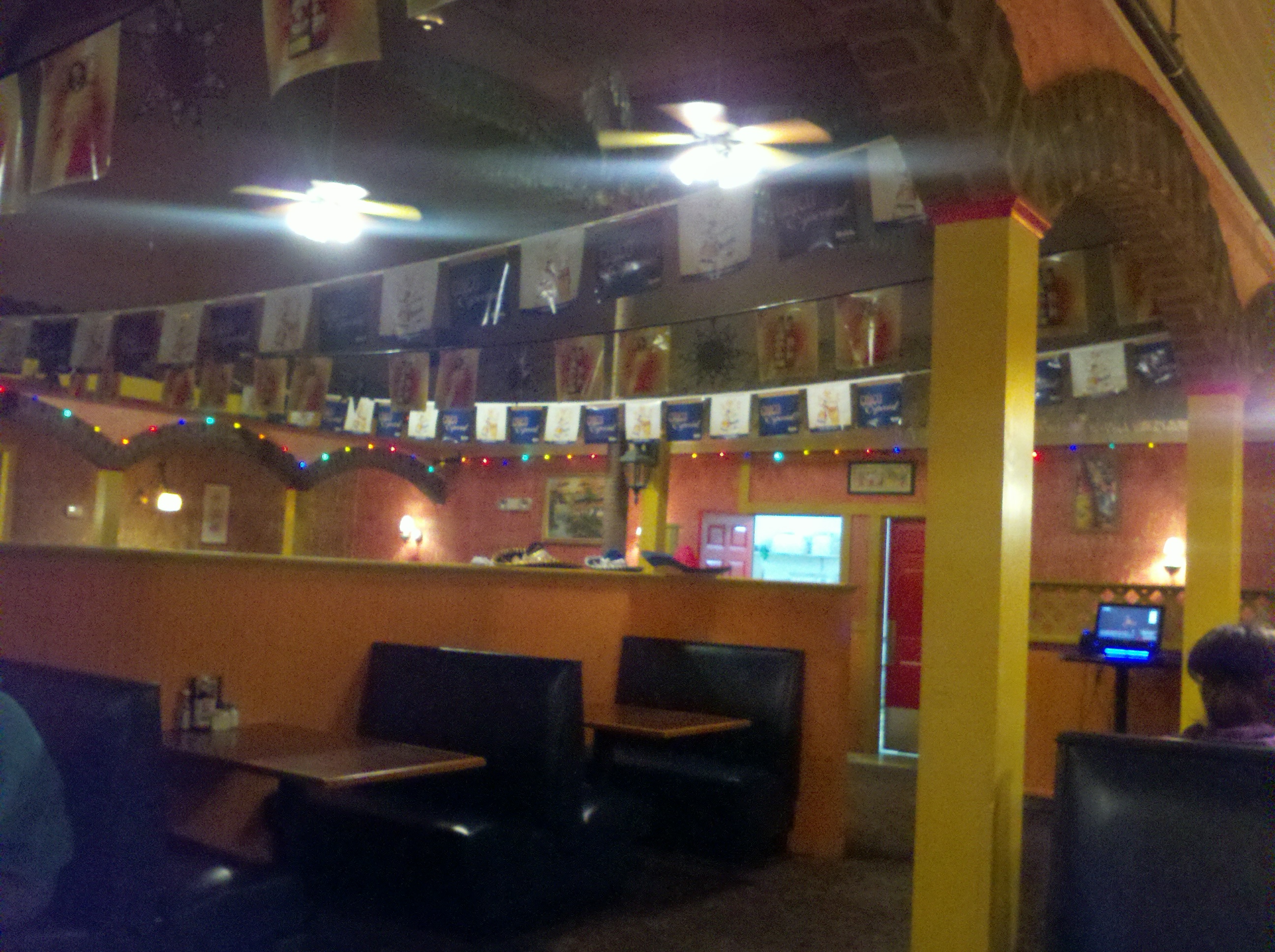
As we take our seats in the booth, Mandy rushes over with menus. She plops down our bowl of salsa and chips, which seem to have been recently cooked in a deep fryer and are still warm. Overall, the entire experience is in accordance with what one would typically expect of a Mexican restaurant. Frankie, a friend who has joined us for dinner is almost overwhelmed by the vibrant atmosphere on this drab Wednesday night and is surprised at how busy the restaurant is. She says, “Wow. I’m surprised at how many people are here. There’s a bunch of kids sitting over there who are in my government class.” This restaurant seems to be a popular dining location for Colby students. Just a quick survey around the room reveals that the majority of customers go to Colby. We all notice how extremely “branded” the atmosphere is. Posters, flashing signs, flag banners, and even the cups all present a trademark of some kind; Pepsi, Dos XX, Corona, etc. There seems to have been a conscious attempt to make the atmosphere more Latino by advertising Spanish brands that are popular in America. These colorful advertisements are all around the store and are partly responsible for the vibrant and extremely busy atmosphere.
After ordering and receiving our meals, Frankie excitedly delves into her wings and ground beef tacos. As Frankie enjoys her food she mentions that she is surprised how much she likes the Mexican food here. Although Frankie is dining at one of Waterville’s most popular Mexican restaurants, the food she is eating is actually not in keeping with traditional Mexican fare. Chicken wings are an American phenomenon, and are most likely on Cancun’s menu in order to provide the bar crowd with something to munch on while watching the game. Additionally, although Frankie’s tacos are inspired by the Mexican tradition of wrapping beans and chorizo in a corn or flour tortilla, the ground beef inside of her taco is not common in traditional Mexican cuisine. Ground beef has been integrated into Mexican cooking by Americans, specifically Texans, and does not reflect the beefsteak or grilled meat that is actually served with tacos in northern Mexico. We promptly inform our guest that her understanding of Mexican cuisine is somewhat Americanized, to which she replies, “Well, I’m glad that they do it this way. Otherwise, I don’t know what I would eat here.” According to Frankie’s comments, Hector—Cancun’s owner—has clearly made the right decisions about serving Americanized food in his restaurant. Straying from traditional Mexican fare has opened Cancun up to a wider customer base in Waterville, Maine, thereby making the establishment entirely more successful. Although this menu is not reflective of traditional Mexican cuisine served in Mexico, it is representative of the ways in which cuisines are altered and adapted to certain demographics and locations in order to please customers’ specific appetites.
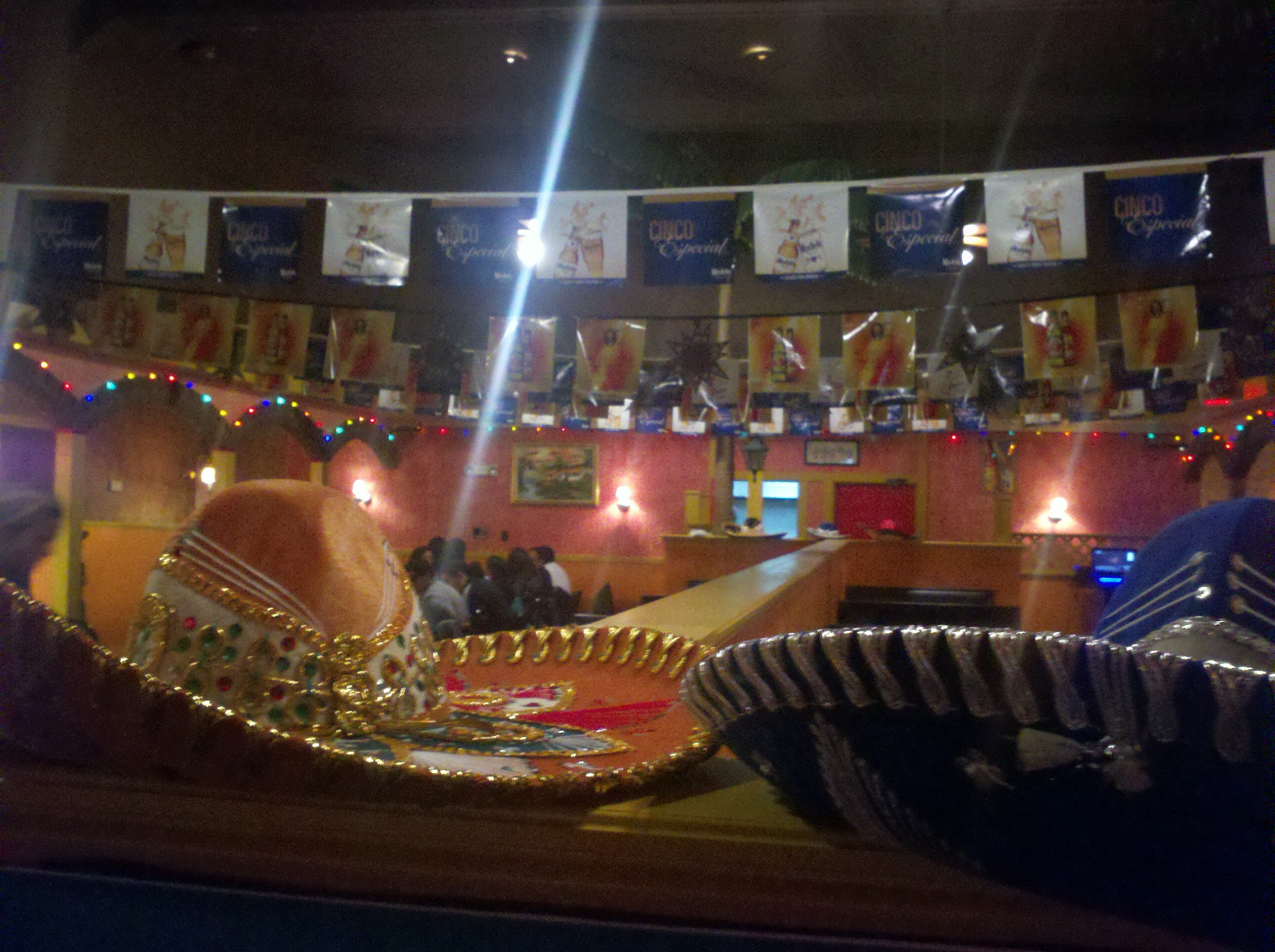 The sombreros, Christmas lights, beer flag banners, and pre-recorded mariachi music all seem to contribute to Cancun’s fun, but somewhat cliché atmosphere. The large-rimmed, rhinestone-studded Sombreros are placed prominently in the center of the dining room. The sombrero is very much a part of traditional Mexican culture, where they serve as a means for workers to block Mexico’s strong sun. However, the hats featured at Cancun are no ordinary sombreros; they are brightly colored and are clearly meant to serve a decorative purpose. Although these hats reflect Mexican tradition, they cause students to form a cartoonish impression of Mexican culture and reaffirm American stereotypes. All of these objects, the advertisements, the decorations, even the menu, have become symbols of an Americanized version of Mexican culture.
Cancun Restaurant serves as Waterville’s own interpretation of Mexican cuisine and culture. Although most of these objects, and the atmosphere itself, are extremely Americanized, the restaurant is still successful and popular with Colby students and Waterville residents. For a place with very few people of Mexican decent, this simplified representation creates a caricature of Latino subjects and allows Colby students to form an inaccurate understanding of culture. Although these symbols of Mexican culture are not unique to Cancun, they reaffirm familiar stereotypes about class and nationality. Because these cultural signifiers are sometimes recognized as tacky or low-brow by Colby students and patrons of Cancun, they pave the way for deeper assumptions about Latino subjects being of a lower, working class. These re-enforced stereotypes about class hierarchy and Mexican workers’ place in society perpetuate assumptions and connections between ethnicity and labor. While Cancun is a beloved, and seemingly innocuous, staple of the Waterville restaurant scene, the constructed atmosphere and décor may lead to the perpetuation of ethnic stereotypes.