The Pugh Center is located within Cotter Union, the student center at the heart of the Colby College campus. It can be found at the end of a hallway that begins in Pulver Pavilion, the main area of the building. The wall that separates Pugh from the rest of the building is made entirely of glass. Once through the glass doors, the space is bright and sunny. There lots of windows, and the view reveals the road outside, bordered by trees. Six tables are placed around the room, each surrounded by three or four chairs. 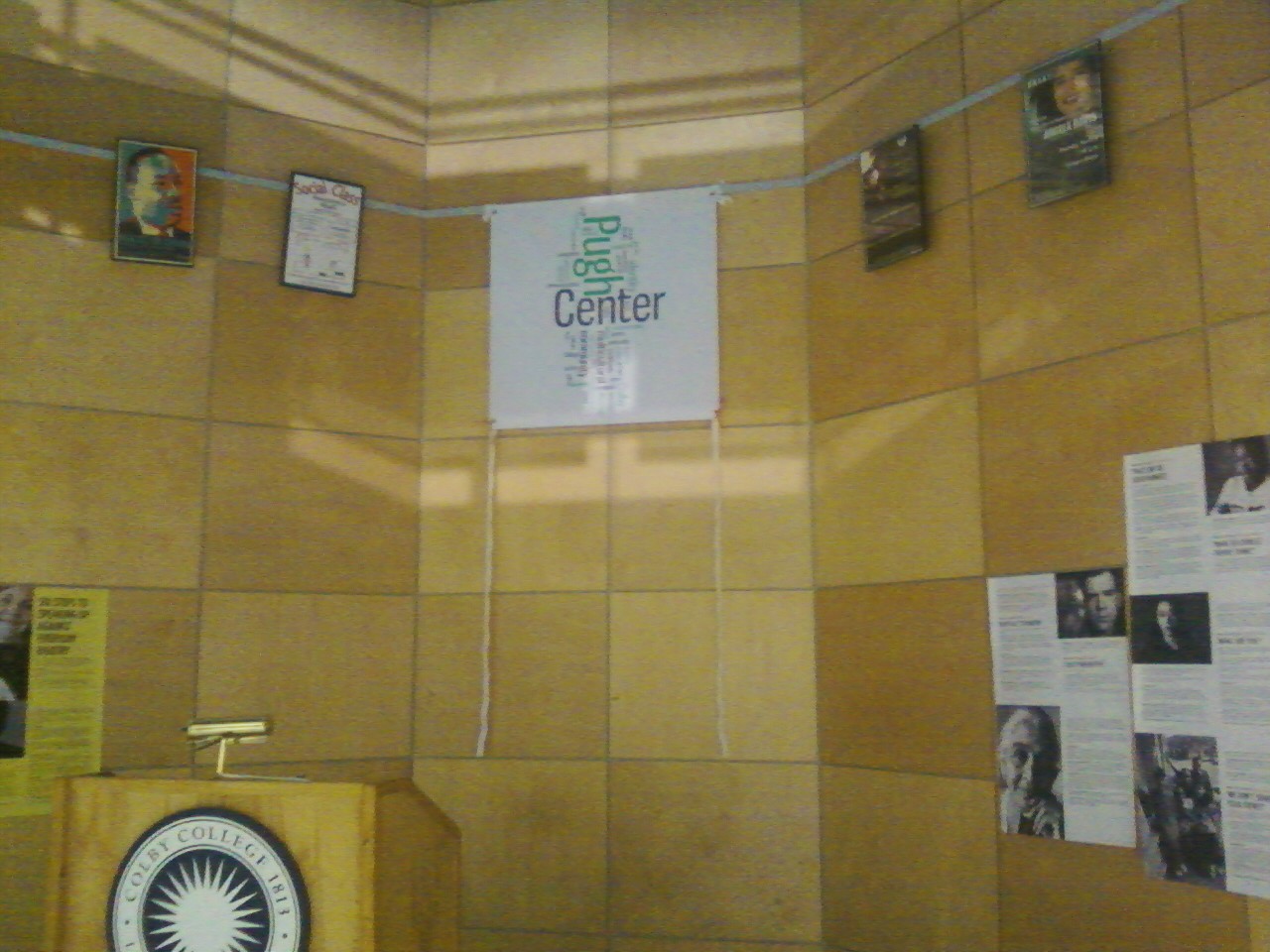 Potted plants sit atop two large bookshelves standing against the wall. There are four couches, on which students sprawl to chat, study or relax. There are pillows on the couches, and rugs beneath them; these are unheard of, elsewhere on campus. Indeed, this is one of the most comfortable, homiest spaces on campus. The books and the magazines that fill the shelves cover topics of race, gender or sexuality. These reading materials are one indicator of the function of this space.
The Pugh Center, opened in 1996, was designed to serve as a “common ground in which students of all races, cultures and religions have a stake.” It was conceived of and created as a response to the 1994 request by students of color for a multicultural residence hall. The Pugh Center itself provides space for programming organized by the Pugh Community Board (PCB). It also houses a variety of clubs dedicated to various issues of multiculturalism, including SOBHU (Students Organized for Black and Hispanic Unity); the Asian Cultural Society; the Colby Muslim Group; the Bridge, Colby’s queer and allied group; and the Feminist Alliance.
The mission of the Pugh Center expresses three major goals. “The Center,” it reads, “serves as a catalyst for a variety of programs that…assist in the College’s efforts to foster a campus climate that embraces, supports, and celebrates an increasingly diverse community. It also provides a safe space for Colby students who identify with groups that have been traditionally underrepresented within the Colby community.” Finally, it states, “The Pugh Center’s building is the physical symbol of Colby’s commitment to a multicultural society.” But how well is the Pugh Center actually achieving each of these goals? In order to answer this question, I drew on my own experience with the Pugh Center, as well as interviews with two students: Cosme Del Rosario-Bell, the president of SOBHU, and Ismael Pérez, a member of SOBHU, the Bridge, the Feminist Alliance, and the Pugh Community Board.
According to the mission, the Pugh Center itself is not meant to bring change to Colby’s campus climate in regards to issues of multiculturalism. The statement is explicitly clear that that is the role of PCB and Pugh clubs’ programs, which are often associated with or housed within the Pugh Center. Ismael was critical of the goal itself. “The problem,” he said, “is that the idea is that it [multiculturalism] is supposed to start in this one place and radiate out to the rest of campus. And that’s really ineffective and inefficient and just sucks.” While the mission may differentiate between the purpose of the Pugh Center and the purpose of programming associated with the Pugh Center, I agree with Ismael that this distinction is irrelevant to most members of the Colby community, who conflate the two. The physical entity of the Pugh Center does contribute to the campus-wide notion that ideals of multiculturalism will emanate from this singular space.
But how well does the Pugh Center function as a safe space? I would argue that in this respect, the space is extremely effective. During the fall semester, when a banner that asked students if they felt safe appeared in Pulver, one student wrote, “The only place I feel safe is in the Bridge room.” I have spoken to many students throughout my time at Colby who have expressed similar sentiments. For many students who are religious, racial, ethnic, or sexual minorities, and even for many who are not, the Pugh Center and its attached club rooms are crucial safe spaces on Colby’s campus.
The Pugh Center also serves as an excellent manifestation of the power dynamics regarding space on Colby’s campus. When I have asked students who spend minimal time in the Pugh Center why they do so, they generally reply with some variation of the phrase, “It’s not my space.” Sometimes this sentiment is not explicitly stated, but there is a prevailing notion on campus that the Pugh Center is only for minorities, particularly racial or sexual minorities. When I asked Cosme whether he believed that there were spaces on campus students of color do not feel are “their” spaces, he replied, “I would say that’s true of most other spaces on campus. Every other space at Colby is dominated by social structures that serve the majority of people on campus, who are white and upper-middle class.” Because of this, the Pugh Center is essential for students who do not fit these criteria. However, Cosme insisted that the Pugh Center is not only for minorities. Taking part in the space, he said, only requires that you contribute something to the Pugh Center community. I have found this to be an accurate assessment of the power dynamics that I have encountered within the Pugh Center. Although I am neither a racial nor a sexual minority, I feel comfortable in the space, and I believe this is because I have made a conscious effort to engage in many of the Pugh Center clubs and PCB’s programs.
Finally, does the Pugh Center serve as a symbol of Colby’s commitment to a multicultural society? Yes, argue Ismael and Cosme, in the most ironic ways possible. Cosme noted the circular shape of the space as representative of the way that multicultural issues are enclosed within the Pugh Center. He also pointed out that its [creation as an addition to a preexisting building] is fitting of the college’s stance towards multiculturalism—that Colby only deals with issues like multiculturalism as an afterthought. Ismael agreed, pointing out some other ways that the Pugh Center is an unfortunate symbol of Colby’s position on multiculturalism. “The fact that it is a permanently constructed space is problematic to me,” he said. “It points out that bringing multiculturalism to the rest of a campus is a long-term goal, or a never-ending one.” While I believe that making Colby a more accepting place in terms of multiculturalism will certainly be a long-term goal for the community, I take Ismael’s point. There is a frustrating contradiction in the permanence of the Pugh Center. While it attempts to establish an unending dedication to the issue of multiculturalism at Colby, it simultaneously serves as a reminder that Colby has so far to go, and that the Pugh Center may never fully realize its own mission. On further reflection it seems as if Ismael and Cosme do not actually take issue with the Pugh Center itself, but with Colby’s troubled relationship with multiculturalism, which is reflected in the physicality of the space.
While in 1996, Pugh may have appeared to be an important step in the right direction, Colby College still has a long way to go in addressing issues of multiculturalism. We, as a country, have grown and changed in the past sixteen years and the college must reflect that. While the Pugh Center may be achieving its goal of providing a safe space on campus for those who need it most, it struggles to effectively spread issues of multiculturalism to the rest of campus. In addition, Colby’s struggle to successfully incorporate multiculturalism and make the entire campus safe for minority students is unfortunately symbolized in many aspects of the building itself. I offer these critiques with the hope that Colby will continue to reevaluate its commitment to multiculturalism and all of its students.
(For more on the Pugh Center, see The Pugh Center: Where Safety is Shattered)