
From 1901 to 1996 Levine’s Clothes for Men and Boys, a locally owned clothing store in Waterville, Maine, operated as one of the most popular shops in Southern Maine. Known all over the state for its quality clothing, fair prices, and friendly owners, Levine’s defined the type of store that Waterville’s downtown area was filled with from the 1940s to the 70s. Located right in the midst of both Waterville’s residential and industrial sections, the downtown area was an easy and safe walk for residents of Waterville. Even those who traveled from elsewhere in the state came to walk throughout Waterville’s streets under the large Elm trees while shopping for pretty much anything one could imagine. This is how Peter Joseph, a former local business owner and lifelong Waterville resident himself, recalls Waterville’s downtown area when he was first going into business. He, like many other members of Waterville’s elderly community, recalls a Waterville whose economy was based in mill jobs and a downtown that was clean, pretty, and a place where you were on a first name basis with every store owner. This is the Waterville that many remember, but since industry packed up and moved either to the south or abroad, this is not the Waterville that exists today. Although the forces of capitalism that provided Waterville its economic success in the midcentury are no longer working to its advantage, but they have affected and continue to affect Waterville’s landscape in profound ways.
Today, Waterville’s Main Street and downtown area are surrounded by chain stores and ugly parking lots. Cracked streets lined with poorly maintained concrete and trash run between the storefronts of the last remaining locally owned businesses sitting amidst empty properties with “For Lease” signs in their windows. The city is immensely poor, with almost fifteen percent of its residents living under the poverty line (Wikipedia) and local businesses failing every year. Interestingly, the sources of Waterville’s current troubles are essentially the same ones that made the city so successful starting more than one hundred years ago. The same economic incentives that brought industry to Waterville, cheap labor and land, would condemn the city’s economy as industry continued to move overseas. Due to the large number of immigrants willing to work for competitive wages and the powerful Kennebec River which was able to power many different factories and mills, Waterville was an attractive place for a business owner to establish a factory. The city attracted immigrants from Quebec, Syria and Russia amongst other locations, all looking for reliable wages to either support their families or bring them to Maine (Rowe). These immigrants became the foundation of Waterville’s economy as they both provided labor for the mills and factories and spent their money locally in the family owned businesses that populated the city. In essence, Waterville attracted industry because it was, at the time, one of the cheapest places to find labor in the United States.
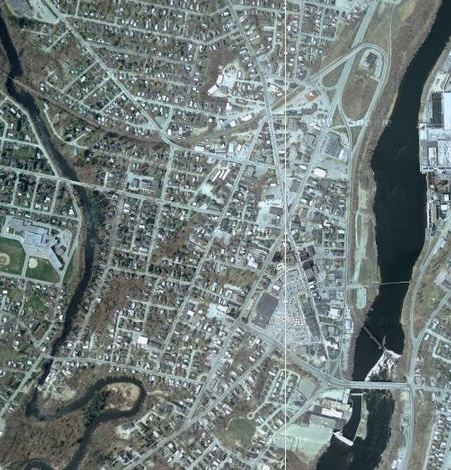
Sadly, Waterville’s status as an economically viable locale for industry was short lived. Just as the forces of capitalism seeking the maximal profit brought money and people into Waterville, it would begin to take both away starting in the 1950s. The Lockwood Cotton Mill was the first major installation to pick up and move, opting to relocate in the South where production costs were much lower (Amy Rowe Senior Thesis). As industry moved out of the United States in general and started to move abroad, so did the factories in Waterville as their owners realized that just as Waterville had been a century prior, there were places where laborers were willing to work for less. This striving for maximal profit of course, is the essence of capitalism, and more than anything it has shaped the way Waterville has changed in the last half century.
Returning to Main Street, the downtown area of Waterville, it is easy to see how the loss of industry has affected the city. Many jobs left Waterville when the factories closed, and with those jobs left the wages that many local businesses depended on to stay afloat. With less people, and residents who generally had smaller incomes, it didn’t take long for Waterville’s nice, locally owned business district to fall on hard times. But the storefronts are not the only thing to have changed drastically, the entire area surrounding Main Street has experienced its own share of upheaval. When industry left Waterville and many of its residents followed suit, much of the real estate around Main Street fell into disuse. During the lifetime of the mills and factories, communities of laborers built a residential neighborhood between the downtown area and the riverside where the mills resided, but when they left their homes and nobody else moved in to replace them, the properties became abandoned. These properties became the focus of Waterville’s Urban Renewal Project, a federally funded mandate to prepare American cities for the demands of the times (Rowe). In Waterville, Urban Renewal was not only about preparing for the introduction of automobiles or other aspects of modern life, rather it was also about shifting Waterville from a site of production to a site of consumption.
Instead of hand painted storefronts, like the faded one that still hangs outside of the old Levine’s building, plastic signs for national banks and chain stores like Family Dollar dominate the landscape of Main Street. With the loss of industry, and therefore the economic support needed for small, locally owned businesses, Waterville has needed something new to power its economy. Sadly, this relief has come in the form of corporatization of the local businesses and a unprecedented increase in chain stores and restaurants. Although it had not been very effective, the replacement for the industry of production in Waterville has come in the form of vastly increased levels of consumption, mainly in national and international chains such as Walmart. Not only are people consuming more, they are finding employment inside these corporate owned businesses, thus increasing the hold that these companies have on Waterville’s economy. The landscape has suffered immensely as a result of this. Rather than a collection of locally owned businesses that have a stake in the community, Waterville has been left with a collection of institutions that see only profit, and have no regard for the wellbeing of the community. These businesses have changed the community’s small town feel, replacing the friendly store owners with people working for minimum wage and the unique storefronts with the recognizable logos of Bank of America or Rite Aid.
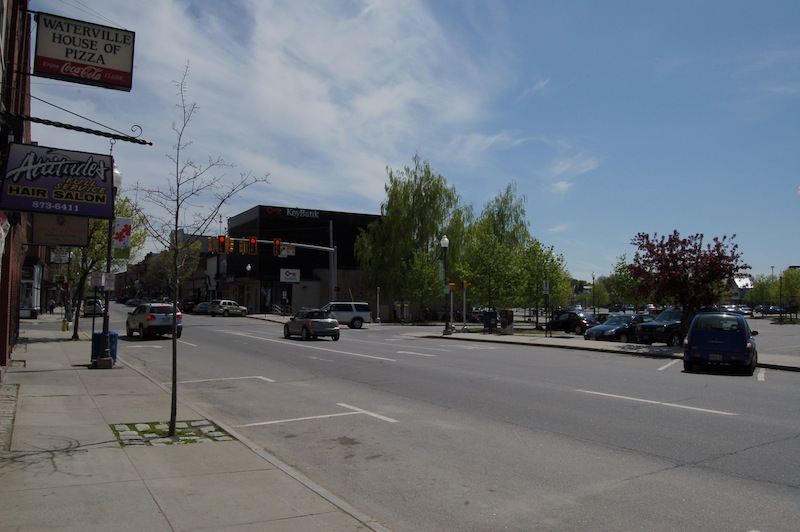
In addition to Waterville’s economic collapse and loss of population, both of which had their parts in spurring an urban renewal project in the downtown area, the need to accommodate automobiles played a major role in shaping the landscape. With the small businesses either gone or dying and large chains moving in, Waterville needed to adapt to the commercial demands of these businesses. The largest change for Waterville’s landscape came when, due to the loss of industry, Waterville became a city designed for cars, rather than pedestrians. In order to attract the large chains that now dominate the city’s economy, Waterville needed to be transformed into a consumer city, one equipped with roads to bring people in and parking lots to store their vehicles. The urban renewal project centered around Waterville’s Main Street serves as a great example of this change. The houses once occupied by the city’s mill and factory employees, which surrounded the downtown area providing easy access by foot to both the shopping area as well as the industrial one, were destroyed to make way for a new shopping center. The Concourse, as it is known, includes several very large parking lots, a couple of locally owned stores, three banks, two cut rate retail chains (Family Dollar and Dollar Tree), and a very large Goodwill. It is ugly, filled with trash, and very impersonal. While it isn’t quite a strip mall, it is quite reminiscent of those that have been built just up the road. Created for cars and consumption, Waterville’s Main Street no longer holds the appeal that brought so many shoppers there during the mid-twentieth century.
Looking at Waterville’s downtown area today, it is hard to believe that once it housed the most successful and flourishing shopping centers of the state. With an economy driven by the local mill and factories, Waterville was a place of production that could support a burgeoning Main Street filled with locally owned businesses. Sadly, without that production driven economy, Waterville can no longer claim to be anything but a site of consumption. Chain stores provide both the majority of the employment (often times at minimum wage) and the goods needed by the community. Because of this, no money is able to stay in the community. Corporations control Waterville’s economy now, and they have shaped its landscape in order to achieve maximal profit. The city’s landscape belongs to cars, once vacant residential areas are now expansive parking lots, and the businesses that own these lots still struggle to fill them up today. The Main Street that Peter Joseph recalls no longer exists, there is no longer a place for businesses like Levine’s on Main Street, only space for dollar stores and banks. Sadly, Waterville’s demise came from the same forces of capitalism that formed its twentieth century successes, and while it is no longer supported by industry, the capitalist logic of cars and consumption continues to shape the landscape.