Moving from my urban neighborhood in Pittsburgh, Pennsylvania to the small, rural landscape of Waterville was jarring, but it allowed me a fresh perspective with which I could view both the city of Waterville, its residential portions, main street area and all of the strip malls in between, and the campus of Colby College which sits upon a hill, overlooking the tiny city it so desperately tries to forget. Maybe it is incorrect to make this judgment about the college, perhaps Colby is not trying to forget its location in this small, extremely poor city found in rural Maine, but rather tries to make those who venture onto its brightly lit and clearly defined campus forget what lies on the other side of its arboretum.
I make this judgment not because of the ways in which I’ve seen the students and faculty of Colby College interact with the residents of Waterville, the statement finds no basis in any sort of (or lack of) social interaction between these two radically different populations, rather it finds justification in the differences between the landscapes each have built and exist within. Colby’s campus is one of the most intentionally constructed environments I’ve ever spent a large amount of time in. By intentionally constructed I mean that almost every aspect of the campus, from the architecture of the buildings, to the placement of the paths, greens and trees, has been chosen specifically to emulate the classic New England liberal arts College campus. This campus is clean, well lit, and safe, its footpaths cut cleanly through the grass (or snow, depending on when you decide to visit) of the picturesque quads that lie between pretty brick academic buildings and dorms, an architecturally modern student union, a library with a tower, and of course, a chapel on a hill.
Waterville’s landscape is much closer to the vernacular landscape (as defined by John Brinckerhoff Jackson) of small towns found all over the United States, a space engineered by necessity, efficiency and the goal of making a living. Waterville’s landscape did not arise because its citizens actively intended it to look this way, or to inspire the feelings it does, rather it came about as a result of industry, economic successes, and eventual failures. The small city has been built around the Kennebec River and its many mills, although no longer operating, that were once the lifeblood of Waterville, providing jobs for the immigrants that would come to make up its population. The landscape is made up almost entirely of old wooden houses, abandoned buildings and mills, a couple hospital campuses, a dying main street and strip malls with their giant signs and even larger parking lots. As is by now apparent, the landscapes of Waterville and Colby College would struggle to be more different, one defined by an image of wealth, knowledge and security, the other by necessity and industry.
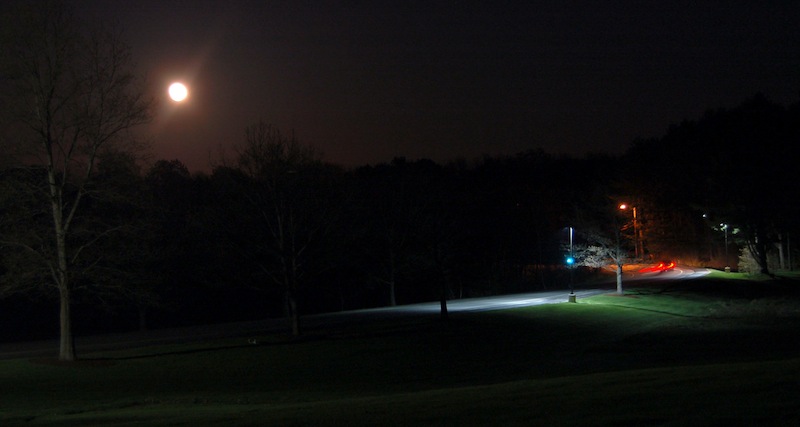
For me, this difference has been most adequately described by a small stretch of Mayflower Hill Drive, the street that leads from Waterville’s main street all the way to Colby’s Campus, or rather the lighting of this small stretch of Mayflower Hill and the devices that are responsible for it. As one approaches Colby’s campus from the southern portion of Waterville his or her only choice is to travel up this road. An almost completely straight shot once you’ve turned onto it, Mayflower Hill Drive takes you through the nicest residential area of Waterville, where many of Colby’s faculty and the local hospitals’ doctors have purchases houses, through a bend and into Colby’s campus. This particular stretch of road is found with the bend, and is defined by two landmarks, telephone pole 47 with its streetlight attached to the top and the first Colby lamppost, unmarked and anonymous. As one rides or walks up the road and into this stretch, he or she leaves the incandescent, almost orange light provided by the streetlight hanging off the top of telephone pole 47, providing light by which to travel and nothing more, and enters into the cool, fluorescent light of Colby’s lampposts, designed specifically to light the road in the most inviting and clean way possible.
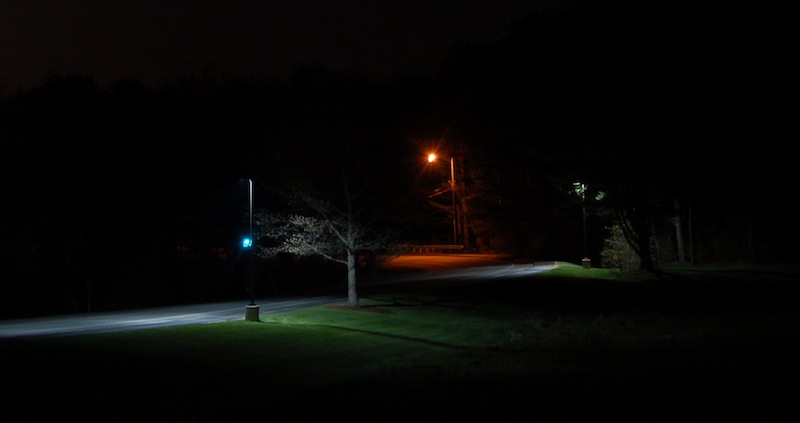
The streetlights found throughout Waterville are all very similar; most consist of a metal mounting on a telephone poll, reaching out over the road and providing adequate lighting to those using it, nothing more. The lights reveal the wooden telephone poles, cracked and covered in black exhaust from the cars that travel past them, and the wires and cables wrapped around the wood and incased in plastic. The streetlight mounted on telephone pole 47, which is designated as such by the metal “47” hammered into the wood, does not break this trend. With its orange cables and black wires, dirty white plastic tubes and metal footholds, 47 is a model of efficiency, created and maintained to provide light to the street and telephone service to the homes along it, it is true aspect of the vernacular landscape. Forty-seven is not named as such because it is a landmark, or because it is known to the populous of either community, but rather because it is little more than a tool, a resource of the city which has to be checked, maintained and easily remembered by those who check and maintain it, thus the simple two digit number 47. The light, as I described it before; incandescent and almost orange, does a great job of lighting the rural streets which would otherwise be cast in a deep darkness, keeping both drivers and pedestrians safe, but it does nothing to help the appearance of these streets, casting them in a unappealing, sickly glow. It contrasts heavily with the fluorescent; almost white light of the Colby lamppost that sits little more than one hundred feet away from it.
This streetlight, impossible to differentiate from the others found beyond it, marks the beginning of a different environment, one defined by a repetition and symmetry, which makes one feel safe and contained. These lampposts are clean and slick, their metal poles sprout out of rounded concrete cylinders. There are no exposed wires or cables; the lamppost supports nothing but the streetlight, square and incased in glass, composed of the same black metal found in the pole. The small metal plate mounted on the side of the concrete cylinder is the only aspect of the object that suggests there are any wires involved at all, as the electronics are purposefully hidden away under the surface of the street. Like the light it creates, the lamppost is designed to seem clean and inviting, identical to the others found around the campus, it helps, again as the light does as well, to create an atmosphere of wealth and security, control and superiority. During the summer, spring and fall, the fluorescent light serves to highlight the green grass that encompasses the campus, highlighting the artificially colored quads and clean, black asphalt that the paths are composed of. During the long winter months, when the Maine is covered in many inches, and often feet of snow this light makes it appear white and clean, as opposed to the incandescent lights of Waterville, which make the snow appear yellow and dirty. Given that the campus is covered in snow more than half of the time school is in session, this was a calculated decision, just like the architectural designs of the buildings were, and the layout of the campus itself, from the very central tower on top of the main library to the placement of the football field where everyone passing through campus will get a view of it was. Unlike the landscape of Waterville, Colby College has been designed over a period of more than sixty years to make its visitors feel a certain way, to create an air of wealth and most importantly, to designate itself as separate from the economically depressed area surrounding it.
One can feel this as they walk through that stretch of road between telephone pole 47 and the first of Colby’s black metal lampposts towards the campus. As they walk towards 47, they can look up and back to see the telephone cables stretching back into Waterville, but as they turn back around they can see the long lines of cable come to an end, wrapped around telephone pole 47. Passing under the incandescent light and into the fluorescent, he or she notices the greenness of the grass or the whiteness of the snow, somehow more appealing that it was ten steps ago. As they look up at the brightly lit tower sitting atop the Miller Library, poking through the trees, all memory of the small houses, litter covered streets and strip malls of Waterville disappears. Here, in this moment where the light changes, he or she finds the difference between the vernacularly defined and the constructed, the rich, who can afford to shape their landscape, and the poor, whose landscape is shaped by what they can afford.