I am in the passenger’s seat of my roommate’s car; we are driving to Walmart. Familiar scenes of Waterville stream by the window as familiar songs blare from our favorite radio station. We are both singing along to the music, but I am thinking about Walmart. I am thinking about how I never set foot into a Walmart until my freshman year at Colby, and about Mr. Ahn’s, the Korean grocery store where my parents shopped every week until it was forced to close last December. I am thinking about all of the trips I have taken to the Waterville Walmart with other Colby students, to pick up toiletries and Easy Mac, Halloween costumes, and this year,  alcohol. I am thinking about the subway rides I used to take to downtown Manhattan when I wanted to go shopping, and about peopleofwalmart.com, a website designed to mock the working-class individuals who shop there.
Straight ahead, above the entrance, is the word “Market.” The Oxford English Dictionary displays a number of definitions for the word market, including “A meeting or gathering together of people for the purchase and sale of provisions or livestock, publicly displayed, at a fixed time and place,” and “An open space or covered building in which vendors gather to display provisions (esp. from stalls or booths), livestock, etc., for sale.” No such market exists here, however. The people who gather in the Walmart parking lot have not come to sell their wares—there is only one vendor here. This is made clear when I glance down the façade of the colossal building and the ubiquitous “Walmart” sign is visible in the center of the building.
As I step outside of the car, I turn in a circle, attempting to search out any inconsistencies or variations in the colorless, barren landscape. The only vivid hues in sight are the signature Walmart colors. The bright blue is used to label carts and cart return racks; the lamppost bases are painted yellow. As I look up at the lampposts, I am suddenly struck by how visually unappealing,  how strikingly utilitarian they are. They consist of a black pole, with either two or three black boxes at the top.Indeed, the longer I spend scanning the lot, the more apparent it becomes that whoever designed it was exclusively concerned with utility, rather than the visual appeal of the space. I can imagine Walmart officials’ negotiations with building contractors centering around two words: functional and cheap. Walmart is notorious for its preoccupation with low cost, both in item prices and worker pay. This fact is harshly apparent in their parking lot.
The tower of Colby’s Miller Library and the spire of Lorimer Chapel pull my eyes away from this barren scene. The two structures rise above the dense trees that surround them, giving the mistaken impression that the buildings are located in the woods. They are situated far above the lot, on Mayflower Hill. Their elevated position provide another facet to the stark contrast between the Colby buildings and the Walmart parking lot. Miller and Lorimer, it is clear, exist in a completely different world. They inhabit a world of decorative architecture, surrounded by nature—of beauty for beauty’s sake. Miller’s tower serves absolutely no functional purpose.
Finally, I step into the building, through the automatic doors. I am in an entrance room, the space between the parking lot and the store itself. As I stand in this room, I occasionally spot another Colby student. It is easy to pick them out of the Walmart crowd, whether because I recognize them from campus, because of their clothing—Colby sweatpants or New England brands are a dead giveaway—or because they are in the late teens or early twenties, and do not look like Waterville residents. Whenever we see each other, we look at each other like the outsiders we are. I would venture to guess that almost all Colby students feel like outsiders in this space. Most come from very privileged backgrounds; their families, like mine, never shop at Walmart. And even students from working-class families are often from major cities, where Walmart has not yet moved in. We come for our snacks, our cheap, ironic costumes. We walk through this anteroom, calling ourselves “broke college students.” This is a space for Waterville, used by Colby.
This becomes perfectly clear at the Red Box DVD rental. I stand in this entrance room and watch families push their carts, loaded with children and groceries, up to the Red Box and return a DVD, rent a new one. This is where Waterville gets its movies. Residents do not frequent a local video rental store, as I remember doing as a child. Perhaps they did at time, twenty, or even ten 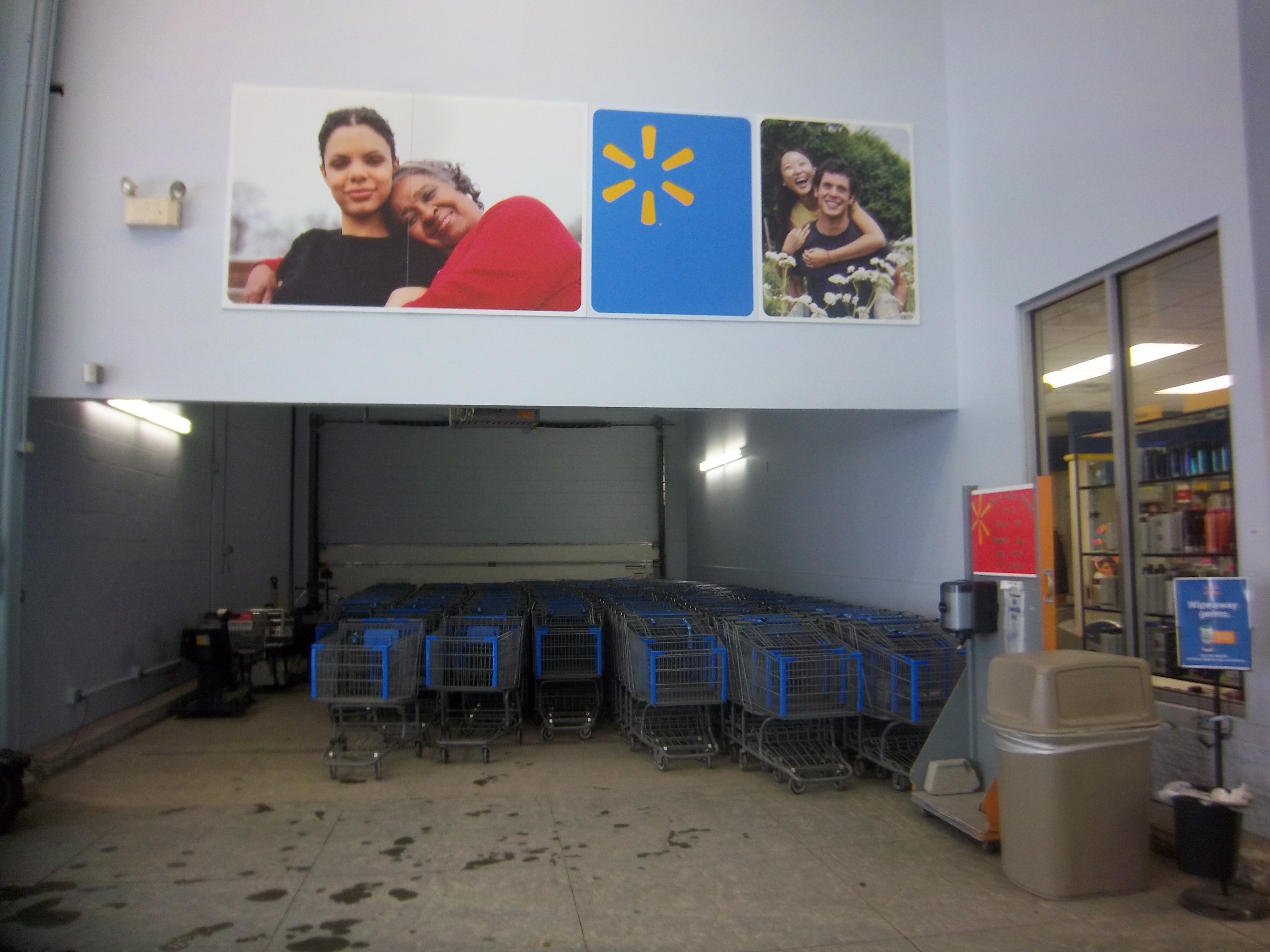 years ago, before the chain stores came to their city. And they do not watch movies online, through Netflix or illegal streaming websites, as Colby students do. Waterville takes its family and goes to Walmart.
Even so, this space does not truly belong to Waterville either. This fact becomes perfectly clear in the smaller entrance room on the other side of the building. There are photos on the wall here as well—three in total. One of them is the same exact photo of the mother and child. The other two depict smiling, self-consciously multiracial pairs. One appears to show an African-American woman and her mother; the other, a young White male and his Asian-American girlfriend. The fact that three out of the four individuals in these photos are not White indicates that this is a national marketing campaign for Walmart, not one geared to the predominantly White Waterville. Indeed, there is no attempt to personalize the parking lot, the building, or these entrance rooms to this city at all. Walmart belongs to Walmart.