Throughout the semester, as I wrote about Moses and Aaron, I was referring to features present in the copy in Colby’s collection. While a lot of the things I wrote about, like the content, origins, and purpose of the book, are the same from copy to copy, there are many differences between copies that will affect the understanding we can gain from the books themselves. This difference between copies is profoundly complicated by the addition of digital surrogates, such as the one offered by Early English Books Online through ProQuest.
In discussing digital versus printed books, it’s easy to slip into a habit of only discussing the downsides of looking at digital books, I feel like it’s worth pointing out the various benefits of online copies. The first and most obvious advantage is accessibility. Certain websites with digital surrogates, such as Early English Books Online, which I mentioned earlier, require an account in order to access them, others, such as Project Gutenberg, do not. Moses and Aaron can be found in various formats on their website here: http://www.gutenberg.org/ebooks/52639. This means that anyone interested in reading or studying the book, and particularly the text of the book, can access it as long as they have access to the internet and they do not need to seek out one of the finite number of surviving copies of the book. While this doesn’t provide all of the things the physical book would, which I’ll get into later, for a lot of people it’s good enough, and gives them access to a book they may never have been able to get a physical copy of. That’s a major advantage. Another important advantage of digitization is preservation. While digital copies aren’t as permanent as we might like to believe, they certainly aren’t subject to the same kinds of environmental threats as physical books. Their maintenance is significantly cheaper, and it’s relatively simple to create several identical copies as a backup in a way that isn’t possible with a physical book. Digitization is a good way to ensure the survival of books in some form, even if the physical books themselves cannot be saved, or as a backup against the potential destruction of the physical copies.
Now we’ll move on to the drawbacks of digital facsimiles of these books. The first ones are relevant only to the Project Gutenberg version. Given the nature of the project, their text pulls from a single edition of the book, and they do not provide access to any others. This is important for people who are looking to study a particular edition of the book outside of the 11th, or for people who want to compare multiple editions to each other. Additionally, the Project Gutenberg version is not made up of photographs of the book itself, but an approximation of the appearance of the original book, adapted to be read on a computer. This makes it relatively useless for those trying to study things about the page layouts and structure of the book.
The facsimile offered through Early English Books Online avoids these problems. There are digital facsimiles available for multiple editions of the book, and each of those is made up of high quality scans of the books rather than a retyped approximation, and so it retains many features of the book that the Project Gutenberg version doesn’t maintain. This is not to say that it is equivalent to the printed book, however. A very obvious downside of looking at a digital facsimile is that you lose any copy specific information from copies outside of the one that’s been digitized. Now clearly this is a downside of looking at any one copy and not at all of them, but the way books are digitized prioritizes the text over anything else. Once one copy is digitized, the work is viewed as complete, even if there are many other copies that have not been scanned. Beyond that, there are other aspects of the book that are deprioritized in the digital facsimile as well. The covers of the book are not included in the scan, which removes some information that might be useful to book historians studying Moses and Aaron. It also only shows pages with print on them, excluding the recto of the flyleaf, which is where I found the note that identified the Colby copy’s previous owner. I can only assume that there’s nothing on the flyleaf of the copy that was digitized, but I’ll never know unless I check the physical book it was scanned from.
On top of parts of the book that are explicitly excluded from digitization, there are many features of a book that are made more difficult, or even impossible, to understand, through the process of digitization. There’s something written on the verso of the flyleaf in the digitized copy, but the harsh scanning process has rendered it mostly illegible.

This is information that’s readily available when consulting the printed copy, and theoretically included in the digital copy, but it isn’t usable, even if it’s technically there. Another similar complaint is that this book has a watermark on the paper, but it’s impossible to see when looking at a digital version. The only way to see that watermark is by shining a light through the pages, and this can’t be done with a copy on a computer. I don’t know enough about early modern paper manufacturing to be able to say what this watermark means, but I do know that it is entirely unavailable in the digital version.
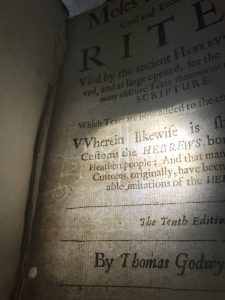
This of course only addresses some of the practical issues that arise when looking at online books versus printed books, and doesn’t get into the philosophical and psychological effects, but these practical concerns were the ones that were most relevant to me during the time I spent analyzing Moses and Aaron.