Martin Brimmer’s Egypt: three essays on the history, religion, and art of ancient Egypt contains various forms of decoration that make this book an aesthetic object and aid in the use of the book itself. This decoration includes the cover design, paratext (such as the initials, tail-pieces, and typography), photographs, and a map of Egypt. Each of these non-textual additions were thoughtfully chosen to enhance the reader’s experience by providing important visual context and organization. The elegant cover establishes this book as an aesthetic object and brings beauty to the home of the owner–here it is important to judge this book’s cover.

Published in 1891, this book was designed during the Arts and Crafts movement (1880-1920) which advocated for the incorporation of art into daily life and increased accessibility of visually appealing objects for all people, independent of class. The movement was a reaction against industrialization and aimed to reestablish the inseparable nature of art and life. Sarah Whitman, the designer of this book, was a strong supporter of the movement and incorporated its values into her designs. Bringing aesthetics to more common objects, such as the book, was an important vehicle for the Arts and Crafts movement. In Sarah Whitman’s words:
“You have got to think how to apply elements of design to these cheaply sold books; to put the touch of art on this thing that is going to be produced at a level price, which allows for no handwork, the decoration to be cut with a die, the books to go out by the thousand and to be sold at a low price. . . What I feel is that under these conditions, the more necessary it is to design covers well because they are really like aesthetic tracts. They go everywhere.” -Sarah W. Whitman (https://en.m.wikipedia.org/wiki/Sarah_W._Whitman)
Thoughtful decoration is achieved in Egypt: three essays on the history, religion, and art of ancient Egypt through its elegant cover design and binding made from soft, earthy-green suede (very discolored today) with black and gold embossing. The book also has deckled edges, a feature that was originally a consequence of the handmade paper making process, but here is incorporated purposefully to help establish this book as a crafted object. These elements make the book more than just a conveyer of verbal text, it is an object intended to be admired for its physical qualities. The cover also sells itself to potential buyers, even though the cover does not include the entire title of the book, but only the central topic, Egypt. Through its typography and artistry, one can sense that the book is about ancient Egypt and will discuss Egyptian art and culture. The gorgeous simplicity of this crafted object would capture the attention of potential buyers, helping to market the book in a bookstore.
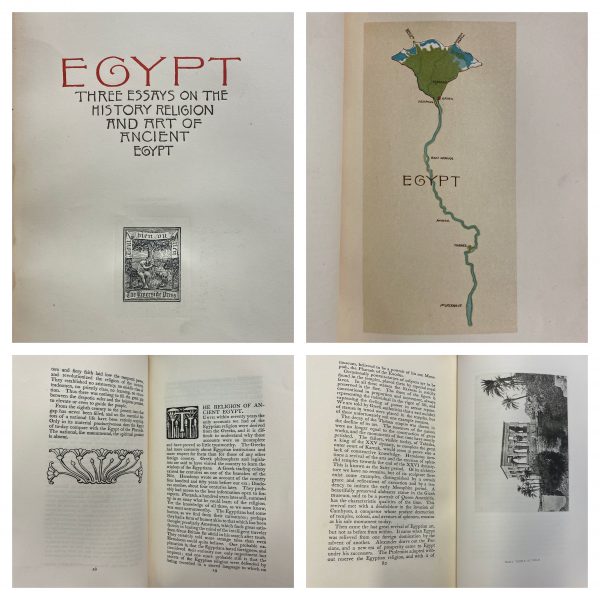
But, as always, there is more than just the beautiful cover to judge for this book. Inside, one map and frequent photographs (along with the decorative paratext described in the last blog) help contribute to the overall aesthetic of the book and serve important functions for the reader. The map and photographs are included on their own pages, separate from the text, on different types of paper. They are each printed using different technologies which can be postulated from their visual characteristics. These photographs and the map were most likely inserted into the book, and closer investigation into the binding could tell how and when their pages were tipped in.
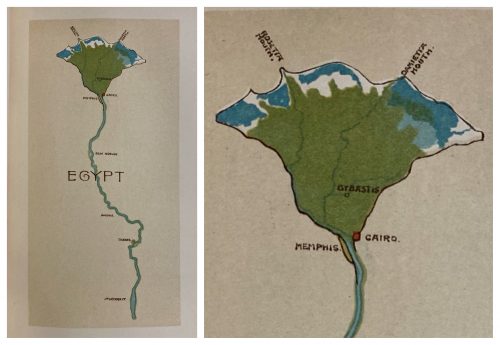
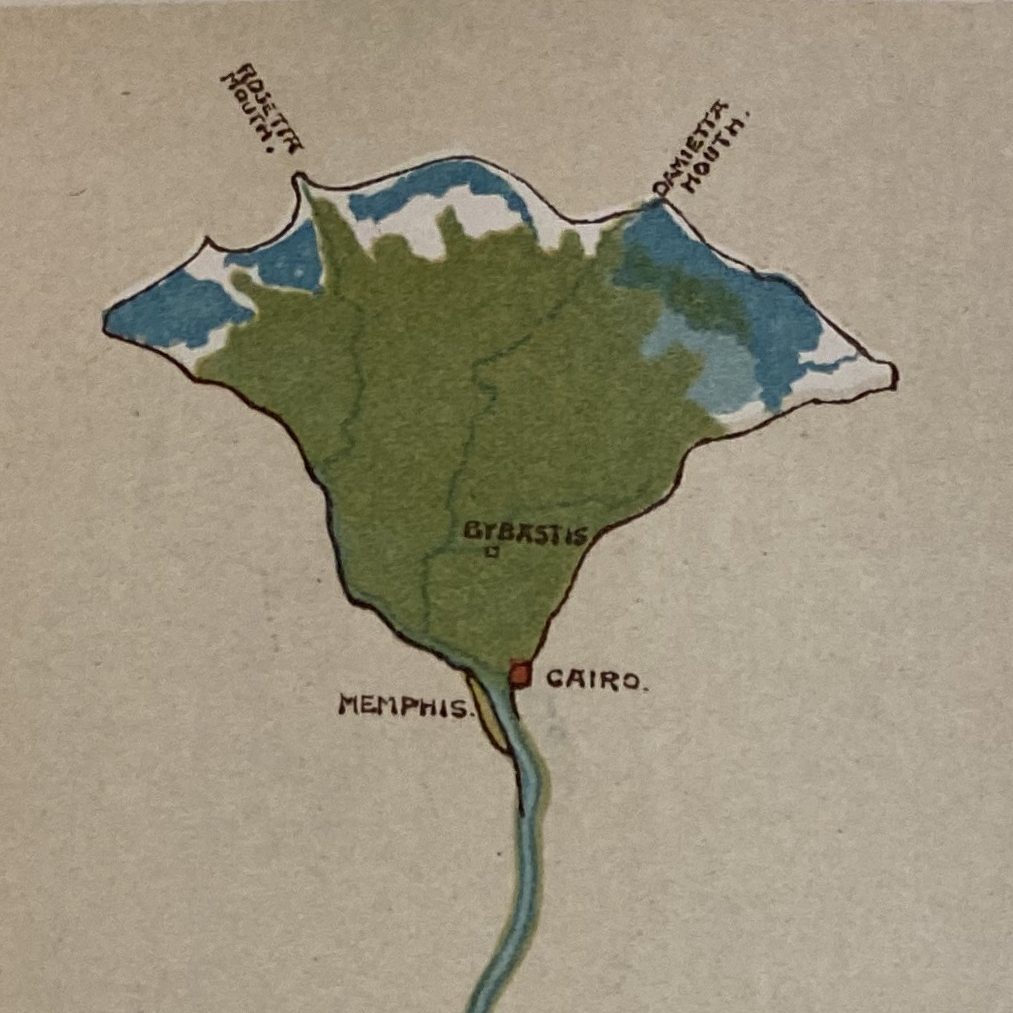
The first illustration in Egypt: three essays on the history, religion, and art of ancient Egypt is the colored print of a map of Egypt (figure 9). This image could have been printed using chromolithography, the common method for multi-colored prints at the end of the 20th century. There are 6 different colors used (red, brown, white, green, light blue, and dark blue), with some extra tones produced by the overlap of colors. The map is not registered perfectly, but even so, it is easily understandable and navigable. The typography used in the map matches the typography of the cover and title page, however, here the words are not perfectly legible due to printing error. I was surprised to see this in a book from 1891 because many other examples of chromolithography from this time period and earlier are executed with a great level of precision. This leads me to question my initial designation of chromolithography, perhaps the map was printed using 6 wood blocks? A comparison to other copies of this book could help show if chromolithography was used and only this edition’s map was printed poorly, or if all the maps were printed poorly from a woodcut lacking precision. However, as explained by Professor Sperling in the Colby’s art department, because the book was printed in Boston, a center for chromolithography, this is the most probable technique, although it looks a little odd.
The map of Egypt is on the last page before the start of the text. The placement at the beginning of the book seems to be a frequent feature of maps in novels, something I have seen in both historical texts and fantasy novels such as The Hobbit. This common practice to place a map at the start of a book sets the scene for the reader and anchors the text to a specific place, whether real or fictional. Singled-out at the start of the book, this map can be easily referenced while reading the text. This makes the book an object to be used rather than just a text to be read.
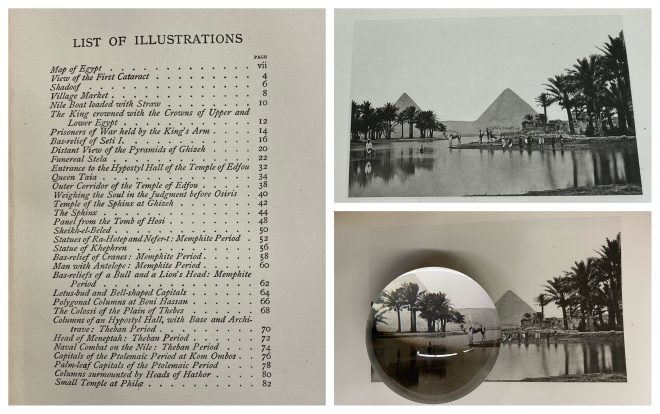
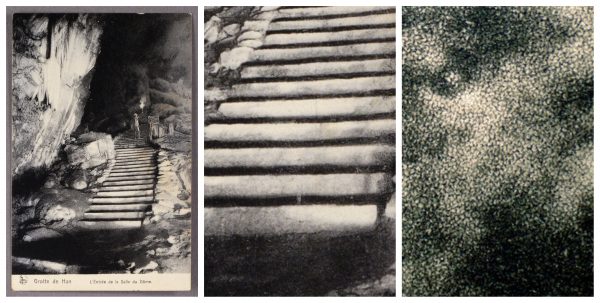
The last type of decoration to discuss are the 32 photographs appearing usually every two pages in the body of the text (figure 11). These photographs were printed using a photomechanical process. The images are not photographic negatives themselves; they are printed from printing plates made from the original photographic negatives. The main photomechanical processes include collotype, photogravure, letterpress halftone, and offset-lithography. By process of elimination, the photographs in Egypt: three essays on the history, religion, and art of ancient Egypt are most likely collotype. There is not an embossed plate mark around the photographs (a sign of intaglio printing) eliminating the intaglio photomechanical process, photogravure. These photographs also lack the tiny discernable dots that would point towards offset-lithography or letterpress halftone as potential candidates. This leaves collotype, which also accurately describes the characteristics seen in the photographs of this book. Collotypes became popular after 1870, are most commonly monochrome with a matte finish, and, under magnification, a brain-like pattern is visible (figures 14-16). These features match those of the photographs printed in this 1891 book (figures 12-13). Closer examination under microscope could confirm this photomechanical process.
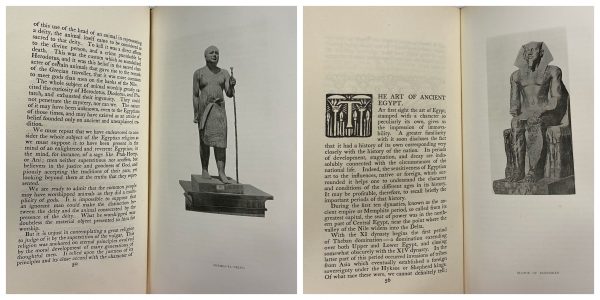
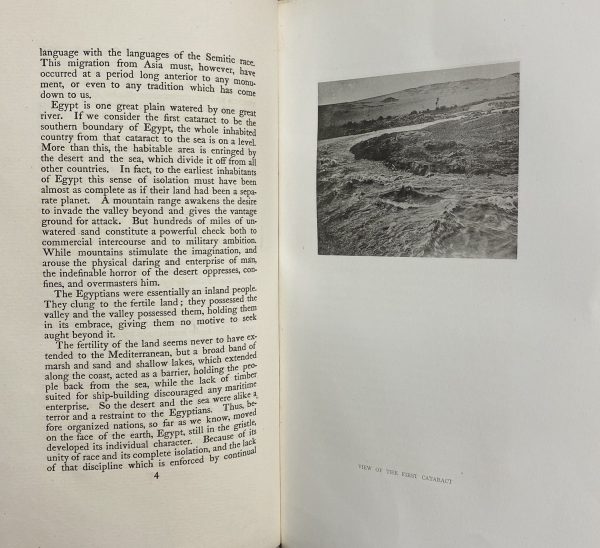
The photographs in this book serve a clear purpose; they give visual form to the places, architecture, objects, and art discussed in this book. When it comes to describing places and things, a picture really is worth a thousand words. The regular appearance of pictures in the text also give the book a regular rhythm for readers. However, the technological requirement of each individual photograph to be on a separate page and the photographs’ even spacing throughout the text leads to some discontinuities between the words and images. For example, the image of Skiek-el-Beled (figure 17) appears after page 50 (in the second essay) but the discussion of portraiture sculpture and this image does not appear until page 65 (in the third essay). Page 65 is also the first description of the statue of Khephren, but the corresponding photograph is after page 56 (figure 18). This technological consequence of the printing processes alters the way the book is read; readers need to flip between pages to see images as they read its description. This is very different from books printed after technological advancements that permitted text and images on the same page. However, there are some instances where the photograph and its description fall on adjacent pages, such as for the view of the first cataract (figure 19).
Decoration is a very important aspect of Egypt: three essays on the history, religion, and art of ancient Egypt. Without the decorative features of the cover, binding, typography, initials, tail-pieces, map, and photographs, this book would loose most of what makes it special. Without these decorative features, the book would no longer achieve its important aesthetic purpose of bringing beautiful objects to everyday life, and it would be less functional as a historical and artistic reference for readers.
Sources:
https://en.m.wikipedia.org/wiki/Sarah_W._Whitman
https://psap.library.illinois.edu/collection-id-guide/photomechanical