The notion that the formatting of a book impacts the reader or user’s experience with it is inarguably applicable at this time of reliance upon the internet in order to gain knowledge. Physical books are no longer readily available in libraries in bookstores. The difference in experience between reading my tangible pet book, and an online version is palpable. The Holy Spirit has no scent, or musty aura on my laptop screen.
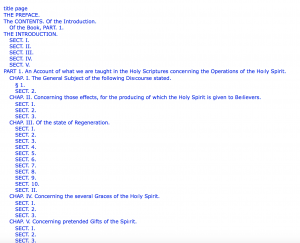
The digital facsimile of The Holy Spirit that I looked at was on the platform of Early English Books Online. I had trouble accessing it with the link, which was to the detriment of my experience. This would certainly influence the ability for others to access the book online, granted that an account was needed in order to use this particular website. However, The Holy Spirit is readily available for purchase on Google Books, and the copy is in color. This contrasts the online copy I looked at, which was uploaded in black and white. This impacted the experience because the text contrasted the page more than it would have with the brown pigment. The text itself was clearer. I also found a version that was typed up and posted as a document wholly independent from photographs. The reader can select each section separately. The online experiences of reading the book can vary considerably. There are many options for formatting the electronic translation, if you will, of a book that would otherwise always look relatively uniform.
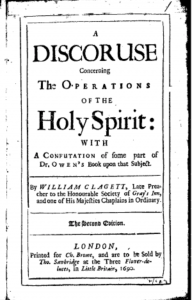
Once I successfully launched it, I was taken aback by the blatant mistake in the print: “A Discourse Concerning the Operations of the Holy Spirit” was “A Discoruse Concerning the Operations of the Holy Spirit.” While the physical nature of the publication is not the reason for this misspelling, it does add to the contrast between the two copies of the text. In fact, the book’s title on the website exhibits this same misstep. Someone seeking the online text may have difficulty finding it due to this error, making the online copy essentially obsolete if it cannot be accessed by name search. Anyway, there are evident differences between the two formats aside from the fact that the copy online is a different print than the one I previously studied.
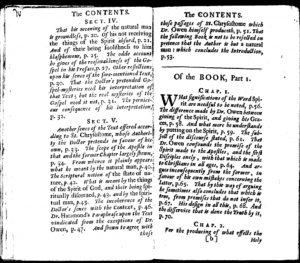
On the blank backside of the title page, there is a stamp which likely indicated where the text was stored, like in a library or university. However, on the Imprimatur page, there is another stamp. It is legible; it says “Trinity College Library.” This is one of many characteristics that contrasted those of the book I worked with in person. On the ninth page, the leaf was bound in a way that concealed some of the text, due to the angle at which it was printed. These errors are peppered throughout both copies, but not in the same locations. The online copy was tainted by this mistake in countless places (at least thirty spots in the first half of the book), which made the pages nearly illegible since entire words were swallowed by the seam. It is likely the faults were the product of the method chosen for scanning the book. The entire spread was photographed, rather than the single leaves, which was how the Google Books copy was done (and it did not have this problem). When scanning old books with fragile, brittle bindings and leaves, it would probably be more effective to scan each individual leaf, instead of both simultaneously.
Completely removing the digital facsimile from the equation, studying the pet book in person differs greatly from pulling up images I took on my phone. The most evident distinction between the experience of studying the book in person and doing so online was the lack of connection to it. Perhaps this sensation was heightened by the lack of provenance in the copy I found on the internet. That is merely the result of what its previous owner(s) chose to do with it. Regardless, it feels impersonal with no evidence of ownership. That particular copy of The Holy Spirit may also have been coveted for online use due to the lack of provenance; a marked up copy is not preferable for electronic publications. Analyzing the provenance in the margins, the names written, and stamps in the book amplified the fact that it was nearly alive, influencing people’s lives before it was placed on a stiff library shelf. Feeling the aged and weathered materials, and being confronted by the owner’s writing emphasized the book’s significance in a manner that was not achieved in the electronic copy. Despite having sifted through each page numerous times, I never actually read the text. But, hey, at least I can read it online!