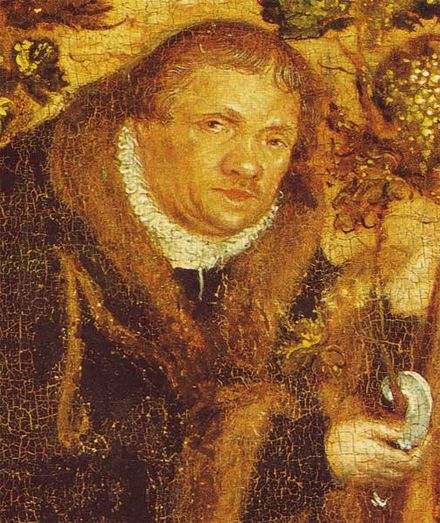
By Serena Desai
This is an ongoing blog series. To view my previous posts on Eber’s Calendarium, click the link below:
Introduction to the Text: http://web.colby.edu/bookhistory2020/2020/02/20/decoding-the-codex-the-calendarium-historicum-conscriptum/
____________________________________________________________
An Overview of the Text

In 1559, George Rhau’s printing press in Wittenberg, Germany printed Paul Eber’s Calendarium Historicum Conscriptum— the first calendar of its kind to undermine the papacy by replacing the traditional “Saint of the Day” format with a historical account of the Reformation. Written by devout Lutheran scholar Paul Eber and heavily annotated by multiple previous owners in the mid sixteenth century, this text highlights important Protestant holidays and astrological events, providing Roman, Egyptian, Macedonian, Attic Greek, and Hebrew versions of the day calendar for readers to reference. This blog series is concentrated on Colby College’s 1559 copy of the work, donated by Mrs. Florence Hahn and currently housed in the Special Collections library.
The Protestant Reformation: The Backdrop to Paul Eber’s Calendarium Historicum Conscriptum
On October 31, 1517, Martin Luther famously nailed his Ninety-five Theses to the door of the Castle Church in Wittenberg, Germany, signaling the beginning of the Protestant Reformation. On that same day, hundreds of citizens– derogatorily called “Lutherans” by leaders of the Catholic Church– memorialized “XXXI Octob.” in their day-journals, deeming it the “prima die” of official resistance against papal authority. One such unapologetic Lutheran was Paul Eber, the author of Calendarium Historicum Conscriptum in 1550. Born in Kissingen, Germany, on November 8, 1511, and schooled at the University of Wittenberg (Luther’s own alma mater), Eber supported Luther’s theological argument that salvation could only be achieved through faith in Jesus Christ as redeemer from sin. Opposing the commercialization of “indulgences”– certificates sold by the church that could supposedly erase all traces of one’s sin– Luther and his followers claimed that repentance could only be gained through inner spiritual transformation as opposed to mere “external sacramental confession.” They also held that the written text of the Bible (not necessarily the preachers who taught it) was the only source of divinely revealed knowledge.
Despite the rapid growth of the Protestant movement, with intellectuals such as Paul Eber and Philip Melancthon spearheading its development through academia and scholarship, Luther was not without opposition. Those who disapproved of his Ninety-five Theses– namely Pope Leo X and the Holy Roman Emperor Charles V– contributed to his infamous excommunication in 1521, deeming him not only a heretic but an outlaw of the Empire. The Edict of Worms, released on May 25, 1521, banned Luther’s literature, made it a crime for anyone in Germany to offer him food or shelter, and permitted anyone to kill him without legal consequence. According to the edict, the church “[wanted] him to be apprehended and punished as a notorious heretic.”
It was in the midst of this religious, intellectual, and cultural upheaval that Paul Eber consciously decided to ignore threats from the papacy and publish the Calendarium Historicum Conscriptum— a reconstruction of the Roman ecclisiastical calendar that replaced hagiographical descriptions with key moments in classical and modern history. As I was researching this text and the author who penned it nearly five-hundred years ago, I wondered how much of a risk publishing such a “scandalous” text would have been in Eber’s time. I started digging for my answer in the “biography” section of Paul Eber’s entry on Hymnary.org.
The Life of Paul Eber
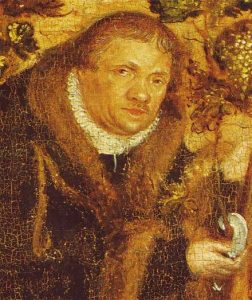
From 1511 to 1526, Eber received scholarly instruction from his father, and then continued his studies at the Gymnasium at Ansbach. After the sudden death of his mother, and subsequent injuries caused by a fall off of his horse during the rush back home for her funeral, Eber was forced to pause his studies until 1526, later resuming his work in Nuremberg. In 1532, he entered the University of Wittenberg, following in the footsteps of Martin Luther, and was eventually employed as “amanuensis” (literary or artistic assistant) to German theologian Philip Melancthon.
I find it particularly fascinating that Eber was able to occupy multiple positions on Darnton’s Communications Circuit simultaneously at this point in his life; not only was he authoring popular hymns such as “Wenn wir in höchster Noth und Pein” and “Wenn wir in höchsten Nöten sein,” but he spent the beginning of the 16th century dictating and copying manuscripts for Melancthon. Willingly accepting the job of a scribe– a position typically lower on the bibliographical hierarchy– Paul Eber humbly placed himself at the feet of the Protestant scholar he revered whilst nurturing a promising theological career of his own. Eventually, Eber became so intimate with Melancthon and his ideals that he was given the name “Repertorium Philippi,” or “Philip’s Repository.”
In 1536, Eber began to lecture on grammar and philosophy, and in 1541 he accompanied Melancthon to the Diet at Worms, where he voiced his unconditional support for Martin Luther. In 1544, as the Reformation bloomed, he was appointed professor of Latin grammar, after which he became Dean of the philosophical faculty in 1550. In 1556, Eber was appointed professor of Hebrew and chaplain to the royal chapel at Wittenberg (explaining the many Hebrew sections of Calendarium Historicum), and in 1559, he was made general superintendent of the electorate. From this point until he died on December 16, 1559, Eber devoted himself entirely to theology and to the “faithful discharge” of his duties to the state.
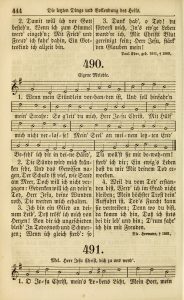
Throughout his life, Paul Eber authored dozens of literary works, including a wide range of tender hymns such as “Herr Jesu Christ, wahr Mensch und Gott,” “Helft mir Gotts Güte preisen,” and “Herr Gott, dich loben alle wir,” each published in the latter half of the 16th century. He additionally wrote an elementary handbook of Jewish history for the purpose of distributing it to his students, and a revision of the Old Latin Testament showcasing his distinctly Lutheran perspective.
*A Note on Jews in the Context of the Reformation: I am interested to find copies of Eber’s handbooks on Jewish history in order to determine whether or not they are anti-Semitic, especially since Martin Luther was a documented anti-Semite mid-way through the Reformation.
On the Calendarium Historicum Conscriptum
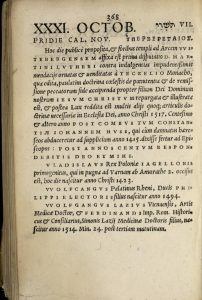
Like Melancthon, Eber wished to accord history a more prominent place in university curriculums, and to give time a “new shape reflecting the Protestant and humanist vision of God working across the centuries.” This “humanistic” approach, one that attached prime importance to human rather than divine matters, allows us to understand why Eber scrapped the traditional Saint of the Day format of the Roman Catholic calendar in favor of details regarding floods, the weather, comets, astrological events, medical information, and historical events taken from classical and contemporary sources. This also explains why the name “Martini Lutheri” is peppered throughout the text, specifically on page 368 (the page pertaining to October 31), the day Luther’s disputation was supposedly “fastened” (affixa est) to the door of the Castle Church in Wittenberg. On this page, Eber dutifully reproduces Luther’s interest in his fulfillment of the dying prophecy of John Wyclif– the predecessor to Protestantism. A piece of Wyclif’s prophecy is even copied into Calendarium Historicum Conscriptum verbatim, reading: “Post annos centum respondebitis deo et mihi” (in a hundred years you will answer to God and to me”).
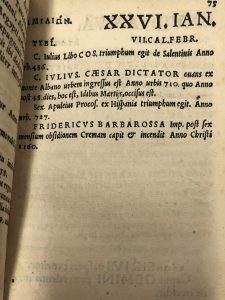
The changing fortunes of kingdoms, including those under the control of the church, were reminders of the “fragility of human existence.” Some might called them “prompts” for the reader to place trust in divine providence– one of the fundamental ideals of Protestantism. The text also features numerous leaves with blank space, likely intended for readers to write in continuations of modern history, or perhaps even their own personal events that occurred each day. This deliberate placement of blank space is once again a way for Eber to force readers to think of their own lives as continuations of the ancient past instead of mere additions to the histories of Saints come and gone.
Reviewing the biography of Paul Eber, along with the text of his Calendarium, was crucial to understanding how his work was produced and sold so quickly. There are dozens of digital facsimiles of the text in its entirety, each dating back to a period between 1550 and 1561. As corroborated by HathiTrust, this was the general period during which the book was printed in Wittenberg by the Rhau printing press. There is no existing copy of the original book produced by another printer, however, there was a small knock-off called Ephemeris Historica, printed in 1551 by Jean Crespin and authored by Gilbert Cousin. There was additionally a series French-language Protestant historical calendars that were published from 1555 onwards in France following the release of Eber’s calendar.
Clearly, Eber was influential for his time; he not only sold hundreds of copies of the Calendarium (dozens of which survive today all over Europe and the United States), but he introduced the concept of the “reconstructed calendar” to a rapidly-growing Protestant population in Europe. Certain physical clues throughout the book indicate its mass circulation among multiple religious groups– the first being the index at the back of the book (used to decode the phrases written in Attic Greek and Hebrew throughout the text), and the second being the book’s small size, indicating its portability. Eber’s popularity and success as a Lutheran author are indicative of his close ties with the leaders of the Reformation, and the protection afforded to him by the sheer number of individuals converting to Lutheranism as the movement continued (likely rendering it difficult for the Roman Catholic Church to track down each “heretic” and punish him individually).

*The only portion of the text that still remains enigmatic to me is the book’s binding, which is blind-tooled with images of what seem to be saints (based on the presence of halos and bugles). Knowing that Eber consciously cut hagiographical information from his calendar, I find it difficult to understand why a book-binder would cover the text in traditionally- Roman Catholic images. My only guess would be that the binding was strategically created to disguise the text that lay underneath– perhaps even to fool Catholic passerby who hoped to catch heretics red-handed. I’m unsure whether I am making “zebras out of horses” here, as Hannah Heath from People of the Book would say, but it’s nonetheless a fascinating mystery.
The Life of George Rhau (1488-1548)

Unlike the life of Paul Eber, which has been written about by numerous scholars, George Rhau’s known biography is sparse. Born in 1488 (making him a full twenty-three years older than Eber himself), Rhau was a German publisher and composer. Sharing a very similar pattern of interests with Eber, Rhau studied philosophy at the newly-established University of Wittenberg in 1513; five years later, however, he moved to the University of Leipzig, where he worked as a tutor. He is well-known for performing his mass Missa de Sancto Spiritu for twelve voices on 27 June 1519. While he lived in Leipzig for more than a year, Rhau was forced to leave, as the area was targeted for its production of Protestant texts; printers were restricted to selling books approved by the Roman Catholic Church, and were thus losing money at a rapid pace. Likely in an effort to save his printing business as a devout Lutheran, Rhau moved to Wittenberg, where he became one of the most significant music printers in Germany in the first half of the sixteenth century. It is not specified exactly how he came to publish Eber’s work, but considering the proximity of the two men (each living in Wittenberg, the birthplace of the Reformation), it makes sense that the two of them would rely upon each other to mass-produce prominent Lutheran works throughout the 16th century.
A Note on the University of Wittenberg

The University of Wittenberg was founded in 1502 by Frederick the Wise (Elector of Saxony), and was heavily criticized by Roman Catholic leaders following Martin Luther’s famous nailing of the “Ninety-five Theses” to the door of Castle Church in October of 1517. The Archbishop of Mainz, who held power over the Electorate of Saxony during the Reformation, openly criticized Luther’s teachings; as one of the primary leaders of the Counter Reformation, he viewed the university a breeding ground for heretical ideas. Despite the university’s controversial founding, chief Protestant scholars such as Phillip Melancthon, Paul Eber, and even Luther himself spent time teaching moral theology, ethics, philosophy, and language at the University of Wittenberg, slowly transforming the school into a center of the Protestant Reformation. The institution even incorporated Luther’s house at one point in time (called the Lutherhaus) as a part of its campus. It could be argued that one of the factors affecting the magnitude and growth of the Reformation was the fact that schools like the University of Wittenberg were spreading Lutheran teachings to new generations, publishing hundreds of Protestant texts and distributing them across the continent.
Sources:
Abstract of Jason D. Lane’s Essay on Eber’s Life:
Bibliographies of Paul Eber:
https://hymnary.org/person/Eber_Paul
https://hymnology.hymnsam.co.uk/p/paul-eber
http://www.bach-cantatas.com/Lib/Eber.htm
https://en.wikipedia.org/wiki/Paul_Eber
Information on Luther and the Reformation:
https://www.britannica.com/biography/Martin-Luther
https://www.learnreligions.com/martin-luther-biography-700828
https://www.simpletoremember.com/articles/a/the_reformation_and_the_jews/
Bibliographies of George Rhau:
http://www.bach-cantatas.com/Lib/Rhau-Georg.htm
https://churchofatonement.org/files/The-Large-Catechism-1.pdf
Information on the Calendarium Historicum Conscriptum
https://news.virginia.edu/content/reformation-era-daybook-challenges-gutenbergs-place-history-0
Background on the University of Wittenberg