Sylvia Dubois (Now 116 Years Old): A Biografy of The Slav who Whipt her Mistres and Gand her Fredom by Cornelius Wilson Larison, M.D. was published in Ringoes, New Jersey in 1883. The book, which was written in an effort to educate students on how to teach reading in phonetic forms, originated as a small piece of Larison’s scholarly work around orthoepy, the correct pronunciation of words, and its role in teaching reading. Dr. Larison recounts this information in the book’s short afterward, in which he explains that the body of work from which the book resulted was conducted for the Academy of Science and Art in Ringoes and submitted to several unnamed prestigious journals of education. Pleased by the work’s reception and surprised a bit by public interest in his scholarship, Larison decided to produce a limited number of copies of Sylvia Dubois (Now 116 Years Old): A Biografy of The Slav who Whipt her Mistres and Gand her Fredom with front matter on phonetic reading to sell to a wider market. Thus, through the business venture of Dr. Cornelius Wilson Larison, the book I am now studying came to be.
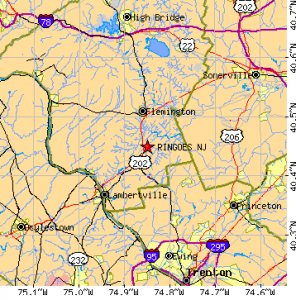
Accessed from:http://www.usbeacon.com/New-Jersey/Ringoes.html
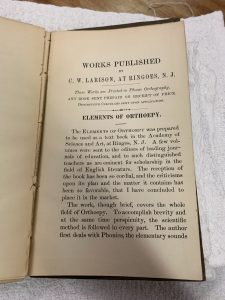
Larison operated a kind of nineteenth century crowdsourcing campaign in which he released printed copies of the Sylvia Dubois book and twenty-three other publications of his own writing at the Academy of Art and Science on the basis that he received prepayment from interested parties. Unfortunately, according to an account of Larison’s life and work compiled by the creators of the East Amwell Township Walking Tour Guide, Larison found little success in his publishing ventures and few copies were released into circulation, meaning that the volume of Sylvia Dubois (Now 116 Years Old): A Biografy of The Slav who Whipt her Mistres and Gand her Fredom that I am reading is one of few in existence. The nature of the books as printed and bound on a short-order basis as explains the simple bindings and plain covers on the books, which were created with no marketing intentions in mind because volumes were already paid for at the time of binding. Books were produced in what Larison called the “Fonic Publishing House,” where Larison’s books were printed and bound for distribution. The publishing operation found its home in the same building where C.W. Larison operated his Academy of Art and Science and set up his offices.
A fair amount of photographic documentation of Dr. Larison’s presence in the Ringoes, New Jersey community remains today. Several pictures of Larison with family in front of his home or with neighbors on a store front porch are available through the archives of the East Amwell Township Historical Preservation Committee, which includes information that describes Larison as “one of the most prominent citizens” of Ringoes during the late nineteenth century. In another publication, Jerseyana, Marc Mappen also speaks to this prominence, but it also identifies Larison as one of the most eccentric, even odd figures in the state of New Jersey at the time. Both sources report that Larison’s role in the community was largely related to his commitment to growing educational opportunities, which drove him to open two educational institutions in Ringoes in addition to writing phonetic texts that supported his educational pedagogy. One of the institutions was, of course, the Academy of Art and Science, and the second was a seminary that Larison operated with several of his family members between 1869 and 1881. The seminary came to be because Larison’s brother was a Baptist minister and Larison though the people of Ringoes were of “weak faith” and set out to use the seminary to provide education for moral and spiritual reform in his community. This motivation for providing education offers interesting context in considering the author’s motivations for writing, and particularly the author’s motivation for writing reformist work designed to challenge the conventions of language. Understanding the author’s orientation toward using education and literacy as a tool for religious guidance suggests an interesting potential reason for the author to write books to make reading more accessible in order to spread religious and spiritual messages. Larison was also a big supporter of Darwin’s theory of evolution, and used publications to disseminate scientific information. The author was especially compelled by Dubois’ advanced age. Knowing this given his interest in fitness and Darwinism suggests that both scientific and moral factors influenced the origins of Sylvia Dubois (Now 116 Years Old): A Biografy of The Slav who Whipt her Mistres and Gand her Fredom because the book, like all of Larison’s published work, was created as a result of his individual passions and curiosity.

Accessed from: https://eastamwelltownship.pastperfectonline.com/photo/02863E40-AF2D-466C-9F04-921114975204
What is missing from my considerations of the origins of Sylvia Dubois (Now 116 Years Old): A Biografy of The Slav who Whipt her Mistres and Gand her Fredom thus far is how Dubois herself contributed to the telling of her story and its wider sharing. Dubois and Larison became acquainted, according to Larison’s foreward in the Biografy, after Larison heard about Dubois, an elderly farmwoman, in a tavern during his work as a traveling physician and decided to go and meet her for himself. Larison’s account of the two meeting tells little about any actual conversations the two shared. Instead, his account focuses on Dubois’ “hospitality,” and the characteristics of her body.
Silvia is large of stature. In her palmy days she has not been less than 5 feet 10 inches high. She informs me that she usually weighed more than 200 pounds. She is well-proportioned, of nervo-lymphatic temperament, and is still capable of great endurance.
This description does not give Dubois a great deal of agency, instead taking a reductive approach to her by focusing on her bodily traits (following a precedent from descriptions of enslaved people). Furthermore, the emphasis on Dubois’ body suggests interest on Larison’s part in Dubois as a medical subject more so than a human being. This is troubling because Larison had a history in his medical career of “‘experimenting'” on patients and given the power differentials between Dubois and Larison, Dubois was undeniably vulnerable in relation to Larison (Berthold, 7). The foreward says nothing about how Dubois told her story to Larison. It only implies that at some point she did. “Authority and Identity in Sylvia Dubois: A Biografy of the Slav who Whipt Her Mistres and Gand Her Fredom by C.W. Larison,” an article by Agatha Rowe-Crowder, points out that Dubois had limited agency in the story that was ultimately published. “The Peals of Her Terrific Language”: The Control of Representation in Silvia Dubois, a Biografy of the Slav Who Whipt Her Mistres and Gand Her Fredom by Michael Berthold suggests that Dubois did not fully consent to her story being published and did not intend for a written narrative to emerge when she talked with Larison. “Dubois dismisses any formalization of herself as Larison’s biographical subject…she is not ambitious to be either written or writerly and disavows any inexorable association of autonomy and text”(Berthold, 8). Dubois also notes that publishing her story “t’wont do me no good,” further demonstrating that Dubois did not feel publishing her narrative gave her a meaningful avenue to express herself. The context of Dubois’ story outside of Larison’s description offers quite a lot to consider in terms of the power involved in the origins of Dubois’ biography.
Works Cited
Berthold, Michael C. “‘The Peals of Her Terrific Language’: The Control of Representation in Silvia Dubois, a Biografy of the Slav Who Whipt Her Mistres and Gand Her Fredom.” MELUS, vol. 20, no. 2, 1995, pp. 3–14.
Rowe-Crowder, Agatha (2018) “Authority and Identity in Sylvia Dubois: A Biografy of the Slav who Whipt Her Mistres and Gand Her Fredom by C.W. Larison,” Liberated Arts: a journal for undergraduate research: Vol. 5 : Iss. 1 , Article 4.