
The origins of my pet book, Egypt: three essays on the history, religion, and art of ancient Egypt by Martin Brimmer, are not defined by gender barriers or national borders.
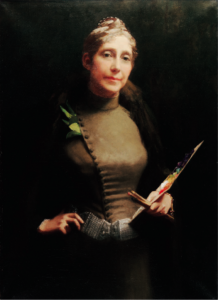
The cover of Egypt was designed by Sarah Wyman Whitman, a prolific artist who lived and worked in Massachusetts in the late nineteenth century. One of the first women students at the Boston Museum School, Whitman helped pave the way for female artists in a male-dominated field at a time when female careers themselves were a rarity. Whitman was successful in multiple different mediums; making a name for herself in oil painting and stained glass, opening and operating a glass studio, Lily Glass Works, and designing approximately three hundred book covers during her time working with Houghton Mifflin & Company.
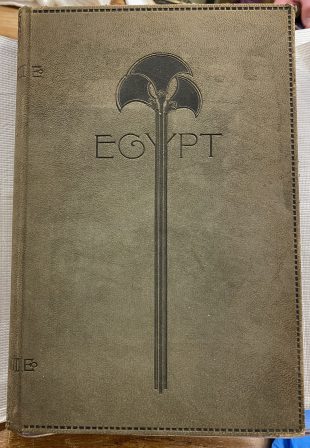
Whitman was a strong advocate for the Arts and Crafts movement and in 1897 served as a founding member of Boston’s Society of Art and Crafts. The Arts and Crafts movement emphasized the inseparable nature of art and life and promoted simple forms and lines in decorative design. These principles are evident in Whitman’s book designs which feature elegant, simple forms in harmony with color and negative space to create graceful compositions. The Boston Public Library is home to an extensive collection of books designed by Sarah Whitman, an online album of these covers is available here. In Whitman’s design for the cover of Egypt: three essays on the history, religion, and art of ancient Egypt, her style is easily recognizable. The negative space of the cover is split in half by a stylized papyrus flower which also forms the “Y” in Egypt. The calligraphy of the title and elegant papyrus design allude to the text within–without much emphasis on the specific narrative and information. The design makes the book cover compelling to potential readers and is work of art in its own right (figure 2).
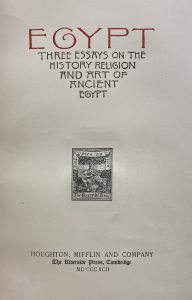
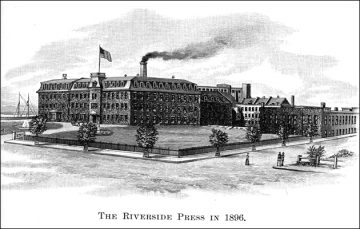
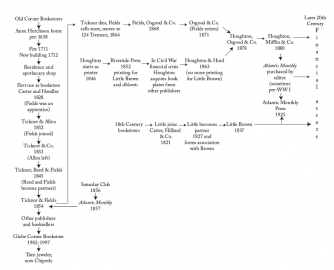
Sarah Whitman’s employer, Houghton Mifflin and Company, published Egypt: three essays on the history, religion, and art of ancient Egypt with the Riverside Press in Cambridge, Massachusetts. Forty-nine years before the publication of this book, Henry Oscar Houghton founded the Riverside Press in 1852, which is named for its location on the bank of the Charles River in Boston. In 1872, George Mifflin was admitted to the firm and the company was renamed Houghton, Mifflin & Company. This company had greatly expanded from its modest beginnings with 90 employers to over 600 by 1886 (Dornbusch). By this time, Riverside Press was well known for their artistic publications, many designed by Sarah Whitman. In 1891, Egypt: three essays on the history, religion, and art of ancient Egypt was printed and published by Houghton Mifflin and Company at the Riverside Press. The title page of this book features the Riverside Press logo and motto, “Tout bien ou rien”–“do it well or not at all” (figure 3).
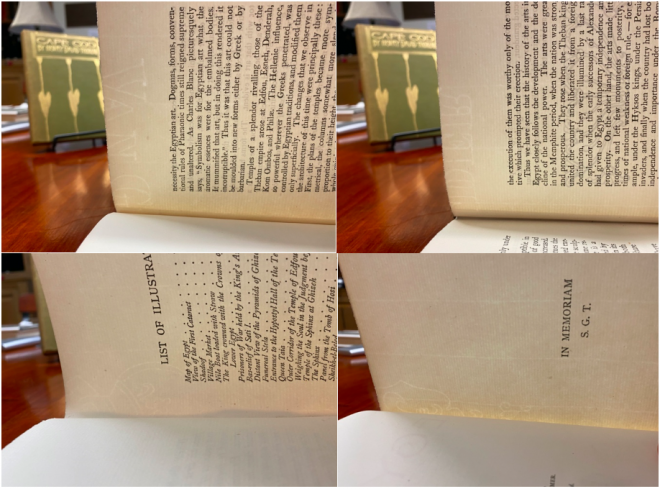
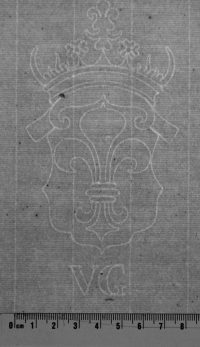
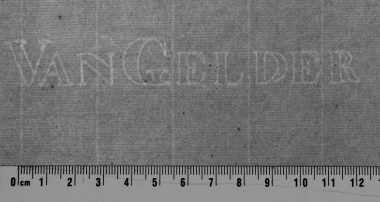
But what about the origin of the paper that serves as the support for this book? This material without which there would be no tangible text for reading? Watermarks, mostly hidden in the gutter of this book, can be deciphered and serve as important clues to identify the paper maker. Watermarks are images within paper which are made during the production process and only easily visible when light shines through them. In Egypt: three essays on the history, religion, and art of ancient Egypt, the letters in a watermark spell “Van G … der”. The middle of the name, hidden in the gutter of the book, can only be hypothesized. Strong evidence points towards the Holland paper manufacturer, Van Gelder. A convincing comparison can be made between the watermarks in the book (figures 6-9) and a digital example of both the Van Gelder name and the watermark lily with crown (figures 10-11). Furthermore, although 37 years after the publication of Egypt, there is evidence that Van Gelder was advertised in Boston (figures 12-13), making possible the link between a Holland papermaking company and the Boston Houghton Mifflin & Company.

Sarah Whitman, the previously discussed book designer, was a socialite and often painted portraits for her important friends in society. One of these portraits include that of Martin Brimmer (figure 14), the author of Egypt: three essays on the history, religion, and art of ancient Egypt, giving us the first insight into who was the person who crafted the verbal text of this book. Of this portrait Brimmer wrote, “I told you that I did not think I had any right to be painted. Now I feel a hundred-fold that I have no right to be painted as well as this. The picture tells the story of what I should like to be. It is simple and great and strong and humbles me as I look at it. And while others praise its power, you will let the subject himself say that he is always helped and inspired by your great interpretation of him” (Andrews).
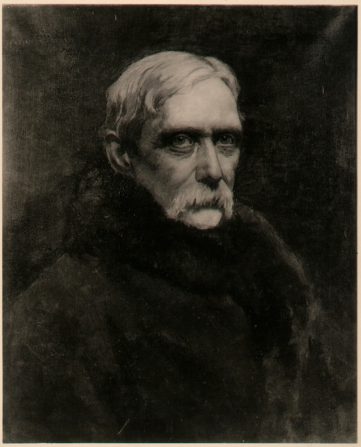
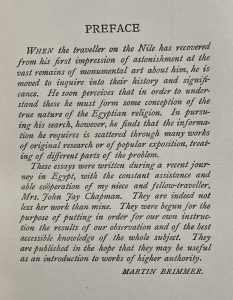
Martin Brimmer was the first president of the Boston Museum of Art, supporting the arts in his native city and serving as the president of this museum from its opening in 1876 until his death in 1896. Brimmer was born in Boston in 1829 and graduated from Harvard in 1849. He was an important philanthropist and politician, serving as a representative for Massachusetts legislature from 1859-61 and in 1864 serving in the state senate. Brimmer was married to Marianne Timmins, together they had no children of their own but adopted Marianne’s two nieces Minna and Gemma. Minna, whose husband was John Jay Chapman, was also an important contributor to this book, as explained by Martin Brimmer in the preface; “these essays were written during a recent journey in Egypt, with the constant assistance and able cooperation of my niece and fellow-traveler, Mrs. John Jay Chapman” (figure 15). Minna Timmins, Sarah Whitman and Martin Brimmer were all close friends. Sarah Whitman and Martin Brimmer communicated regularly, evident in the eighty-six letters between the pair now housed in the Archives of American art which “indicate that she was not only a great friend but the only person to whom he could confide his hopes and fears for art in New England” (Andrews).
In investigating the origins of Egypt: three essays on the history, religion, and art of ancient Egypt, one begins to see the tangled web of connections between the author, Martin Brimmer, book designer, Sarah Whitman, publisher, Houghton Mifflin & Company with The Riverside Press, and Holland papermaker, Van Gelder. The individual companies and people are inseparably woven, and today we can only guess at how they came together to make this book a reality.
Sources Cited
Andrews, Wayne. “Martin Brimmer: The First Gentlemen of Boston.” Archives of American Art Journal 30, no. ¼, (1990): 4-7.
Dornbusch, Erin. “Riverside Press.” Cambridge History (2012). https://cambridgehistory.org/industry/riversidepress.html [accessed 1 May 2020].
https://www.flickr.com/photos/24029425@N06/albums/72157604192955355/page1
Gelder, Van. “A fine book paper from Holland, mould made No. 75g”, Japan Paper Company, New York, Philadelphia, Boston, 1928.
Gelder, Van. “Two blank sheets of laid paper. One with watermark lily with crown and VG underneath and on sheet with counter mark: van Gelder.” https://www.abebooks.co.uk/Two-blank-sheets-laid-paper-watermark/22548472439/bd [accessed 1 May 2020].
Martin Brimmer letters, 1880-1896. Archives of American Art, Smithsonian Institution.
Smith, Bonnie Hurd. “Sarah Wyman Whitman.” Women’s Heritage Trail (2020): https://bwht.org/sarah-wyman-whitman/ [accessed 1 May 2020].
Smith, Betty S. “Sarah Wyman Whitman: Brief life of a determined artist: 1842-1904.” Harvard Magazine (2008) https://harvardmagazine.com/2008/01/sarah-wyman-whitman [accessed 1 May 2020].
Sorensen, Lee, ed. “Brimmer, Martin.” Dictionary of Art Historians http://www.arthistorians.info/brimmerm [accessed 2 May 2020].
Walden, David. “My Boston: Some printing and publishing history.” TEX Users Group annual conference, Omni Parker House, Boston, Massachusetts, July 2012. Walden, David. “My Boston: Some printing and publishing history.” TEX Users Group annual conference, Omni Parker House, Boston, Massachusetts, July 2012
Whitman, Sarah. “Martin Brimmer” oil on canvas, 1896. The Harvard Art Museums, Cambridge, Massachusetts.