
Looking into the origin of this book, the place to start is with the author. Thomas Godwin was born in either 1586 or 1587. He attended Oxford and graduated BA in 1607. Following his time at the University, he took on the position of the Abingdon School in Berkshire. At Abingdon he created a scholarship for poor boys, and in 1614 he published Romanae Historiae Anthologia to be used at Abingdon. His writing during this period was criticized and his authority as a theologian was challenged by his critics. They criticized him for being at pedagogy than theology. He later retired from teaching and took up the rectory of Brightwell in Berkshire, which was given to him by James Montague, bishop of Bath and Wells. It was during this period that he published the first edition of Moses and Aaron, in 1625. Godwin died in 1642 and was buried at his church. (Oxford Dictionary of National Biography; Godwin, Thomas; W.F. Wentworth-Shields; September 23, 2004; accessed 3/1/20. https://doi.org/10.1093/ref:odnb/10896)
There are a couple of interesting things to take from this information. The first thing is that he wrote other books about religious history, most famously the Romanae Historiae Anthologia, which also was published in many editions. He came to this field both as a teacher and as a theologian. The other thing to take from this is that the large number of editions of Moses and Aaron were printed, at least in part, due to popularity rather than changes made by the author. The 10th edition, which is the one we have here, was published in 1671, 29 years after Godwin’s death. He can’t have been making changes to the book at that point, so it seems like those later editions were published due to popularity.
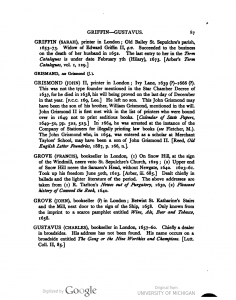
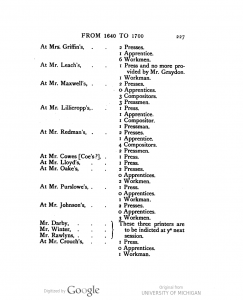
Of course, the author isn’t the only person involved in making this book. This edition has a printer’s note in the front that says that it was printed by S. Griffin for Andrew Crook in London in 1671. With a little bit of digging on the English Short Title Catalog (estc.bl.uk; search term S. Griffin in Publisher), I found that this S. Griffin was Sarah Griffin, widow of Edward Griffin II and mother of Bennett Griffin. These names are important because they are among the names of the printers of other editions of Moses and Aaron found on the Short Title Catalog (search terms Moses and Aaron in title and Thomas Goodwin in author). Doing a little more research on Sarah Griffin, I found that she inherited the print shop from her husband Edward, who inherited it from his mother Anne, who inherited it from her husband Edward. Sarah later passed it on to her son Bennett. Sarah’s print shop had two presses and employed six workmen and an apprentice. This would make it on the larger end of the medium shops listed in Henry Plomer’s A short history of English printing, 1476-1898. Looking through the other books published by the Griffin family on the ESTC, I found that they mostly published theological texts and books about religious history, including several editions of Moses and Aaron. (Henry R. Plomer, Dictionary of Booksellers and Printers Who Were at Work in England, Scotland and Ireland, 1641-67 (London, 1907). https://hdl.handle.net/2027/mdp.39015033589576?urlappend=;seq=117; Henry R. Plomer, A Short History of English Printing 1476-1898 (London, 1900). https://hdl.handle.net/2027/mdp.39015019147175?urlappend=;seq=251)
The bookseller/publisher, Andrew Crook, has an interesting history. He was apprenticed to Roger Potts in 1622 and then made free in 1629. He rose through the ranks of the Stationers’ Company quickly and served in various leadership positions. He also served in the city government in London for a short period. During his career, Crooke took on a number of apprentices, most notably William Crooke who was likely his nephew. While most of the books Andrew Crooke sold were plays, his catalogue was quite broad and included many other types of books including the works of Thomas Hobbes. Between 1637 and 1679, almost all official publications of Thomas Hobbes’ material were done by Andrew or William Crooke. While not directly related to Moses and Aaron, this information exposes the context in which the book was published. (Oxford Dictionary of National Biography; Crooke, Andrew; Mark Goldie; September 23, 2004; accessed 3/1/20. https://doi.org/10.1093/ref:odnb/67206)