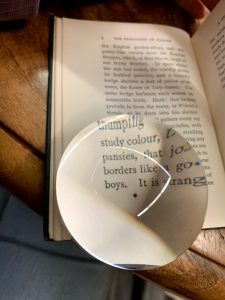
The book I chose for my Pet Book project is The Friendship of Nature: A New England Chronicle of Birds and Flowers by Mabel Osgood Wright. Published in 1894 by Macmillan and Company in New York, The Friendship of Nature is an ode to the natural world written during the “back-to-nature” movement of the late 19th century. Mabel Osgood Wright is one of the heroes of the conservation movement in America, having written a multitude of books both celebrating and explaining the ways of nature. I came across this book while perusing the Special Collections catalog online, after searching for a book on nature using the keywords. I aimed to find more of a catalog of environmental information than a novel describing the ways of nature, but this book spoke to me because I remember briefly learning about Wright while learning about the American conservation movement, and I know that there were many beautiful works of literature that came from the turn of the century regarding the environment. I’m also interested in the New England aspect of it, as I grew up in Massachusetts and Maine and know how beautiful the East coast is. When I went to visit the book in Special Collections, Wright’s work did not disappoint; it’s an elegant story dedicated to the natural world and celebrating the miracles within it.
At first glance of the book, it seems to be in almost perfect condition. It’s a small book, likely able to fit into a pocket, and yet it’s not worn down as a pocketbook taken out and about would expectedly be. It has kept the rich green color of the binding, and it’s golden title and illustration both on the front and side of the book, etching a quiet scene of a lily pond. Based on the shape of the binding, I assume the book was not being constantly read by it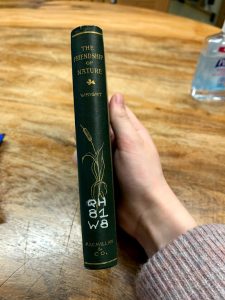 s owner. The only sign of fraying is near the spine and the end of the top head of the book, leading me to think it was kept perhaps between books on a shelf. The pages are in great condition and seem expensive, with a shiny finish on the tops of them and a curve to make them easier to turn.
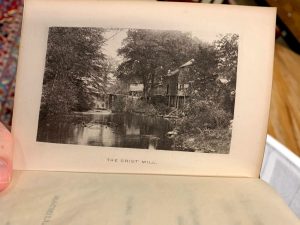
The book has dark, clearly legible ink and relatively large print with large margins, making the book easy to read. The first page has an illustration that I originally believed to be a mountain signaling her connection to nature and conservation but after looking closer learned to be the logo of the publishing company. The next and final piece of artwork is a photograph of “The Grist Mill” protected by a wax-type of paper. The book continues with a dedication poem to “S.O.,” a table of contents and the first chapter. The book has a page number, the chapter name and the title on each page, and along with the table of contents is very organized and understandable. The book formerly belonged to a library, as it has a “Due Date” sheet and pocket in the back holding two library cards, both revealing that the book was not once taken out. The library code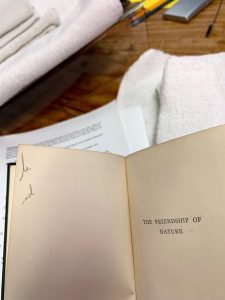 for the book must have been “QH 81 W8” as that is inscribed on the spine of the book, written in pencil at the beginning of the book, and printed onto the library card pocket. The only other note written in is also penciled in the front pages of the book, however, I can’t decipher what the letters are, the first word looking to be “le” and the second ending in “d,” but otherwise illegible. The pages are in great shape for their age, with no signs of decay and the only imperfections being tiny splotches on multiple pages throughout the book. The dots are not raised and don’t seem to be mold, so I assume they could be inkblots, but I am intrigued to look further into it in the future. I’m excited to continue working with Wright’s book and uncovering more of the history of the work.