Introduction to Pet Book
Meg Charest
I selected the book Sylvia Dubois (Now 116 Years Old): A Biografy of The Slav who Whipt her Mistres and Gand her Fredom by Cornelius Wilson Larison, M.D. The edition I will be working with was self-published by the author in Ringos, New Jersey in 1883. The context of the book is also compelling; I’m looking forward to learning more about the role and influence of slavery and Abolition narratives after the Reconstruction era and particularly in middling states, which are not typically at the forefront of popular histories of this time or topic. I was drawn to the book when it was introduced to me in Special Collections because it had recently entered the collection, coming to Colby through the gift of Lucia Whittelsey, a private, local donor who thought the book would be of interest to the College when she found it while cleaning out a home. The text offers a narrative about an enslaved woman claiming her freedom, which interested me because it offered the opportunity to study the material culture aspect of one exceptional account that is part of an underrepresented collection of historical voices and perspectives. I’m hoping to learn more about specific trends and tendencies of books about women of color, if such trends and tendencies exist at all. The biography is written by a medical doctor although it has little to do with medicine other than Dubois’ described advanced age. I am interested to learn more about the authorial history of the text given this unique circumstance. The aspect of the book I found most compelling is that it was written in phonetic language. The book’s title page makes mention of orthoepy, the study of correct pronunciation, and I wonder if the phonetics of the book are meant to explore a specific pronunciation of a dialect, or, as folks in Special Collections suggested, to teach reading, particularly to freed enslaved people. The text includes notes about publishing in educational journals as well as several pages of a phonetic alphabet breakdown, suggesting the book was intended to play a role in teaching reading in some capacity.
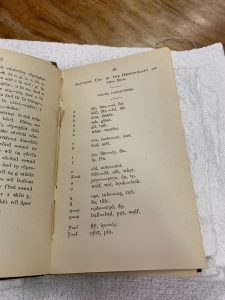
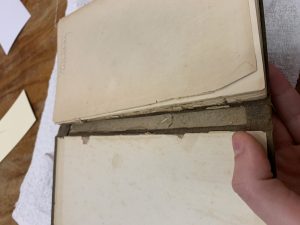
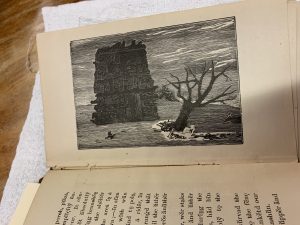
Brown and unlettered, with signs of age and use, the front and back covers give little away about the contents of the book, although the unassuming finish is unsurprising for a self-published book. Upon opening, the front flyleaf shows a signature in the upper right corner. The book’s 124 pages show mild discoloration and browning with wear especially at the outer edges, the pages remain in fairly good condition overall. The book is small, measuring approximately six inches wide by eight inches tall. It is bound with cloth on boards. The binding is significantly damaged, showing signs of wear and age. The hinge of the binding shows cracking and over-stretching, and the textblock has separated from the casing almost entirely, exposing a traditional sewn binding technique holding pages together. The broken binding makes pages difficult to turn, but in perusing the book, a common, medium-sized typeface populates pages with margins of about one inch. One of the pages is illustrated with a block-printed illustration in black ink. Another illustration, a portrait of Sylvia Dubois printed on the flyleaf when the book is first opened, stands out from the others because it is printed in a more ornate style, showing a realistic depiction of Dubois’ face in much sharper relief than simpler block prints at other points in the text offer.
In future considerations of form, history, and context, I look forward to exploring answers to the following questions:
–Where does this book fit in with the larger history of books about people of color, specifically women of color during the post-Reconstruction era?
–What is the authorial history of this book? How did the author develop a relationship to the biography of Sylvia Dubois and how, if at all, was she involved in the writing process?
–What is the history of the self-publishing press the author used to produce this book? Did it publish other works?
–How does the source of the text as a gift to Colby and the text’s current status as a holding in Colby’s special collections influence the way it is read? What was the history of the text beyond what is known by Colby’s Special Collections–where was it before it was in the collection of the donor?
–What is the status and influence of other copies of the book? Where are they located and who owns them and reads them?