
For my Pet Book Project, I have chosen History of the New Zealanders, an explorer’s glimpse into the native population’s culture. I have chosen this text because, having spent the last semester abroad in New Zealand, I fell in love with the land and people and I have grown curious about the changes the country has undergone since this book was published in 1833. Even though I chose this book because of its topic, the physical book itself is leading me toward some neat discoveries.
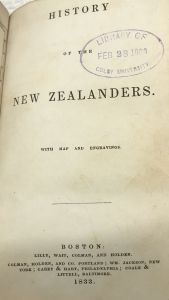
The first interesting, and not at all surprising, discovery is the location of the book’s publishing. The publishers are from New England, the main publishers being Lilly, Wait, Colman, and Holden in Boston. Interestingly enough, the book was published seven years before New Zealand was annexed by England, so by the time of its release New Zealand was still autonomous.
 From what I can tell, the contents have been gathered through first-hand interactions with the native folk or through stories from those that visited the islands before the publishing of History of the New Zealanders. The text itself was written by Western folk for Western eyes and contains anglicized views of the native population. Before the text even starts, there is an ADVERTISEMENT that praises the author and his (I’m assuming its a man) character and intellect and his ability to present “practical views of the human character, in the savage and civilized state”. Some of the phrases have been outdated, specific terms such as “savages.”
The text is nothing fancy. It is all typed in a plain font with no change throughout. Because it is a historical and informational text, there was no reason to use a flashy font.
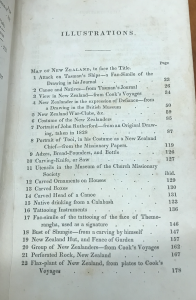 There are 46 illustrations throughout the text that give depictions of the people of New Zealand and their lives, homes, tools, etc. All of the images are listed at the beginning of the book with their captions and page numbers. The images are prints, but some came from specific sources and have been in circulation before the printing of this book. For instance, one image is listed as “Canoe and Natives – from Tasman’s Journal.” I have yet to discover who Tasman was, but he seems to be quite notable because a fair amount of images have been pulled from his journal.
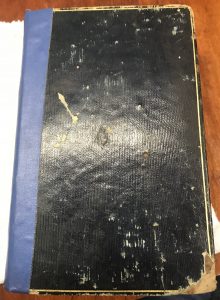 Despite its age, the book is in surprisingly good condition. The pages have a few stains, perhaps from water damage or foxing, but there are no tears. The black-cloth cover is fairly worn and the spine has been mended with blue tape, but overall it has aged well. On the cover, there is neither a title nor an author. The only embellishment is a thin gold frame along the edge. The tape on the spine arouses many questions. First of all, it makes me wonder whether this is the original binding. I wish it were possible to see the spine. I believe that if this is the original binding, the title and author would be printed there for all to see.
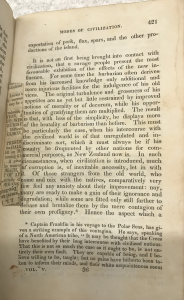
In addition to mysterious tape on the spine, I noticed a few other odd physical aspects as I perused through the book. Firstly, there were a few differently sized pages. The different sizes of paper don’t embellish the book in any way, so I suspect that the reason for the difference was simply an error in printing. Also, I noticed a small clipping inserted bookmark-like near the end of the text. The clipping itself seems to be from a different text, but it is difficult to decipher what it says. Determining where it came from would likely give insight to who one of the previous owners of the book may be.
Even though I’ve learned so much already, there are still so many things to be discovered. Each trip to Special Collections will grant me a deeper insight into the life of this edition of the History of the New Zealanders. As I delve deeper into the annals of the book, I look forward to each discovery.