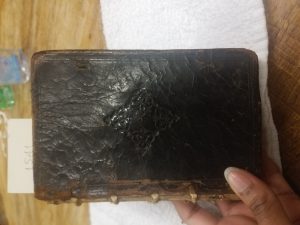
The copy of the castell of helth that I chose for my pet book project was published circa 1541. As a book that is over 400 years old, this book has been passed down through numerous owners and shows signs of use and wear over time. Every page of the book is dotted with evidence of foxing, a clear indicator of the book’s age. However, much of the history of the use of this book seems to lie within its binding. On the surface of the covers of this book there is evidence of both accidental and deliberate damage to this text. On the inside of the covers are marginalia that tell the story of its ownership.
The marginalia in this book comes in the form of handwritten text. There are many examples of handwritten text inside the covers of the castell of helth. Most of the handwritten text seem to be names, signatures or dates- all evidence pointing to numerous owners of this book. It is safe to assume that this particular copy of the castell of helth has been mostly shuffled from one personal collection to the next. The signatures in the book indicate individual owners rather than the text being a part of some public facing collection such as a library. This assumption falls in line with many other aspects of the book. For example, despite being a medical text, the castell of helth is relatively small. Contemporary medical texts tend to be much larger than the average book. The small size of the castell of helth suggests that this book was designed with the intent for personal use. It is easy to slip this book into a large pocket or small bag and carry it around as an everyday reference tool. The content of the book itself is very much of a personal nature as it is focused on medicinal practices and activities that an individual can carry out daily to improve their health. At the time that Thomas Elyot published this text, information on healthy living was accessible only to those who had access to higher education. Despite health being a highly personal topic, not many people knew how to approach their personal health. The castell of helth made this information more accessible to the general public. All this evidence points to a text that was meant to be owned and frequently used by a single individual. It is also interesting to note that despite the numerous writings in the cover of the book, there is no sign of handwritten marginalia on the pages of the book. This suggests that this text was coveted enough to purchase for personal use but was perhaps too valuable to line the pages in handwritten notes.
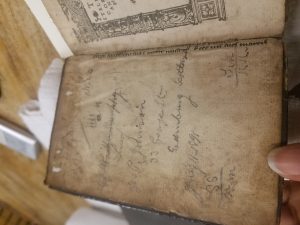
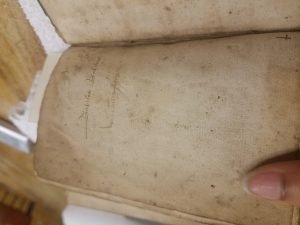
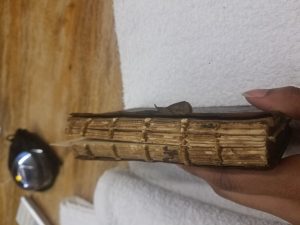
In addition to the marginalia there are also signs of use in this copy of the castell of helth through the obvious wear (and tear) of the book. The covers and the spine of the binding of this copy especially show signs of use. The binding of the book shows signs of long-time exposure to heat or ‘sunning’. At some point, the book might have been stored in an area where it was often exposed to sunlight, causing the condition of the leather covering and open binding to slowly deteriorate. The binding is so worn that the sections of the book are barely held together. The inside of the covers, along the line of the spine, are lined with a manuscript. This is evidence that at some point someone tried to repair the binding of the book with a manuscript. Using unwanted manuscripts or ‘book wastes’ to bind other texts was a fairly common practice among bookbinders in the 16th and 17th century. It is clear that at least one of the owners of this text, found the book important enough for the binding to be repaired.

The most peculiar thing regarding use of this book has to be the small hole that runs all the way from the front cover, through the pages and to the back cover. It’s hard to make an informed assumption about how this hole ended up in the book but it’s clear at some point something small and quite sharp pierced through it. The hole in the text seems to have been made deliberately as it runs through the center of the book, starting right in the middle of the design printed on the front cover. The front cover is fairly plain except for a single rhombus shaped pattern that seems to have been stamped into the center of the book. The puncture goes directly through the center of this rhombus. The position of the puncture seems too perfectly placed to have been accidental.

All this evidence adds up to a text that has a long and interesting history hidden within the various sections of this book. This book has become so worn over time that it is surprising that it has somehow managed to survive for centuries. However, the wear of this book tells the story of each individual who had this book in their possession. The signs of use in this copy of the castell of helth tell the story of this book, beyond the story told through its written content.
References
Materials and Techniques of Manuscript Production. Bookbinding. http://web.ceu.hu/medstud/manual/MMM/bookbinding.html
Atlas Obscura. The Surprising Practice of Binding Old Books With Scraps of Even Older Books. https://www.atlasobscura.com/articles/book-waste-printed-garbage
International League of Antiquarian Booksellers. Book Conservation- Ghosting and Sunning and Foxing, Oh My!. https://ilab.org/articles/book-conservation-ghosting-and-sunning-and-foxing-oh-my