My plan for this project is to take a comic book miniseries I have and bind it into a custom hardcover book. There’s a well established custom binding subculture in comics, and it’s a relatively common practice for turning fragile and awkward single issues into durable and shelf-worthy hardcover books. I’ve become increasingly interested in this in the last few years and saw this as a good way of applying the study of the materiality of books to my own interest in comics.
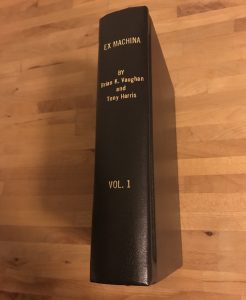
Before I set out to bind these comic books, however, it’s worth examining the history of similar practices. The first example of this is the sammelband, or compilation volume, which is a single bound volume containing many books within it. The practice of making these sammelbände was very common throughout the Renaissance period. These were compiled for a few reasons, the most basic of which is simple cost. A large portion of the cost of buying books was the binding. By waiting and having multiple books bound together, customers could reduce the cost of having all of their books bound. This tradition also led to books being grouped by subject and bound together in topical volumes. These compilations bear some similarity to the books I plan to make, in that they are both compilations of separately published material, but there are also some major differences. The key difference is that the books making up any given sammelband would have needed to be bound in some format or another, and so it becomes cheaper to bind them together. The comics I plan to bind don’t need any binding and can’t really be bound individually, making the decision to bind them more a question of aesthetics rather than economics. (Knight, Jeffrey Todd. Bound to Read: Compilations, Collections, and the Making of Renaissance Literature. University of Pennsylvania Press, 2013.)
The other practice similar to these custom bound comic books is the practice of creating composite volumes of stab-stitched playbooks, as explained by Aaron Pratt. These books were collections of many playbooks that were initially sold as roughly stitched pamphlets. These were made as a way of preserving the fragile playbooks, but the practice was far from universal. For several reasons, these compilations are more similar to the work I plan to do. The playbooks bound in these volumes resemble comic books in that they were often, even primarily, kept in their original stitched form, just as most people who collect comics keep them in boxes in the original stapled format. In both cases, the decision to bind the books together comes from concerns outside of the realm of economics. One difference that remains, however, is that for the most part, the books bound together in playbooks were different stories, bound together out of convenience or some perceived similarity between the works. In the case of the comics I plan to bind together, all six issues are one story, told in six parts. There are certainly times when people bind multiple series together, or even otherwise unrelated issues loosely connected by a common theme, but for the most part, when people bind single issues, they usually have a complete series bound in some number of volumes. (Pratt, Aaron T. “Stab-Stitching and the Status of Early English Playbooks as Literature.” The Library, vol. 16, no. 3, 2015, pp. 304–328., doi:10.1093/library/16.3.304.)