The Holy Spirit, with its pleasureless, functional leather binding is not exactly an eye catcher. The title, A Discourse Concerning the Operations of the Holy Spirit: With a Confutation of Some Parts of Dr. Owen’s Book Upon That Subject, does not roll off the tongue either. However, both the simplicity of the physical object and text’s name indicate the book’s purpose. It is not meant to be boasted about or pridefully displayed. The Holy Spirit is a concise, serious text intended to stimulate Christian thought in a time when Christianity was cutthroat, rigid and uniform. It represents that, in an authoritative religion that urges people to wholeheartedly conform to sacred texts and directions, jurisdiction can be challenged.
William Clagett’s 1680 discourse regarding another book by a man referred to as Dr. Owen has a clear intended audience: individuals interested in Catholic notions, teachings, and practices. The book seems to be somewhat controversial granted that The Holy Spirit was written entirely directly addressing the work of another author. Since Clagett was a preacher, one can easily infer that the text is aimed towards Christian readers of the time. The book was bound and likely wholly produced in London, which was presumably an epicenter for Christianity and Catholicism in particular during that era. However, the subject matter is not conventional; Clagett addresses and refutes the argument of another Christian leader. Given the unorthodox nature of the content, the work probably attracted more progressive, educated or intellectually inclined Chrtistians who seeked knowledge beyond purely what was spoken to them by priests. It is doubtful that, given the physical size of the book, it was created to be used in school, though. As a compact, uncomplicated, nearly lackluster piece, The Holy Spirit does not fit the mold for a textbook, nor a text used in church. It could have been formulated in this way for portability, and discretion. This assumption is based on Clagett’s reputation as an unorthodox preacher in addition to the book’s physical attributes.
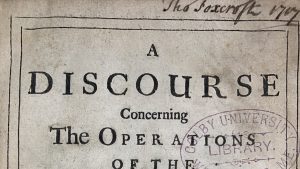
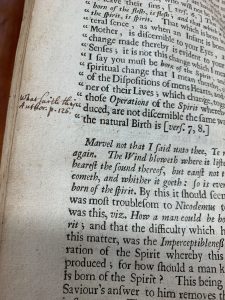
With regards to pricing and production costs, the book offers a fair amount of hints. The book’s owner for whom it was printed, Henry Brome, was probably affluent having been able to afford to privately print the text. As described in a previous post titled “Origins of The Holy Spirit,” Henry Brome and a relative of his purchased numerous products from the company that printed the book. Having purchased works that may not be conditionally considered essential like a Bible or prayer book from a private printer, Brome was probably wealthy. It is possible that this book could have been viewed as a luxury, even. Regardless, it was not mass produced, which illustrates that it may not have been particularly desired, politically correct, or seen as a necessity. The multiple names inscribed in the book suggest that it had multiple owners, but it lacks clues as to why it may have been sold or given away. In fact, the annotations throughout it imply that it was well loved by its owner(s). That is just one of many unanswered questions the publication presents.