
When I was first introduced to biology, I was captivated by it as the science of life. A younger version of myself could imagine nothing more essential to combating death and disease than understanding the central dogma and the complex choreography of proteins within and beyond a cell. Lately, my exposure to biochemistry has completely reshaped that view. I’m learning that simply grasping the organization and function of a wide array of cells and organelles isn’t enough. Within every cellular process exists a world of physical and chemical principles, and it’s an understanding of those molecular details that imbues one with the power to both understand and manipulate life itself. A key example of this we’ve explicitly gone over in class is the concept of rational drug design and the importance of understanding protein structure.
Take for example, our discussion of enzyme inhibitors. Imatinib is a drug that essentially revolutionized treatment for chronic myeloid leukemia. Drugs like Imatinib aren’t discovered through coincidence (as might be the approach of serendipitously discovering that a certain compound is upregulated within a disease, and working back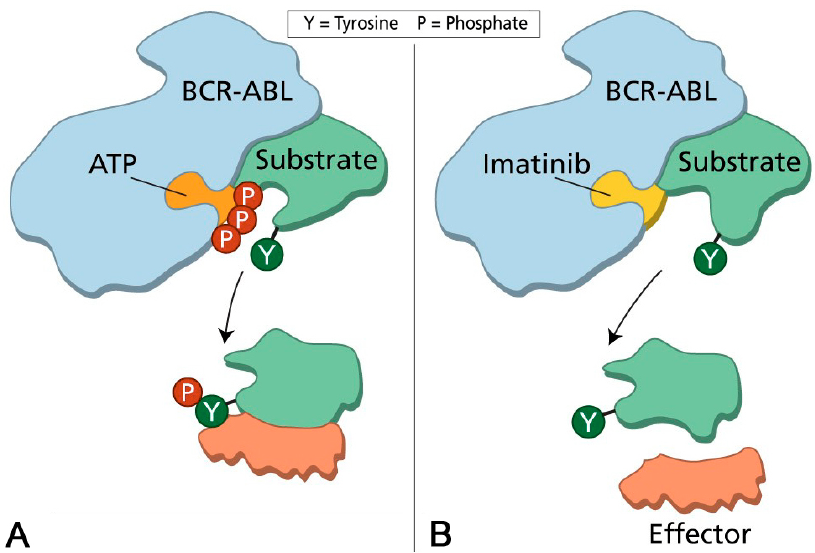 wards to design an agent that downregulates its expression). Scientists studied the 3D structure of the BCR-ABL protein and were able to design a drug that lodges itself in the ATP-binding pocket of the ABL kinase domain, locking it in its inactive conformation. This work, a product of a concrete biochemical understanding of disease, has been key in boosting overall 10-year survival rate for CML patients by more than 80%.
As someone with a wide variety of interests within the of biology who strives to make a foundational impact in an underexplored terrain, it’s clear that there is no field more fundamental than Biochemistry, the very field that ties it all together.
Your reflection is very detailed and well researched. I found your explanation clear and a good real-world applied example of our in-class discussion (and just how complex drug development can be!). If there are any other examples of drug development you find particularly interesting, I’d love to hear about them 🙂
This reflection was really thoughtful – and I related to your captivation. I was particularly engaged by the example of rational drug design for 5-FU in class because this past summer, I shadowed a dermatologist, where I saw it prescribed for actinic keratoses. This lecture pieced it all together for me, allowing me to fully grasp the “Trojan horse” enzyme inhibition which blocks the DNA synthesis of cancer cells.
I’m really enjoying reading your reflection, which is engaging and clear. The example of Imatinib was a great way to show how understanding protein structure can directly lead to new treatments. I also liked how you explained the difference between random drug discovery and rational drug design—it made me appreciate how much detailed biochemical knowledge goes into developing modern medicine. Your reflection reminded me why learning about enzyme mechanisms and inhibition is so important, not just in theory but in real-world medical applications.