What is Head Start? How did it start? Why is it important?
Head State is a locally operated, federally-funded program that provides early childhood education to low-income children before they enter the k-12 school system. Local non-profits such as Urban League run the day-to-day operations of the program. Under this non-profit, the Head Start program at Jacksonville, Florida was left to ruin with an unsafe environment, abusive teachers, and low test scores. At this time, the school test score were in the lowest 10 percent in the nation. Today, it now has scores that approach the national average. What caused this drastic change in student achievement? Revitalizing their Head Start program. The federal government stepped in to replace Urban League with Lutheran Services Florida to provide higher quality teachers, safer classrooms, and rising test scores. With this change in leadership, Florida’s test scores are approaching the national average.
This is only one story that represents the overall improvement of the Head Start program in recent years. When Head Start was first created in 1965, it was “an eight-week long summer program that aimed to prepare low-income children for kindergarten in the fall, provide them with medical and dental services, and help parents improve their home environment.” Policymakers saw the great strives that needed to be made to provide adequate resources to needy students, and they began gathering federal funding for these programs. It is widely known that students who attend quality pre-k programs lead to higher test schools once those students attend school. Researchers have found that with the higher projected income and diminished likelihood of incarceration of students who attend a quality pre-k program, every dollar invested in quality preschool could generate a two-dollar return. Today more than $7.8 billion is allocated to Head Start and the program serves 927,275 children nationwide.
Amazingly, Head State has generally held bipartisan support. Under the Trump administration, Head Start’s budget has increased by $900 million. There was contention between the two major political parties when studies emerged in the early 2000’s that suggested that the impacts of Head Start were short term, but they came to the bipartisan solution of requiring “periodic audits of classroom quality, with groups in the lowest 10 percent forced to compete to keep their grants.” In the first four years of this new implementation, about 120 of those programs lost all or part of their grant. Many places, like the earlier example of Jacksonville, Florida, have noted the risk and made the proper adjustment to increase test scores to prevent the loss of funding. While some question the morality of a program that helps children in poverty losing their funding over a single violation of unrelated regulations, the public can agree that our children deserve safe, healthy learning environments to set them up for the best future possible.
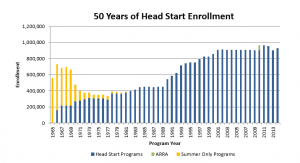
Since its creation, the Head Start program has served thousands of children in poverty. This graph as shows the stagnation of enrollment once the federal government began cutting funding for programs that were not safe or producing competitive test scores.
Post by: Amber Churchwell