Observations
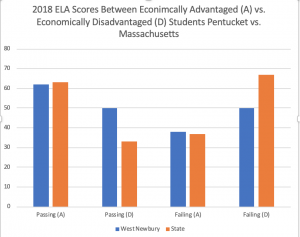
After observing the ELA test scores from 2018 between 3rd graders from my (Justin) local public school and the state of Massachusetts, we have come to the conclusion that the local elementary school, overall, is performing better than the state as a whole. Both groups of students that we observed, economically advantaged and economically disadvantaged, that attended the Page School performed better than their counterparts on the state level.
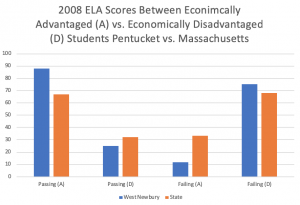
There is an achievement gap for both the local elementary school and the state between the groups of students. The local elementary school is doing a better job with the achievement gap, which shows the gap of failing students only falls in at 12 percentage points, as compared to the state, which has failing rates between the two groups at almost 30 percentage points. We think a main factor as to why the local public school’s achievement gap is lower is because the percentage of economically disadvantaged at the local public school is lower when compared to the amount of economically disadvantaged students at the state level. According to the School and District profiles, the local public school has a total of 6 economically disadvantaged students, as compared to the 26,103 in the rest of the state. We believe it becomes an easier task to combat the achievement gap between these two groups of students when only a small number of students need extra help and special attention.
2008 to 2018: Changes
After this, We observed the same demographics and same test, except we used test scores from 2008 to view the changes in the achievement gap. The state as a whole saw similar trends in the achievement gap over the 10 year period, which shows similar passing and failing rates for both sets of students between 2008 and 2018. What surprised us was the change that the local school district saw within the 10 years. 90 percent of advantaged students passed, while only 25 percent of disadvantaged passed, which is a gap of 65 percent, one of the largest that we had seen. While passing rates dropped drastically in 2018 for non low income students, down to 62 percent, low income students saw their passing rates double, up to 50 percent. The Pentucket school district managed to close the achievement gap by 53 percent, leaving only a 12 percent difference in performance between low income and non low income students. One possibility to the decrease in test scores in 2018 at the local public school could be due to a change in principal in 2010. It’s difficult to call this decrease in the achievement gap a success, because part of the decrease is due to a group of students underperforming, but the improvement that is displayed between the 2008 and 2018 economically disadvantaged students is incredible, and deserves recognition. The question that leaves us with is how do we close the achievement gap while improving test scores for both groups of students?
Solutions
If the rest of Massachusetts wanted to follow suit to decrease the achievement gap in the same way that the local public school did, schools should start providing all students with after-school programs to increase the number of students being actively engaged. This would go a long way to decreasing the gap. These programs reinforce the academic concepts students are learning inside school. When a student is able to take the academic concepts they learned in class and apply it in a new environment it reinforces the concepts they are learning. This is easier to do when the child comes from a financially stable family, because they are able to pay for these extend services. However, for students in financially unstable situations summer time and school breaks often cause a halt or even decrease in academic comprehension because the curriculum they learned before is not being utilized anywhere else but within school.
According to researchers at Johns Hopkins University, it is believed that two thirds of the achievement gap can be contributed to the lack of summer extracurricular activities available to low income students. This show that extracurricular activities have a serious effect on the potential success of a child. For the state of Massachusetts to improve their achievement they need to work on making extra curricular activities more available to low income students outside of the classroom. It is important that stimulation and learning is encouraged outside the classroom because these program can help bolster student test scores. According to research 3,000 ethnically diverse elementary and middle school students improved their test by 12 to 20 percentage points because they consistently attended a quality after-school program.
Currently, I (Justin) have a cousin attending the same public school I (Justin) attended, who participates in afterschool programs, due to his parents being occupied by work until the late afternoon. In this program he receives help on his homework and is often encouraged to read for pleasure. If more program like these were available at public schools students would struggle less in school and would improve state test scores.
Written by:
Justin Alvino and Talon Logan