The achievement gap is a widespread problem in the United States, and it can be witnessed in schools across the nation. I will be exploring the achievement gap in my own school district. I grew up in Falmouth, Maine, and I attended the public school system in Falmouth and I will be exploring the extent of the achievement gap at Falmouth.
Maine is the second whitest state in the nation, behind Vermont, with white people making up 95% of the population. The Falmouth High School, or FHS, student body reflects this large proportion of white students. FHS serves 695 students, 93% of which identify as white. Asian students are the second largest group, coming in at 5%, while Hispanic and Black students account for 1% each of the entire student body.
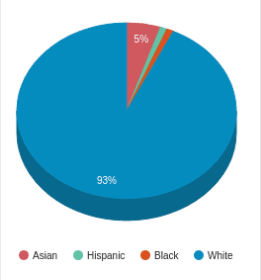
Racial Makeup of Students at Falmouth High School. For more information about FHS, click here.
Falmouth, a suburb of Maine’s largest city, is also known for being quite affluent, especially in comparison to the rest of the state. This is evidenced by the the fact that only 2% of FHS students qualify for free lunch, compared to the 40% of students in Maine public schools that qualify. Additionally, FHS is a high achieving school. Falmouth High School is ranked within the top 1% of all 525 schools in Maine (based off of combined Math and Reading proficiency testing data) for the 2015-16 school year. In 2018, FHS was named a Blue Ribbon School. The Blue Ribbon designation is given by the government to honor schools that have “achieved high levels of student achievement or made significant improvements in closing the achievement gap among student subgroups.” Given this context, I assumed that the achievement gap would not be present in FHS. However, the data reported by The Maine Assessment and Accountability Reporting System (MAARS) showed that there is still a gap between white students and minority students.
The most shocking gap was between white and black students. In 2017, 78.42% of white students met or succeeded state expectations in English Language Art/Literacy, whereas only 50% of black students met or surpassed the same expectations. This represents a gap in achievement of over 28%. The gap was smaller between Latino and white students, and Asian and white student on the same assessment. Latino students lagged behind by 9.67%, while only 3.74% less Asian students reached the same standard. (If you want to explore this data more, you can do that here).




Test Score Breakdown for English Language Arts and Literacy at Falmouth Schools in 2017, based on Race
There is also a gap in achievement between female and male students. The Maine Department of Education reported that for the 2017-2018 school year, 83.24% of female students scored at or above state expectations, while only 72.29% of male students reached or exceeded the same expectations.

Test Score Breakdown for English Language Arts and Literacy at Falmouth Schools in 2017, based on Gender
One particularly interesting piece of data related to the gap in achievement between white students and asian students in mathematics. Herein, 71.55% of white students met or surpassed state expectations, as opposed to 82.28% of Asian students. This statistics is interesting because typically, in the achievement gap, white students are the ones who perform better than minority students.
Although there is a gap present between white and minority students, I do not think it is a fair assessment because of how few minority students there are at Falmouth. However, I think the gap at Falmouth is probably less significant in comparison to other schools, given its high quality of teaching, its high socioeconomic status, and its recent designation as a Blue Ribbon school.
Post by: Grace Connolly