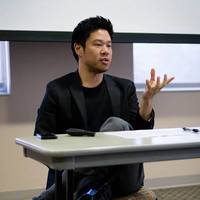
Se Young Kim, who goes by Seth, was born in Seoul, South Korea. Both his parents are from Seoul, but both his parent’s families are from North Korea originally. When he was an infant, his family moved to the U.S. His family lived in the U.S. until he was fourteen, when they moved back to Seoul. They lived for a year in Seoul and then moved to a city in Southern South Korea. Seth attended middle and high school and South Korea. He then attended university for a year before serving in the South Korean military. After finishing his military service, Seth finished university and then taught English in Korea. He moved back to the U.S. and attended the University of Iowa’s cinema program. Seth Kim is currently a professor in the cinema studies department and is working on research regarding Asian media violence and techno-orientalism.
Marian Searby is a Senoir History Major and Cinema Studies Minor at Colby College. This interview highlights the intersection between my academic interests regarding the history of Korea and the way that it is culturally and historically important for understanding bias and patterns within the media industry today.
Marian: If you could say your name just so I have it on the record and for the oral history.
Seth: I’m Se Young Kim. I go by Seth generally.
Marian: And where were you born?
Seth: I was born in Seoul, Korea.
Marian: Where are your parents from and could you talk a little bit about their background?
Seth: My parents were both born in Seoul. I could be wrong on this, but I know that my mother’s family is actually from North Korea and so they emigrated around the war. I think I remember hearing that my father’s family was also from North Korea, but that’s the part that’s a little bit more iffy, but I also know at some point that they were from Guangzhou.
Marian: What was your experience like growing up in Seoul and how long did you live in Seoul for?
Seth: So, I was born in Seoul and then we came to the US when I was seven-months-old, and then when I was 14 we moved back [to Korea]. We were in Seoul for about a year when I was 14, and that was when I did the last year of middle school, which is about the ninth grade in the US, and then we actually moved to the south of the country, but that one year in Seoul was, so this was 1995 I believe, it was different, it was very hectic. You know, in the US my family spoke Korean, we ate Korean food, we behaved like a Korean family. I knew some of the things to expect, but it was a really big cultural shift in a lot of ways. Mostly around what school was like, but even just socially and a lot of the time and how I spent it. I think most of it had to do with the fact that we were in a city as opposed to, when I was growing up, I was in Delaware, so most of the time was spent around the neighborhood at other kids’ houses. When we had bikes, we would kind of roam about the neighborhood a little bit more. So go to local restaurants, bike over to McDonald’s, video game/movie rental place, that kind of thing. But when we moved to Seoul, now that I was in the city and public transportation was so readily available. I just remember being really, really, really mobile and really kind of seeing a lot of the city on my own just entire day. So that was a big shift.
Marian: What were kind of the differences in your schooling in the US versus Korea?
Seth: School was really intense in Korea. And whenever I talk about education, I do think it’s really important to frame it not so much in oppositional, but kind of on a spectrum, and what I mean by that is that it’s easy to hear about what South Korean and, let’s say, Japanese or even places like Taiwan, what education was like, especially when I was growing up, so in the 90s and 80s, and sort of slot it into this kind of easy framework where it’s so much more terrible, it’s so much worse, the US is so much better and more progressive. But having spent a good deal of time in both education systems, there are some really key specific differences. But I think on a structural level, much more similar than not. As a 14 -year-old, it was really difficult adjusting for a number of reasons. The key being the sort of strict standards across the board, but that we had to wear a uniform. We had to have our hair cut a certain length. And that was a really formative kind of memory for me was that whole transition, the whole year, was very difficult. But when I remember going to the salon and they’re just chopping off all my hair, and it’s basically like a crew cut or a buzz cut, which kind of gestures to sort of broader, I think, things about Korean history. And I just remember just being just this 14 -year-old, just so, so sad. I don’t remember if I cried in the chair, but I certainly cried afterward. And then the fact that it was an all-boys school, and that was very difficult at that age. And I remember in, you know, adolescence, and that year when I was 14, just having so little interaction with girls my age, that was very difficult. I think that kind of speaks to the sort of fabric of the country and what young people and children and teenagers and how their lives are kind of structured. And then the other big thing was, of course, was that there was still corporal punishment at the time, so we were getting regularly hit in school. And I think that’s one of those things that people hear, and they think that it’s sort of—and it is—it’s a terrible, terrible, terrible thing. But I also think it’s important to, you know, try and understand it from the perspective of people that lived it as opposed to, you know, just kind of the sort of comfortable distance, whether it’s historical or geographically. Then the days were just structured differently, so school went on longer. I can’t remember when, but I don’t think the school day ended at 3pm. And then there was school on Saturdays. All of that stuff was very, very difficult.
Marian: Especially moving at such a young age back to Korea, how did that impact socially how you transitioned to living in South Korea?
Seth: I mean, and this is what I say funnily enough, there were moments definitely in middle school and high school in Korea where I experienced, I think what we could actually call cruelty. One kind of key instance really stands out in my mind where a teacher during class asked me, because she knew that I barely spoke the language and I couldn’t read and I was effectively just kind of filling space. She asked me, “so you grew up in the U.S.?” And I was like, “yes.” And she said, “so you came back with your family?” I said, “yes.” And she said, “your mother is really pathetic.” And I didn’t understand the Korean word for pathetic. I actually went back to my mother and asked her, what does pathetic mean and she explained it. I think about that every now and then, and I wonder how hard that was for her hearing that second hand. Incidentally at my age, you would think that I have these ill feelings towards that. I actually have more baggage and issues about being in the American school system. I think that the mistreatment that I experienced in the U.S. kind of resonates a lot more. That’s just to set up, that I’ve never really fit in anywhere, and that was very difficult. I couldn’t really understand it at the time. But in the U.S., you know, you kind of vaguely understood, “well I’m a racial “other.” my family is different. I’m different in a lot of ways.” And so there was somewhere in your mind you kind of accept it. But it was more difficult going to a country where now you’re with people that look like you and to some degree talk like you, and yet they still know and they still don’t really make any bones about the fact that you don’t fit in. My parents are always very quick to remind me, and this fits into the kind of larger geopolitical history, but I also benefited a great deal from the fact that I spoke fluent English and that when I grew up in the U.S. I think that’s the kind of ambivalence that you always see when you have people from different backgrounds and histories put into a situation together, where I always stood out for better or worse. I think factually a lot of the stuff that I went through was really difficult, but I kind of have fond memories and it was sort of fun also. It’s that weird sort of friction, right, where we all sometimes want to be anonymous, but at the same time, we want to be the center of attention. By hook or crook, and not really because of anything unique to me but so much as just my circumstances, that tended to happen a lot. So kind of like figuring that out at that age, again, I’m just going to kind of pair it with my parents. I think my family collectively look back and we think like things could have gone a lot worse than they actually did.
Marian: What age did you serve in the military, and when did you attend university in Korea or the United States?
Seth: I’ll try and keep it brief-ish, and this is what I mean by the kind of circumstances that you have no control over. I was growing up in Korea at a very particular point in time in a lot of regards, but this was still a time when there weren’t a lot of people, I think, that had spent a great deal of time abroad or in the U.S. The year that I was applying for university in 1998, there were only two programs in the entire country that were accepting special cases of applicants just purely based on English proficiency. That became much more common later. I don’t know what the situation is like now. It’s probably they don’t do it because there’s so many fluent English speakers who have spent time abroad and who have not. Things have changed so immensely, and the system was structured as such where you could only apply to like five places and special cases like this you could only apply to one because my test scores, you know our equivalent to the SAT, I mean the full score out of 400 points, I scored like 140. I basically failed that test because I couldn’t read. For 4 years of school, I basically did nothing in middle school and high school. Purely based on my TOEFL (*Test Of English as a Foreign Language, which is the standardized test to measure the English language ability of non-native speakers who wish to enroll in English-speaking universities.) scores, I applied to this one school. I actually applied to the school that was less prestigious than the other school that had this program because we tried to play it safe and it turned out that I actually got in on a scholarship because I was the second highest scoring between my scores and the interview, which was just kind of hilarious. That first year of college, which I bring up all the time, was the same deal. It’s not like I can all of a sudden understand university level Korean and also it was a big goof. So for the first year, out of a 4 .5 GPA scale, I had a 1.9, and second semester 1.7, so academic probation. The way that the military is structured, and it’s very class based in the sense that such a high degree of high school applicants go to a university or college, I don’t remember the exact number, but it’s in the 80%, I think at least within the last 10 years. For middle to upper class kids that get into college, the general trajectory is that you would do a year, go on sabbatical, or take a break, and then you would do your military service. With working class kids who don’t do that, they would generally go straight out of high school. So they would go around 18 or 19. I went after my freshman year in 2000, December of 2000. I still remember the date: December 26, 2000. I was there until 2003. I think it was March 28 or something around then. There’s a whole story about that which I can or get into or not. The military is this weird thing because it’s a universal thing in the sense that basically every male in the country has to do some sort of version of it. For as ubiquitous as it is, and it’s one of these weird things where afterwards, everyone who’s done it, it becomes this really kind of mundane, banal, boring thing. But for everyone who’s anticipating it, so anyone that’s a teenager, anyone in their 20s, it’s this great source of dread. I think the reality it is both. It’s both of those things. It’s something that’s actually entirely exceptional, that you have no choice and no say in doing two years of military service. It’s kind of nuts in a lot of regards, but it’s also just sort of boring and everyone does it.
Marian: Can you talk more about your experience with the military service and what everyday life was like serving in the military?
Seth: The long and short of it is that there’s a liaison program between the U.S. and Korean military and they call it the “KATUSA” (Korean Augmentation to the United States Army) program. The Korean military gives a certain amount of personnel to the American military. So even though you’re with the Korean military, you’re serving with the American military. And because the US bases in Korea are serving American soldiers, you are privy to certain things and privileges that you would not as a Korean service member. That was highly, highly valued and desired. Because of corruption and such, the way to get into the program has changed. By the time I had to serve, it was a lottery basically. You had to score, there’s a bare minimum cutoff line for this time, scores, another ETS[IKD1] . I’m sure they make a lot of money off all this. But with your scores, you would apply. And then if you won the raffle, you would go. Basically, because of lack of information, what happened with me is I thought I got into the program, but it ended up being that I wasn’t. I only found out in basic training, one of the kind of real sort of like major catastrophic disappointments of my life was finding out that I was in fact not going to the American military, and that I was going to the Korean military. Maybe on some level because of the questions of identity and how I thought of myself and the kind of prestige of being part of the American military for sure. But on the kind of bare bones level, really just about the quality of life. I just remember being kind of utterly devastated. It’s one of those things when you’re going through it, it’s very hard. By the time that I was serving, they had actually phased out corporal punishment. This is one of those things that the kind of paradigm shifts or inversions that I think is hard for people to understand unless you’ve experienced it. You would hear that and you would think, “oh great! now they’re moving towards a more ethical direction because hitting people is terrible.” But, we learned very quickly that psychological torment is far worse than physical. There’s an old Korean adage that goes, “sometimes it’s better to just get hit once and then be over with it.” What that means is that the sort of anticipation of the punishment is sometimes worse than the punishment itself, which speaks to kind of psychological torment and anguish. It was a lot of disciplining in terms of, like [what] you would see in an American context, let’s say in sports where it’s a lot of exercise and jumping jacks. The way that they could twist those things to make them more harsh, that stuff was very, very difficult. Dealing with the incredible hierarchical structure, and this is where a lot of people have written on how that kind of militarism infiltrates everyday life in South Korea. So these questions of power and being at the throes of power and then exercising your power yourself on people that are ostensibly under your care, that kind of stuff was very, very difficult. In some senses, I look back and it’s kind of a wonder that I was able to make it out at all. But I think a lot of that had to do with just kind of, you know, playing the sort of social fabric, those kind of games correctly, getting people to like you, navigating that. A lot of people who, for example, aren’t very social, even antisocial or had, you know, personality problems, or even mental health issues, they did not have a good time. You know, and on the other end, I wasn’t, because of my designation, and I went in as a linguist, I was an office worker. So my days consisted of word processing and PowerPoints. This is why to this day, I’m so adamant and kind of anal about PowerPoint, because of training I got in the military, along with other stuff, and making coffee for officers. There were a lot of things that I realized in the military and I think informed who I am as a person. One of the things that I realized fairly quickly is these organizations, I guess my perspective on institutions in general changed drastically at age 20 because what you think of the military from the outside and then actually being a part of it, that was a really big shift, what you thought of soldiers and especially officers and generals, that changed quite a bit. And then these kind of really complicated questions of national identity, of nationalism, these things really changed, I think, much more subtly, much more, kind of. Because again, especially in grad school and learning about Korean history and thinking about how deep the division is between North and South and what it means to be North Korean as opposed to what it means to be South Korean, especially internationally. Just the kind of cold realization, later, it’s like, “well, what was I actually there for?” I was being taught to kill people on a brass tax level, even though the day-to-day is playing soccer and drinking coffee and goofing off, thinking very deeply about the fact of yeah, but the country’s still technically a war. There was always that possibility. Oh, so I think this would probably be of interest. I was actually serving when 9/11 happened, and I was at the office working late and we came down at 10 o ‘clock, which it was already lights out and everyone should be asleep, but everyone, the entire company was awake and everyone was watching T.V. and was those first news reports about the towers being hit. There was just that, the same way here domestically when that kind of period of time, when no one knew what was going on, for us there was the similar sort of moment where we were only half joking, but the possibility that this was actually North Korea because if that were true, that meant that we were going to war. By the time that I was finishing up, that was when the U.S. was planning the invasion of Afghanistan and Korean soldiers were going to be sent over as well. I was such a different person 20 years ago that I was even kind of entertaining the thought of joining the effort. I mean, thankfully, because I had no plan on becoming an NCO and my time was up anyway, that kind of saved me having to have harder conversations with myself. That was what was going on at the time.
Marian: After your military conscription, did you stay in Korea? When did you move back to the United States?
Seth: I was in Korea about four more years. I had to do five years of college because I was such a screw-up. At some point, I decided to do grad school for all the wrong reasons that a lot of people go to grad school for, which was, I didn’t want to get a real job, and my dad was an academic, and I figured, “I like movies, so I’ll do that.” But in the meantime, I started teaching English as part of the giant, enormous, gargantuan private education industry. In hindsight probably to a certain degree, but not as much as 20 years ago or 15 years ago, it was relatively easy for me to find employment, even though I had no training as a teacher and educator, but just the fact that I had fluent English. Because conversational skills were really kind of poorly lacking in the country, and a lot of people were looking to kind of bolster that, I was able to find gainful employment, you know, straight out of college, making pretty good money for at least like a 26 -year-old, 25-year-old, for about a year and a half. First round of graduate applications didn’t work out. You know, I regrouped and tried to take it more seriously, and then second round went pretty well, and that’s when in 2007, I came back in fall, or summer-fall, for grad school.
Marian: You kind of answered it a little bit, but can you talk about how you got interested in media and cinema, and how your personal background has shaped that interest?
Seth: Yeah, I mean, some of my earliest memories are all film-related, and it was mostly because my dad was just such a movie fan, and my efforts to bond with him at an early age, because I was an only child, or I am an only child, rather. I would always try and get him to take me with him to the movies. That developed into a kind of I mean I was an only child, growing up I was never terribly active there was a brief kind of period I guess in my early-teens, but I always liked things like movies and comic books and video games and television more than going outside honestly. Then in high school I had that kind of period where it starts to tip over from kind of casual viewing into a little bit more intense. I’ll say this with some shame – I never kind of grew into a full blown cinephile like a lot of the people that I know and admire and respect and it’s been a detriment to my work. I was more of kind of like a genre film fan and just watching a lot of stuff. Then around my early 20s, mostly through my dad again, that was the brief interest in what we could kind of call art cinema. Then I started thinking a little bit more seriously about it, started to become more interested in what was going on. I was lucky enough that was the period right when I was kind of becoming a young thinking person, I suppose. A lot of like Korean cinema was really, really exciting during that period. So just by hook or crook, I was kind of getting interested exactly when the films were getting interesting. And it just seemed the most obvious that was the thing that interested me most. I wasn’t really interested in literature. Or even I mean studying comic books, I think at the time, or video games I think was out of the question. Film was the only thing that I think I could do that I was somewhat interested in kind of take seriously. I was really lucky in that regard.
Marian: Can you talk about your experience in higher academia and your trajectory through higher academia and especially with the study of cinema and video games especially? How has your experience been at other schools and at Colby?
Seth: I think it’s very similar to how I think about the kind of trajectory of my life where you know ultimately as a subject in history and really kind of at the mercy or grace of the circumstances. And what I mean by that is that it just so happens that you know in the same way that like I was starting high school right around the financial collapse. I started grad school just a year before the housing collapse in the U.S. and both of those moments have become kind of incredibly important for my research. My research, in turn, is entirely related to why my life played out the way that it did. And I think, you know, thinking about other people’s lives. But in what I mean by this is that I did my PhD work at the University of Iowa. The University of Iowa is important for film studies because it was the first program in the U.S. to do so. That first generation of students, a lot of the kind of ground work for American film studies, a lot of those really important researchers, were all students of Iowa. And yet in 2010, or 2009, I think, because of the recession, the University hired an outside committee to see where they could cut costs. The only program or department that was actually put up on the chopping block to get rid of entirely was the cinema program. The only reason that it persisted is because there was a ground swell of international support where it’s like, “how could you get rid of this storied and important department?” I feel like anyone that’s working in the humanities, especially well, let’s you know, broader working in academia in the last, not just, you know, 15 years, but I think 20 years, is working in the shadow of, you know, the 2008 collapse and I think even more importantly, or comparably importantly, no child left behind, and the sort of change in education in the U .S. in general. And now of course, it’s I mean, you can tell I’m a humanities person, not a physics person or a science person, because I know there’s some sort of concept where it’s the idea of like expounding energy and that’s how I think about it. I think that’s where like a Hot Wheels car on a track where every time it passes a gate it starts to gain speed and that’s how it feels where it’s, you know, no child left behind, 9/11, housing collapse, and now COVID. I feel that it’s very difficult. It seems that the value of higher education are at large, but certainly of the humanities and the liberal arts it’s just not self-evident to people, and it should be, and across the board from students to faculty to staff to administrators to whomever, I just don’t think things are easy. And I think it’s not easy because and you know, look at what’s happening to primary school teachers in the country. How difficult it is to teach in general in this country. And a lot of that’s just because it’s hard to teach in the best of circumstances, but when you’re trying to do something that other people generally kind of undervalue or even actively undermine, it becomes even harder. So, you know, I constantly look at the students and I can’t imagine what it’s like for them, you know, if it’s this hard for us.
Marian: Can you talk about the central focus of your academic work and where you see your research going in the future?
Seth: Yeah, my parents, they frequently, when they talk to me, they bring up this Korean idea of people fortune. And what that means is this idea that there are people who have it and are just very lucky in terms of meeting people. But I think what’s critical to that idea, and they’re the ones that point this out, is that it’s not some sort of mystical, kind of metaphysical quality. It’s also just the idea that some people put in a lot of work towards relationships. I’ve been very, very lucky to have not just one mentor, but several mentors. Steve Cho was my mentor at Iowa and whom I absolutely loved to death. Steve always put it best, where he would say in class, “We need a better way to be with one another.” I think in the broadest sense, my work stems from this experience of exclusion. I did grad school in Ohio and Iowa, and now we’re in Maine. And I was in Nashville before that. When I talk about experiences of everyday racism, it’s very easy for people to say, “Well, that’s because you’re in Maine. That’s because you’re in Iowa.” As if that kind of thing doesn’t happen in metropolitan areas. But that’s why it’s important for me, where it’s like, “No, it was terrible in the U.S. and it was terrible in Korea, and things are kind of terrible everywhere.” And so stemming from that, that’s not why I got into grad school. I got into grad school because I wanna talk about movies. But then, you know, when you read the sort of things that you’re being exposed to, it’s hard not to think about their relevance to your life and then how your life intersects and interfaces with other people’s lives. So my research and all of the humanities researchers that I know and admire, all of their research is dedicated to finding out why are things the way they are and how can we be better with one another. The kind of specificity of that is I tend to look at violence across media, especially cinema, television, video games, but really anywhere, you’ll really see that in my second big project. In terms of the kind of big question of violence, well, it’s really simple. If I go back earlier and talk about, you know, my earliest memories go to Transformers, Star Wars, He-Man, Masters of the Universe – how come from an earliest—from a very early age—children are being exposed to these morality plays where all conflict is resolved with violence on a fundamental level? We can call it action, we can call it justice, but it’s just fundamentally violence. And I think that there’s an ideological function to that. The morality play that we can use violence as a means to end, to “defeat evil people.” There’s a real specific historical and social function to that. And so that’s what kind of my work is about. As far as future projects, I’m still working on this, you know, taking way too long with the book on Korean violence, which situates it, especially within financial crisis. But I think once that’s done, I’ll be moving on. This is where the army experience really comes into the bigger project. It is bigger in scope, in sense. It’s just a bigger undertaking about militarization in the US. Trying to intervene in the kind of discourse that already people are not talking about because our cultural memories are so short. But after George Floyd and Michael Brown, where we had this conversation, a very public conversation about the militarization of the police. I think what I’m trying to argue is that there’s a much more scarier thing going on, where it’s not just that the police are being militarized, but that the general public is being militarized, especially through just our mass culture.
Marian: Can you talk a little bit about techno-orientalism and what this means, especially with your work regarding Asian media and Asian media violence?
Seth: Sure. Techno-orientalism, which was coined by Morley and Robins and works off of [Edward] Said’s Orientalism, is this phenomenon that they identified in, I believe in the ‘90s about the direction, especially of Japanese and European and Neo-European kind of attitudes towards the Japanese, whereas it used to be that East Asians and Southeast Asians were kind of uncivilized and barbaric. But now, because of advancements, and especially in the robotics industry, electronics, and the post-word kind of “miracle,” then now they’re so technologically advanced that they’re now soulless. I think there are a number of key points that are important to techno-Orientalism. For one, it’s the kind of moving signifier/kind of constantly shifting goalposts. And what I mean by that is that you can take something that was a deficit, a supposed deficit or lack, meaning oh they’re not advanced. And you can switch it around. Now they’re too advanced, which goes to show that there’s no logic or reason to the supposed, you know, cause of why there’s a marginalization happening. All that matters is the marginalization. All that matters is that the hierarchy of the supposed west is over the supposed east. We’ll find why afterwards. And that kind of focus on the structure, the logic itself, and then finding the thing that justifies the logic. That dynamic, I think, is really important. And similarly, that’s why I’m kind of always adamant, like my teachers were, that techno-orientalism is differently related, but it’s not the same as Orientalism. And it’s very important that Orientalism was not written about East Asia. It was written about the Middle East. And Said was, as a Palestinian scholar, watching and kind of sussing out the history. And that’s exactly it. As a framework, the history of how Europe and Neo-Europe have thought about that part of the world. And that slots into my work kind of very generally, in the sense that, again, it’s, you know, I’m doing work on Korea by way of the fact that I’m Korean, but so much of it is about the U.S. and so much of it is about Japan, because I’m trying to speak to things that aren’t only particular to South Korea and people of Korean ethnicity or Korean nationality or what have you. And I think that’s the kind of gesture of the humanities is talking about simultaneously both what’s specific, but also what’s general or what’s universal. And so, techno-Orientalism is, to me, no more important or no less important than Korea is or isn’t. These are things that are important as specific iterations of larger phenomenon that go on, so we can use them as examples to learn things about other places, people. I mean, that’s basically the kind of whole lesson of intersectionality that I think a lot of people tend to forget that it should never be at the expense of neither the specific nor the general should be come at the expense of the other. It’s trying to balance those two things at the same time.
Marian: In talking about the humanities theme of PLAY! and still talking about the concept of techno-orientalism, can you talk a little bit about South Korean game culture and the way that intersects with the humanities theme, and also whether you see yourself pursuing further research on this and what that looks like?
Seth: The way that I always talk about the country about South Korea is, and it just sort of follows up what I just said, is that I don’t think that South Korea is a particularly privileged object that demands more study than, let’s say, other parts of the world The way that I think of Korea is the way that I think about most things, is that it’s just a particularly useful example and what I mean by that is that the way that the history of the country has sort of played out makes certain phenomenon that are also present in the U.S. very visible. And what I mean by that, or what I’m kind of gesturing to, is that there has historically been a lot of anxiety about so-called Asian productivity, whether it’s, again, the Chinese Immigration Act in San Francisco, or Japanese kind of the conglomerate and mega companies in the ‘90s and American takeover. And then down to Taiwanese and South Korean students scoring exceptionally well on exams, that kind of thing. But what, and tying it back to my experience as a school child, it’s that the education system is sort of particularly intense, but the kind of central ideas and values is they’re based in the same kind of, fundamental ideas as the American school system. And so, what you see in Korea, I think I would argue is that division of leisure and labor is kind of really intense and really sort of pronounced. And so, if the cliche goes like, “work hard, play hard,” you see that. Koreans, too, what I would say, a sort of deconstructive degree where it’s so intense, and that’s why I think about the violence as well, is it’s so intense it actually raises these sort of key problems that then get us to kind of ask questions about the things that we take for granted, which is the structure of the day and the relationship between leisure and labor. And so, you know, one of the reasons that that first year in Korea was so enjoyable for me and pleasurable was that the ubiquity of arcades, were video game arcades. And then later these internet cafes, like the PC-Bang. But what that meant is that, for as much as schools demanded of children, they also found the way to, you know, basically escape, run away from their kind of responsibilities and to spend hours upon hours in these video game arcades. And again, like playing with the same sort of intensity that they were working. And I mean, game studies as a field is so still young. And I think there’s just, and this speaks to sort of broader issues of the kind of, let’s say, parameters that as much as we would like for, let’s say, academics in the US and academics in other parts of the world to kind of interact, I don’t think it really happens nearly as much as it should. So there’s still a lot that needs to be said about, I mean, let alone Korea, I mean, you know, like think about Japan, about what these countries have done in terms of international game history. But I have so I’ve been stretched in so many directions that at least for the foreseeable future, I mean, it always, I always get seemed to get kind of pulled in. And to be fair, like I pull myself in because, you know, I find this stuff really enjoyable and pleasurable to work on, but nothing necessarily in the pipeline, although again, like mentors of mine are always kind of pushing me to write more on video games, but we’ll see.
Marian: Thank you so much for your time and thank you for contributing to the oral history.
Seth: Absolutely. Thank you so much for having me.
Marian: If you could say your name just so I have it on the record and for the oral history.
Seth: I’m Se Young Kim. I go by Seth generally.
Marian: And where were you born?
Seth: I was born in Seoul, Korea.
Marian: Where are your parents from and could you talk a little bit about their background?
Seth: My parents were both born in Seoul. I could be wrong on this, but I know that my mother’s family is actually from North Korea and so they emigrated around the war. I think I remember hearing that my father’s family was also from North Korea, but that’s the part that’s a little bit more iffy, but I also know at some point that they were from Guangzhou.
Marian: What was your experience like growing up in Seoul and how long did you live in Seoul for?
Seth: So, I was born in Seoul and then we came to the US when I was seven-months-old, and then when I was 14 we moved back [to Korea]. We were in Seoul for about a year when I was 14, and that was when I did the last year of middle school, which is about the ninth grade in the US, and then we actually moved to the south of the country, but that one year in Seoul was, so this was 1995 I believe, it was different, it was very hectic. You know, in the US my family spoke Korean, we ate Korean food, we behaved like a Korean family. I knew some of the things to expect, but it was a really big cultural shift in a lot of ways. Mostly around what school was like, but even just socially and a lot of the time and how I spent it. I think most of it had to do with the fact that we were in a city as opposed to, when I was growing up, I was in Delaware, so most of the time was spent around the neighborhood at other kids’ houses. When we had bikes, we would kind of roam about the neighborhood a little bit more. So go to local restaurants, bike over to McDonald’s, video game/movie rental place, that kind of thing. But when we moved to Seoul, now that I was in the city and public transportation was so readily available. I just remember being really, really, really mobile and really kind of seeing a lot of the city on my own just entire day. So that was a big shift.
Marian: What were kind of the differences in your schooling in the US versus Korea?
Seth: School was really intense in Korea. And whenever I talk about education, I do think it’s really important to frame it not so much in oppositional, but kind of on a spectrum, and what I mean by that is that it’s easy to hear about what South Korean and, let’s say, Japanese or even places like Taiwan, what education was like, especially when I was growing up, so in the 90s and 80s, and sort of slot it into this kind of easy framework where it’s so much more terrible, it’s so much worse, the US is so much better and more progressive. But having spent a good deal of time in both education systems, there are some really key specific differences. But I think on a structural level, much more similar than not. As a 14 -year-old, it was really difficult adjusting for a number of reasons. The key being the sort of strict standards across the board, but that we had to wear a uniform. We had to have our hair cut a certain length. And that was a really formative kind of memory for me was that whole transition, the whole year, was very difficult. But when I remember going to the salon and they’re just chopping off all my hair, and it’s basically like a crew cut or a buzz cut, which kind of gestures to sort of broader, I think, things about Korean history. And I just remember just being just this 14 -year-old, just so, so sad. I don’t remember if I cried in the chair, but I certainly cried afterward. And then the fact that it was an all-boys school, and that was very difficult at that age. And I remember in, you know, adolescence, and that year when I was 14, just having so little interaction with girls my age, that was very difficult. I think that kind of speaks to the sort of fabric of the country and what young people and children and teenagers and how their lives are kind of structured. And then the other big thing was, of course, was that there was still corporal punishment at the time, so we were getting regularly hit in school. And I think that’s one of those things that people hear, and they think that it’s sort of—and it is—it’s a terrible, terrible, terrible thing. But I also think it’s important to, you know, try and understand it from the perspective of people that lived it as opposed to, you know, just kind of the sort of comfortable distance, whether it’s historical or geographically. Then the days were just structured differently, so school went on longer. I can’t remember when, but I don’t think the school day ended at 3pm. And then there was school on Saturdays. All of that stuff was very, very difficult.
Marian: Especially moving at such a young age back to Korea, how did that impact socially how you transitioned to living in South Korea?
Seth: I mean, and this is what I say funnily enough, there were moments definitely in middle school and high school in Korea where I experienced, I think what we could actually call cruelty. One kind of key instance really stands out in my mind where a teacher during class asked me, because she knew that I barely spoke the language and I couldn’t read and I was effectively just kind of filling space. She asked me, “so you grew up in the U.S.?” And I was like, “yes.” And she said, “so you came back with your family?” I said, “yes.” And she said, “your mother is really pathetic.” And I didn’t understand the Korean word for pathetic. I actually went back to my mother and asked her, what does pathetic mean and she explained it. I think about that every now and then, and I wonder how hard that was for her hearing that second hand. Incidentally at my age, you would think that I have these ill feelings towards that. I actually have more baggage and issues about being in the American school system. I think that the mistreatment that I experienced in the U.S. kind of resonates a lot more. That’s just to set up, that I’ve never really fit in anywhere, and that was very difficult. I couldn’t really understand it at the time. But in the U.S., you know, you kind of vaguely understood, “well I’m a racial “other.” my family is different. I’m different in a lot of ways.” And so there was somewhere in your mind you kind of accept it. But it was more difficult going to a country where now you’re with people that look like you and to some degree talk like you, and yet they still know and they still don’t really make any bones about the fact that you don’t fit in. My parents are always very quick to remind me, and this fits into the kind of larger geopolitical history, but I also benefited a great deal from the fact that I spoke fluent English and that when I grew up in the U.S. I think that’s the kind of ambivalence that you always see when you have people from different backgrounds and histories put into a situation together, where I always stood out for better or worse. I think factually a lot of the stuff that I went through was really difficult, but I kind of have fond memories and it was sort of fun also. It’s that weird sort of friction, right, where we all sometimes want to be anonymous, but at the same time, we want to be the center of attention. By hook or crook, and not really because of anything unique to me but so much as just my circumstances, that tended to happen a lot. So kind of like figuring that out at that age, again, I’m just going to kind of pair it with my parents. I think my family collectively look back and we think like things could have gone a lot worse than they actually did.
Marian: What age did you serve in the military, and when did you attend university in Korea or the United States?
Seth: I’ll try and keep it brief-ish, and this is what I mean by the kind of circumstances that you have no control over. I was growing up in Korea at a very particular point in time in a lot of regards, but this was still a time when there weren’t a lot of people, I think, that had spent a great deal of time abroad or in the U.S. The year that I was applying for university in 1998, there were only two programs in the entire country that were accepting special cases of applicants just purely based on English proficiency. That became much more common later. I don’t know what the situation is like now. It’s probably they don’t do it because there’s so many fluent English speakers who have spent time abroad and who have not. Things have changed so immensely, and the system was structured as such where you could only apply to like five places and special cases like this you could only apply to one because my test scores, you know our equivalent to the SAT, I mean the full score out of 400 points, I scored like 140. I basically failed that test because I couldn’t read. For 4 years of school, I basically did nothing in middle school and high school. Purely based on my TOEFL (*Test Of English as a Foreign Language, which is the standardized test to measure the English language ability of non-native speakers who wish to enroll in English-speaking universities.) scores, I applied to this one school. I actually applied to the school that was less prestigious than the other school that had this program because we tried to play it safe and it turned out that I actually got in on a scholarship because I was the second highest scoring between my scores and the interview, which was just kind of hilarious. That first year of college, which I bring up all the time, was the same deal. It’s not like I can all of a sudden understand university level Korean and also it was a big goof. So for the first year, out of a 4 .5 GPA scale, I had a 1.9, and second semester 1.7, so academic probation. The way that the military is structured, and it’s very class based in the sense that such a high degree of high school applicants go to a university or college, I don’t remember the exact number, but it’s in the 80%, I think at least within the last 10 years. For middle to upper class kids that get into college, the general trajectory is that you would do a year, go on sabbatical, or take a break, and then you would do your military service. With working class kids who don’t do that, they would generally go straight out of high school. So they would go around 18 or 19. I went after my freshman year in 2000, December of 2000. I still remember the date: December 26, 2000. I was there until 2003. I think it was March 28 or something around then. There’s a whole story about that which I can or get into or not. The military is this weird thing because it’s a universal thing in the sense that basically every male in the country has to do some sort of version of it. For as ubiquitous as it is, and it’s one of these weird things where afterwards, everyone who’s done it, it becomes this really kind of mundane, banal, boring thing. But for everyone who’s anticipating it, so anyone that’s a teenager, anyone in their 20s, it’s this great source of dread. I think the reality it is both. It’s both of those things. It’s something that’s actually entirely exceptional, that you have no choice and no say in doing two years of military service. It’s kind of nuts in a lot of regards, but it’s also just sort of boring and everyone does it.
Marian: Can you talk more about your experience with the military service and what everyday life was like serving in the military?
Seth: The long and short of it is that there’s a liaison program between the U.S. and Korean military and they call it the “KATUSA” (Korean Augmentation to the United States Army) program. The Korean military gives a certain amount of personnel to the American military. So even though you’re with the Korean military, you’re serving with the American military. And because the US bases in Korea are serving American soldiers, you are privy to certain things and privileges that you would not as a Korean service member. That was highly, highly valued and desired. Because of corruption and such, the way to get into the program has changed. By the time I had to serve, it was a lottery basically. You had to score, there’s a bare minimum cutoff line for this time, scores, another ETS[IKD1] . I’m sure they make a lot of money off all this. But with your scores, you would apply. And then if you won the raffle, you would go. Basically, because of lack of information, what happened with me is I thought I got into the program, but it ended up being that I wasn’t. I only found out in basic training, one of the kind of real sort of like major catastrophic disappointments of my life was finding out that I was in fact not going to the American military, and that I was going to the Korean military. Maybe on some level because of the questions of identity and how I thought of myself and the kind of prestige of being part of the American military for sure. But on the kind of bare bones level, really just about the quality of life. I just remember being kind of utterly devastated. It’s one of those things when you’re going through it, it’s very hard. By the time that I was serving, they had actually phased out corporal punishment. This is one of those things that the kind of paradigm shifts or inversions that I think is hard for people to understand unless you’ve experienced it. You would hear that and you would think, “oh great! now they’re moving towards a more ethical direction because hitting people is terrible.” But, we learned very quickly that psychological torment is far worse than physical. There’s an old Korean adage that goes, “sometimes it’s better to just get hit once and then be over with it.” What that means is that the sort of anticipation of the punishment is sometimes worse than the punishment itself, which speaks to kind of psychological torment and anguish. It was a lot of disciplining in terms of, like [what] you would see in an American context, let’s say in sports where it’s a lot of exercise and jumping jacks. The way that they could twist those things to make them more harsh, that stuff was very, very difficult. Dealing with the incredible hierarchical structure, and this is where a lot of people have written on how that kind of militarism infiltrates everyday life in South Korea. So these questions of power and being at the throes of power and then exercising your power yourself on people that are ostensibly under your care, that kind of stuff was very, very difficult. In some senses, I look back and it’s kind of a wonder that I was able to make it out at all. But I think a lot of that had to do with just kind of, you know, playing the sort of social fabric, those kind of games correctly, getting people to like you, navigating that. A lot of people who, for example, aren’t very social, even antisocial or had, you know, personality problems, or even mental health issues, they did not have a good time. You know, and on the other end, I wasn’t, because of my designation, and I went in as a linguist, I was an office worker. So my days consisted of word processing and PowerPoints. This is why to this day, I’m so adamant and kind of anal about PowerPoint, because of training I got in the military, along with other stuff, and making coffee for officers. There were a lot of things that I realized in the military and I think informed who I am as a person. One of the things that I realized fairly quickly is these organizations, I guess my perspective on institutions in general changed drastically at age 20 because what you think of the military from the outside and then actually being a part of it, that was a really big shift, what you thought of soldiers and especially officers and generals, that changed quite a bit. And then these kind of really complicated questions of national identity, of nationalism, these things really changed, I think, much more subtly, much more, kind of. Because again, especially in grad school and learning about Korean history and thinking about how deep the division is between North and South and what it means to be North Korean as opposed to what it means to be South Korean, especially internationally. Just the kind of cold realization, later, it’s like, “well, what was I actually there for?” I was being taught to kill people on a brass tax level, even though the day-to-day is playing soccer and drinking coffee and goofing off, thinking very deeply about the fact of yeah, but the country’s still technically a war. There was always that possibility. Oh, so I think this would probably be of interest. I was actually serving when 9/11 happened, and I was at the office working late and we came down at 10 o ‘clock, which it was already lights out and everyone should be asleep, but everyone, the entire company was awake and everyone was watching T.V. and was those first news reports about the towers being hit. There was just that, the same way here domestically when that kind of period of time, when no one knew what was going on, for us there was the similar sort of moment where we were only half joking, but the possibility that this was actually North Korea because if that were true, that meant that we were going to war. By the time that I was finishing up, that was when the U.S. was planning the invasion of Afghanistan and Korean soldiers were going to be sent over as well. I was such a different person 20 years ago that I was even kind of entertaining the thought of joining the effort. I mean, thankfully, because I had no plan on becoming an NCO and my time was up anyway, that kind of saved me having to have harder conversations with myself. That was what was going on at the time.
Marian: After your military conscription, did you stay in Korea? When did you move back to the United States?
Seth: I was in Korea about four more years. I had to do five years of college because I was such a screw-up. At some point, I decided to do grad school for all the wrong reasons that a lot of people go to grad school for, which was, I didn’t want to get a real job, and my dad was an academic, and I figured, “I like movies, so I’ll do that.” But in the meantime, I started teaching English as part of the giant, enormous, gargantuan private education industry. In hindsight probably to a certain degree, but not as much as 20 years ago or 15 years ago, it was relatively easy for me to find employment, even though I had no training as a teacher and educator, but just the fact that I had fluent English. Because conversational skills were really kind of poorly lacking in the country, and a lot of people were looking to kind of bolster that, I was able to find gainful employment, you know, straight out of college, making pretty good money for at least like a 26 -year-old, 25-year-old, for about a year and a half. First round of graduate applications didn’t work out. You know, I regrouped and tried to take it more seriously, and then second round went pretty well, and that’s when in 2007, I came back in fall, or summer-fall, for grad school.
Marian: You kind of answered it a little bit, but can you talk about how you got interested in media and cinema, and how your personal background has shaped that interest?
Seth: Yeah, I mean, some of my earliest memories are all film-related, and it was mostly because my dad was just such a movie fan, and my efforts to bond with him at an early age, because I was an only child, or I am an only child, rather. I would always try and get him to take me with him to the movies. That developed into a kind of I mean I was an only child, growing up I was never terribly active there was a brief kind of period I guess in my early-teens, but I always liked things like movies and comic books and video games and television more than going outside honestly. Then in high school I had that kind of period where it starts to tip over from kind of casual viewing into a little bit more intense. I’ll say this with some shame – I never kind of grew into a full blown cinephile like a lot of the people that I know and admire and respect and it’s been a detriment to my work. I was more of kind of like a genre film fan and just watching a lot of stuff. Then around my early 20s, mostly through my dad again, that was the brief interest in what we could kind of call art cinema. Then I started thinking a little bit more seriously about it, started to become more interested in what was going on. I was lucky enough that was the period right when I was kind of becoming a young thinking person, I suppose. A lot of like Korean cinema was really, really exciting during that period. So just by hook or crook, I was kind of getting interested exactly when the films were getting interesting. And it just seemed the most obvious that was the thing that interested me most. I wasn’t really interested in literature. Or even I mean studying comic books, I think at the time, or video games I think was out of the question. Film was the only thing that I think I could do that I was somewhat interested in kind of take seriously. I was really lucky in that regard.
Marian: Can you talk about your experience in higher academia and your trajectory through higher academia and especially with the study of cinema and video games especially? How has your experience been at other schools and at Colby?
Seth: I think it’s very similar to how I think about the kind of trajectory of my life where you know ultimately as a subject in history and really kind of at the mercy or grace of the circumstances. And what I mean by that is that it just so happens that you know in the same way that like I was starting high school right around the financial collapse. I started grad school just a year before the housing collapse in the U.S. and both of those moments have become kind of incredibly important for my research. My research, in turn, is entirely related to why my life played out the way that it did. And I think, you know, thinking about other people’s lives. But in what I mean by this is that I did my PhD work at the University of Iowa. The University of Iowa is important for film studies because it was the first program in the U.S. to do so. That first generation of students, a lot of the kind of ground work for American film studies, a lot of those really important researchers, were all students of Iowa. And yet in 2010, or 2009, I think, because of the recession, the University hired an outside committee to see where they could cut costs. The only program or department that was actually put up on the chopping block to get rid of entirely was the cinema program. The only reason that it persisted is because there was a ground swell of international support where it’s like, “how could you get rid of this storied and important department?” I feel like anyone that’s working in the humanities, especially well, let’s you know, broader working in academia in the last, not just, you know, 15 years, but I think 20 years, is working in the shadow of, you know, the 2008 collapse and I think even more importantly, or comparably importantly, no child left behind, and the sort of change in education in the U .S. in general. And now of course, it’s I mean, you can tell I’m a humanities person, not a physics person or a science person, because I know there’s some sort of concept where it’s the idea of like expounding energy and that’s how I think about it. I think that’s where like a Hot Wheels car on a track where every time it passes a gate it starts to gain speed and that’s how it feels where it’s, you know, no child left behind, 9/11, housing collapse, and now COVID. I feel that it’s very difficult. It seems that the value of higher education are at large, but certainly of the humanities and the liberal arts it’s just not self-evident to people, and it should be, and across the board from students to faculty to staff to administrators to whomever, I just don’t think things are easy. And I think it’s not easy because and you know, look at what’s happening to primary school teachers in the country. How difficult it is to teach in general in this country. And a lot of that’s just because it’s hard to teach in the best of circumstances, but when you’re trying to do something that other people generally kind of undervalue or even actively undermine, it becomes even harder. So, you know, I constantly look at the students and I can’t imagine what it’s like for them, you know, if it’s this hard for us.
Marian: Can you talk about the central focus of your academic work and where you see your research going in the future?
Seth: Yeah, my parents, they frequently, when they talk to me, they bring up this Korean idea of people fortune. And what that means is this idea that there are people who have it and are just very lucky in terms of meeting people. But I think what’s critical to that idea, and they’re the ones that point this out, is that it’s not some sort of mystical, kind of metaphysical quality. It’s also just the idea that some people put in a lot of work towards relationships. I’ve been very, very lucky to have not just one mentor, but several mentors. Steve Cho was my mentor at Iowa and whom I absolutely loved to death. Steve always put it best, where he would say in class, “We need a better way to be with one another.” I think in the broadest sense, my work stems from this experience of exclusion. I did grad school in Ohio and Iowa, and now we’re in Maine. And I was in Nashville before that. When I talk about experiences of everyday racism, it’s very easy for people to say, “Well, that’s because you’re in Maine. That’s because you’re in Iowa.” As if that kind of thing doesn’t happen in metropolitan areas. But that’s why it’s important for me, where it’s like, “No, it was terrible in the U.S. and it was terrible in Korea, and things are kind of terrible everywhere.” And so stemming from that, that’s not why I got into grad school. I got into grad school because I wanna talk about movies. But then, you know, when you read the sort of things that you’re being exposed to, it’s hard not to think about their relevance to your life and then how your life intersects and interfaces with other people’s lives. So my research and all of the humanities researchers that I know and admire, all of their research is dedicated to finding out why are things the way they are and how can we be better with one another. The kind of specificity of that is I tend to look at violence across media, especially cinema, television, video games, but really anywhere, you’ll really see that in my second big project. In terms of the kind of big question of violence, well, it’s really simple. If I go back earlier and talk about, you know, my earliest memories go to Transformers, Star Wars, He-Man, Masters of the Universe – how come from an earliest—from a very early age—children are being exposed to these morality plays where all conflict is resolved with violence on a fundamental level? We can call it action, we can call it justice, but it’s just fundamentally violence. And I think that there’s an ideological function to that. The morality play that we can use violence as a means to end, to “defeat evil people.” There’s a real specific historical and social function to that. And so that’s what kind of my work is about. As far as future projects, I’m still working on this, you know, taking way too long with the book on Korean violence, which situates it, especially within financial crisis. But I think once that’s done, I’ll be moving on. This is where the army experience really comes into the bigger project. It is bigger in scope, in sense. It’s just a bigger undertaking about militarization in the US. Trying to intervene in the kind of discourse that already people are not talking about because our cultural memories are so short. But after George Floyd and Michael Brown, where we had this conversation, a very public conversation about the militarization of the police. I think what I’m trying to argue is that there’s a much more scarier thing going on, where it’s not just that the police are being militarized, but that the general public is being militarized, especially through just our mass culture.
Marian: Can you talk a little bit about techno-orientalism and what this means, especially with your work regarding Asian media and Asian media violence?
Seth: Sure. Techno-orientalism, which was coined by Morley and Robins and works off of [Edward] Said’s Orientalism, is this phenomenon that they identified in, I believe in the ‘90s about the direction, especially of Japanese and European and Neo-European kind of attitudes towards the Japanese, whereas it used to be that East Asians and Southeast Asians were kind of uncivilized and barbaric. But now, because of advancements, and especially in the robotics industry, electronics, and the post-word kind of “miracle,” then now they’re so technologically advanced that they’re now soulless. I think there are a number of key points that are important to techno-Orientalism. For one, it’s the kind of moving signifier/kind of constantly shifting goalposts. And what I mean by that is that you can take something that was a deficit, a supposed deficit or lack, meaning oh they’re not advanced. And you can switch it around. Now they’re too advanced, which goes to show that there’s no logic or reason to the supposed, you know, cause of why there’s a marginalization happening. All that matters is the marginalization. All that matters is that the hierarchy of the supposed west is over the supposed east. We’ll find why afterwards. And that kind of focus on the structure, the logic itself, and then finding the thing that justifies the logic. That dynamic, I think, is really important. And similarly, that’s why I’m kind of always adamant, like my teachers were, that techno-orientalism is differently related, but it’s not the same as Orientalism. And it’s very important that Orientalism was not written about East Asia. It was written about the Middle East. And Said was, as a Palestinian scholar, watching and kind of sussing out the history. And that’s exactly it. As a framework, the history of how Europe and Neo-Europe have thought about that part of the world. And that slots into my work kind of very generally, in the sense that, again, it’s, you know, I’m doing work on Korea by way of the fact that I’m Korean, but so much of it is about the U.S. and so much of it is about Japan, because I’m trying to speak to things that aren’t only particular to South Korea and people of Korean ethnicity or Korean nationality or what have you. And I think that’s the kind of gesture of the humanities is talking about simultaneously both what’s specific, but also what’s general or what’s universal. And so, techno-Orientalism is, to me, no more important or no less important than Korea is or isn’t. These are things that are important as specific iterations of larger phenomenon that go on, so we can use them as examples to learn things about other places, people. I mean, that’s basically the kind of whole lesson of intersectionality that I think a lot of people tend to forget that it should never be at the expense of neither the specific nor the general should be come at the expense of the other. It’s trying to balance those two things at the same time.
Marian: In talking about the humanities theme of PLAY! and still talking about the concept of techno-orientalism, can you talk a little bit about South Korean game culture and the way that intersects with the humanities theme, and also whether you see yourself pursuing further research on this and what that looks like?
Seth: The way that I always talk about the country about South Korea is, and it just sort of follows up what I just said, is that I don’t think that South Korea is a particularly privileged object that demands more study than, let’s say, other parts of the world The way that I think of Korea is the way that I think about most things, is that it’s just a particularly useful example and what I mean by that is that the way that the history of the country has sort of played out makes certain phenomenon that are also present in the U.S. very visible. And what I mean by that, or what I’m kind of gesturing to, is that there has historically been a lot of anxiety about so-called Asian productivity, whether it’s, again, the Chinese Immigration Act in San Francisco, or Japanese kind of the conglomerate and mega companies in the ‘90s and American takeover. And then down to Taiwanese and South Korean students scoring exceptionally well on exams, that kind of thing. But what, and tying it back to my experience as a school child, it’s that the education system is sort of particularly intense, but the kind of central ideas and values is they’re based in the same kind of, fundamental ideas as the American school system. And so, what you see in Korea, I think I would argue is that division of leisure and labor is kind of really intense and really sort of pronounced. And so, if the cliche goes like, “work hard, play hard,” you see that. Koreans, too, what I would say, a sort of deconstructive degree where it’s so intense, and that’s why I think about the violence as well, is it’s so intense it actually raises these sort of key problems that then get us to kind of ask questions about the things that we take for granted, which is the structure of the day and the relationship between leisure and labor. And so, you know, one of the reasons that that first year in Korea was so enjoyable for me and pleasurable was that the ubiquity of arcades, were video game arcades. And then later these internet cafes, like the PC-Bang. But what that meant is that, for as much as schools demanded of children, they also found the way to, you know, basically escape, run away from their kind of responsibilities and to spend hours upon hours in these video game arcades. And again, like playing with the same sort of intensity that they were working. And I mean, game studies as a field is so still young. And I think there’s just, and this speaks to sort of broader issues of the kind of, let’s say, parameters that as much as we would like for, let’s say, academics in the US and academics in other parts of the world to kind of interact, I don’t think it really happens nearly as much as it should. So there’s still a lot that needs to be said about, I mean, let alone Korea, I mean, you know, like think about Japan, about what these countries have done in terms of international game history. But I have so I’ve been stretched in so many directions that at least for the foreseeable future, I mean, it always, I always get seemed to get kind of pulled in. And to be fair, like I pull myself in because, you know, I find this stuff really enjoyable and pleasurable to work on, but nothing necessarily in the pipeline, although again, like mentors of mine are always kind of pushing me to write more on video games, but we’ll see.
Marian: Thank you so much for your time and thank you for contributing to the oral history.
Seth: Absolutely. Thank you so much for having me.
[IKD1]Please double-check the audio on this for accuracy.
Marian: If you could say your name just so I have it on the record and for the oral history.
Seth: I’m Se Young Kim. I go by Seth generally.
Marian: And where were you born?
Seth: I was born in Seoul, Korea.
Marian: Where are your parents from and could you talk a little bit about their background?
Seth: My parents were both born in Seoul. I could be wrong on this, but I know that my mother’s family is actually from North Korea and so they emigrated around the war. I think I remember hearing that my father’s family was also from North Korea, but that’s the part that’s a little bit more iffy, but I also know at some point that they were from Guangzhou.
Marian: What was your experience like growing up in Seoul and how long did you live in Seoul for?
Seth: So, I was born in Seoul and then we came to the US when I was seven-months-old, and then when I was 14 we moved back [to Korea]. We were in Seoul for about a year when I was 14, and that was when I did the last year of middle school, which is about the ninth grade in the US, and then we actually moved to the south of the country, but that one year in Seoul was, so this was 1995 I believe, it was different, it was very hectic. You know, in the US my family spoke Korean, we ate Korean food, we behaved like a Korean family. I knew some of the things to expect, but it was a really big cultural shift in a lot of ways. Mostly around what school was like, but even just socially and a lot of the time and how I spent it. I think most of it had to do with the fact that we were in a city as opposed to, when I was growing up, I was in Delaware, so most of the time was spent around the neighborhood at other kids’ houses. When we had bikes, we would kind of roam about the neighborhood a little bit more. So go to local restaurants, bike over to McDonald’s, video game/movie rental place, that kind of thing. But when we moved to Seoul, now that I was in the city and public transportation was so readily available. I just remember being really, really, really mobile and really kind of seeing a lot of the city on my own just entire day. So that was a big shift.
Marian: What were kind of the differences in your schooling in the US versus Korea?
Seth: School was really intense in Korea. And whenever I talk about education, I do think it’s really important to frame it not so much in oppositional, but kind of on a spectrum, and what I mean by that is that it’s easy to hear about what South Korean and, let’s say, Japanese or even places like Taiwan, what education was like, especially when I was growing up, so in the 90s and 80s, and sort of slot it into this kind of easy framework where it’s so much more terrible, it’s so much worse, the US is so much better and more progressive. But having spent a good deal of time in both education systems, there are some really key specific differences. But I think on a structural level, much more similar than not. As a 14 -year-old, it was really difficult adjusting for a number of reasons. The key being the sort of strict standards across the board, but that we had to wear a uniform. We had to have our hair cut a certain length. And that was a really formative kind of memory for me was that whole transition, the whole year, was very difficult. But when I remember going to the salon and they’re just chopping off all my hair, and it’s basically like a crew cut or a buzz cut, which kind of gestures to sort of broader, I think, things about Korean history. And I just remember just being just this 14 -year-old, just so, so sad. I don’t remember if I cried in the chair, but I certainly cried afterward. And then the fact that it was an all-boys school, and that was very difficult at that age. And I remember in, you know, adolescence, and that year when I was 14, just having so little interaction with girls my age, that was very difficult. I think that kind of speaks to the sort of fabric of the country and what young people and children and teenagers and how their lives are kind of structured. And then the other big thing was, of course, was that there was still corporal punishment at the time, so we were getting regularly hit in school. And I think that’s one of those things that people hear, and they think that it’s sort of—and it is—it’s a terrible, terrible, terrible thing. But I also think it’s important to, you know, try and understand it from the perspective of people that lived it as opposed to, you know, just kind of the sort of comfortable distance, whether it’s historical or geographically. Then the days were just structured differently, so school went on longer. I can’t remember when, but I don’t think the school day ended at 3pm. And then there was school on Saturdays. All of that stuff was very, very difficult.
Marian: Especially moving at such a young age back to Korea, how did that impact socially how you transitioned to living in South Korea?
Seth: I mean, and this is what I say funnily enough, there were moments definitely in middle school and high school in Korea where I experienced, I think what we could actually call cruelty. One kind of key instance really stands out in my mind where a teacher during class asked me, because she knew that I barely spoke the language and I couldn’t read and I was effectively just kind of filling space. She asked me, “so you grew up in the U.S.?” And I was like, “yes.” And she said, “so you came back with your family?” I said, “yes.” And she said, “your mother is really pathetic.” And I didn’t understand the Korean word for pathetic. I actually went back to my mother and asked her, what does pathetic mean and she explained it. I think about that every now and then, and I wonder how hard that was for her hearing that second hand. Incidentally at my age, you would think that I have these ill feelings towards that. I actually have more baggage and issues about being in the American school system. I think that the mistreatment that I experienced in the U.S. kind of resonates a lot more. That’s just to set up, that I’ve never really fit in anywhere, and that was very difficult. I couldn’t really understand it at the time. But in the U.S., you know, you kind of vaguely understood, “well I’m a racial “other.” my family is different. I’m different in a lot of ways.” And so there was somewhere in your mind you kind of accept it. But it was more difficult going to a country where now you’re with people that look like you and to some degree talk like you, and yet they still know and they still don’t really make any bones about the fact that you don’t fit in. My parents are always very quick to remind me, and this fits into the kind of larger geopolitical history, but I also benefited a great deal from the fact that I spoke fluent English and that when I grew up in the U.S. I think that’s the kind of ambivalence that you always see when you have people from different backgrounds and histories put into a situation together, where I always stood out for better or worse. I think factually a lot of the stuff that I went through was really difficult, but I kind of have fond memories and it was sort of fun also. It’s that weird sort of friction, right, where we all sometimes want to be anonymous, but at the same time, we want to be the center of attention. By hook or crook, and not really because of anything unique to me but so much as just my circumstances, that tended to happen a lot. So kind of like figuring that out at that age, again, I’m just going to kind of pair it with my parents. I think my family collectively look back and we think like things could have gone a lot worse than they actually did.
Marian: What age did you serve in the military, and when did you attend university in Korea or the United States?
Seth: I’ll try and keep it brief-ish, and this is what I mean by the kind of circumstances that you have no control over. I was growing up in Korea at a very particular point in time in a lot of regards, but this was still a time when there weren’t a lot of people, I think, that had spent a great deal of time abroad or in the U.S. The year that I was applying for university in 1998, there were only two programs in the entire country that were accepting special cases of applicants just purely based on English proficiency. That became much more common later. I don’t know what the situation is like now. It’s probably they don’t do it because there’s so many fluent English speakers who have spent time abroad and who have not. Things have changed so immensely, and the system was structured as such where you could only apply to like five places and special cases like this you could only apply to one because my test scores, you know our equivalent to the SAT, I mean the full score out of 400 points, I scored like 140. I basically failed that test because I couldn’t read. For 4 years of school, I basically did nothing in middle school and high school. Purely based on my TOEFL (*Test Of English as a Foreign Language, which is the standardized test to measure the English language ability of non-native speakers who wish to enroll in English-speaking universities.) scores, I applied to this one school. I actually applied to the school that was less prestigious than the other school that had this program because we tried to play it safe and it turned out that I actually got in on a scholarship because I was the second highest scoring between my scores and the interview, which was just kind of hilarious. That first year of college, which I bring up all the time, was the same deal. It’s not like I can all of a sudden understand university level Korean and also it was a big goof. So for the first year, out of a 4 .5 GPA scale, I had a 1.9, and second semester 1.7, so academic probation. The way that the military is structured, and it’s very class based in the sense that such a high degree of high school applicants go to a university or college, I don’t remember the exact number, but it’s in the 80%, I think at least within the last 10 years. For middle to upper class kids that get into college, the general trajectory is that you would do a year, go on sabbatical, or take a break, and then you would do your military service. With working class kids who don’t do that, they would generally go straight out of high school. So they would go around 18 or 19. I went after my freshman year in 2000, December of 2000. I still remember the date: December 26, 2000. I was there until 2003. I think it was March 28 or something around then. There’s a whole story about that which I can or get into or not. The military is this weird thing because it’s a universal thing in the sense that basically every male in the country has to do some sort of version of it. For as ubiquitous as it is, and it’s one of these weird things where afterwards, everyone who’s done it, it becomes this really kind of mundane, banal, boring thing. But for everyone who’s anticipating it, so anyone that’s a teenager, anyone in their 20s, it’s this great source of dread. I think the reality it is both. It’s both of those things. It’s something that’s actually entirely exceptional, that you have no choice and no say in doing two years of military service. It’s kind of nuts in a lot of regards, but it’s also just sort of boring and everyone does it.
Marian: Can you talk more about your experience with the military service and what everyday life was like serving in the military?
Seth: The long and short of it is that there’s a liaison program between the U.S. and Korean military and they call it the “KATUSA” (Korean Augmentation to the United States Army) program. The Korean military gives a certain amount of personnel to the American military. So even though you’re with the Korean military, you’re serving with the American military. And because the US bases in Korea are serving American soldiers, you are privy to certain things and privileges that you would not as a Korean service member. That was highly, highly valued and desired. Because of corruption and such, the way to get into the program has changed. By the time I had to serve, it was a lottery basically. You had to score, there’s a bare minimum cutoff line for this time, scores, another ETS[IKD1] . I’m sure they make a lot of money off all this. But with your scores, you would apply. And then if you won the raffle, you would go. Basically, because of lack of information, what happened with me is I thought I got into the program, but it ended up being that I wasn’t. I only found out in basic training, one of the kind of real sort of like major catastrophic disappointments of my life was finding out that I was in fact not going to the American military, and that I was going to the Korean military. Maybe on some level because of the questions of identity and how I thought of myself and the kind of prestige of being part of the American military for sure. But on the kind of bare bones level, really just about the quality of life. I just remember being kind of utterly devastated. It’s one of those things when you’re going through it, it’s very hard. By the time that I was serving, they had actually phased out corporal punishment. This is one of those things that the kind of paradigm shifts or inversions that I think is hard for people to understand unless you’ve experienced it. You would hear that and you would think, “oh great! now they’re moving towards a more ethical direction because hitting people is terrible.” But, we learned very quickly that psychological torment is far worse than physical. There’s an old Korean adage that goes, “sometimes it’s better to just get hit once and then be over with it.” What that means is that the sort of anticipation of the punishment is sometimes worse than the punishment itself, which speaks to kind of psychological torment and anguish. It was a lot of disciplining in terms of, like [what] you would see in an American context, let’s say in sports where it’s a lot of exercise and jumping jacks. The way that they could twist those things to make them more harsh, that stuff was very, very difficult. Dealing with the incredible hierarchical structure, and this is where a lot of people have written on how that kind of militarism infiltrates everyday life in South Korea. So these questions of power and being at the throes of power and then exercising your power yourself on people that are ostensibly under your care, that kind of stuff was very, very difficult. In some senses, I look back and it’s kind of a wonder that I was able to make it out at all. But I think a lot of that had to do with just kind of, you know, playing the sort of social fabric, those kind of games correctly, getting people to like you, navigating that. A lot of people who, for example, aren’t very social, even antisocial or had, you know, personality problems, or even mental health issues, they did not have a good time. You know, and on the other end, I wasn’t, because of my designation, and I went in as a linguist, I was an office worker. So my days consisted of word processing and PowerPoints. This is why to this day, I’m so adamant and kind of anal about PowerPoint, because of training I got in the military, along with other stuff, and making coffee for officers. There were a lot of things that I realized in the military and I think informed who I am as a person. One of the things that I realized fairly quickly is these organizations, I guess my perspective on institutions in general changed drastically at age 20 because what you think of the military from the outside and then actually being a part of it, that was a really big shift, what you thought of soldiers and especially officers and generals, that changed quite a bit. And then these kind of really complicated questions of national identity, of nationalism, these things really changed, I think, much more subtly, much more, kind of. Because again, especially in grad school and learning about Korean history and thinking about how deep the division is between North and South and what it means to be North Korean as opposed to what it means to be South Korean, especially internationally. Just the kind of cold realization, later, it’s like, “well, what was I actually there for?” I was being taught to kill people on a brass tax level, even though the day-to-day is playing soccer and drinking coffee and goofing off, thinking very deeply about the fact of yeah, but the country’s still technically a war. There was always that possibility. Oh, so I think this would probably be of interest. I was actually serving when 9/11 happened, and I was at the office working late and we came down at 10 o ‘clock, which it was already lights out and everyone should be asleep, but everyone, the entire company was awake and everyone was watching T.V. and was those first news reports about the towers being hit. There was just that, the same way here domestically when that kind of period of time, when no one knew what was going on, for us there was the similar sort of moment where we were only half joking, but the possibility that this was actually North Korea because if that were true, that meant that we were going to war. By the time that I was finishing up, that was when the U.S. was planning the invasion of Afghanistan and Korean soldiers were going to be sent over as well. I was such a different person 20 years ago that I was even kind of entertaining the thought of joining the effort. I mean, thankfully, because I had no plan on becoming an NCO and my time was up anyway, that kind of saved me having to have harder conversations with myself. That was what was going on at the time.
Marian: After your military conscription, did you stay in Korea? When did you move back to the United States?
Seth: I was in Korea about four more years. I had to do five years of college because I was such a screw-up. At some point, I decided to do grad school for all the wrong reasons that a lot of people go to grad school for, which was, I didn’t want to get a real job, and my dad was an academic, and I figured, “I like movies, so I’ll do that.” But in the meantime, I started teaching English as part of the giant, enormous, gargantuan private education industry. In hindsight probably to a certain degree, but not as much as 20 years ago or 15 years ago, it was relatively easy for me to find employment, even though I had no training as a teacher and educator, but just the fact that I had fluent English. Because conversational skills were really kind of poorly lacking in the country, and a lot of people were looking to kind of bolster that, I was able to find gainful employment, you know, straight out of college, making pretty good money for at least like a 26 -year-old, 25-year-old, for about a year and a half. First round of graduate applications didn’t work out. You know, I regrouped and tried to take it more seriously, and then second round went pretty well, and that’s when in 2007, I came back in fall, or summer-fall, for grad school.
Marian: You kind of answered it a little bit, but can you talk about how you got interested in media and cinema, and how your personal background has shaped that interest?
Seth: Yeah, I mean, some of my earliest memories are all film-related, and it was mostly because my dad was just such a movie fan, and my efforts to bond with him at an early age, because I was an only child, or I am an only child, rather. I would always try and get him to take me with him to the movies. That developed into a kind of I mean I was an only child, growing up I was never terribly active there was a brief kind of period I guess in my early-teens, but I always liked things like movies and comic books and video games and television more than going outside honestly. Then in high school I had that kind of period where it starts to tip over from kind of casual viewing into a little bit more intense. I’ll say this with some shame – I never kind of grew into a full blown cinephile like a lot of the people that I know and admire and respect and it’s been a detriment to my work. I was more of kind of like a genre film fan and just watching a lot of stuff. Then around my early 20s, mostly through my dad again, that was the brief interest in what we could kind of call art cinema. Then I started thinking a little bit more seriously about it, started to become more interested in what was going on. I was lucky enough that was the period right when I was kind of becoming a young thinking person, I suppose. A lot of like Korean cinema was really, really exciting during that period. So just by hook or crook, I was kind of getting interested exactly when the films were getting interesting. And it just seemed the most obvious that was the thing that interested me most. I wasn’t really interested in literature. Or even I mean studying comic books, I think at the time, or video games I think was out of the question. Film was the only thing that I think I could do that I was somewhat interested in kind of take seriously. I was really lucky in that regard.
Marian: Can you talk about your experience in higher academia and your trajectory through higher academia and especially with the study of cinema and video games especially? How has your experience been at other schools and at Colby?
Seth: I think it’s very similar to how I think about the kind of trajectory of my life where you know ultimately as a subject in history and really kind of at the mercy or grace of the circumstances. And what I mean by that is that it just so happens that you know in the same way that like I was starting high school right around the financial collapse. I started grad school just a year before the housing collapse in the U.S. and both of those moments have become kind of incredibly important for my research. My research, in turn, is entirely related to why my life played out the way that it did. And I think, you know, thinking about other people’s lives. But in what I mean by this is that I did my PhD work at the University of Iowa. The University of Iowa is important for film studies because it was the first program in the U.S. to do so. That first generation of students, a lot of the kind of ground work for American film studies, a lot of those really important researchers, were all students of Iowa. And yet in 2010, or 2009, I think, because of the recession, the University hired an outside committee to see where they could cut costs. The only program or department that was actually put up on the chopping block to get rid of entirely was the cinema program. The only reason that it persisted is because there was a ground swell of international support where it’s like, “how could you get rid of this storied and important department?” I feel like anyone that’s working in the humanities, especially well, let’s you know, broader working in academia in the last, not just, you know, 15 years, but I think 20 years, is working in the shadow of, you know, the 2008 collapse and I think even more importantly, or comparably importantly, no child left behind, and the sort of change in education in the U .S. in general. And now of course, it’s I mean, you can tell I’m a humanities person, not a physics person or a science person, because I know there’s some sort of concept where it’s the idea of like expounding energy and that’s how I think about it. I think that’s where like a Hot Wheels car on a track where every time it passes a gate it starts to gain speed and that’s how it feels where it’s, you know, no child left behind, 9/11, housing collapse, and now COVID. I feel that it’s very difficult. It seems that the value of higher education are at large, but certainly of the humanities and the liberal arts it’s just not self-evident to people, and it should be, and across the board from students to faculty to staff to administrators to whomever, I just don’t think things are easy. And I think it’s not easy because and you know, look at what’s happening to primary school teachers in the country. How difficult it is to teach in general in this country. And a lot of that’s just because it’s hard to teach in the best of circumstances, but when you’re trying to do something that other people generally kind of undervalue or even actively undermine, it becomes even harder. So, you know, I constantly look at the students and I can’t imagine what it’s like for them, you know, if it’s this hard for us.
Marian: Can you talk about the central focus of your academic work and where you see your research going in the future?
Seth: Yeah, my parents, they frequently, when they talk to me, they bring up this Korean idea of people fortune. And what that means is this idea that there are people who have it and are just very lucky in terms of meeting people. But I think what’s critical to that idea, and they’re the ones that point this out, is that it’s not some sort of mystical, kind of metaphysical quality. It’s also just the idea that some people put in a lot of work towards relationships. I’ve been very, very lucky to have not just one mentor, but several mentors. Steve Cho was my mentor at Iowa and whom I absolutely loved to death. Steve always put it best, where he would say in class, “We need a better way to be with one another.” I think in the broadest sense, my work stems from this experience of exclusion. I did grad school in Ohio and Iowa, and now we’re in Maine. And I was in Nashville before that. When I talk about experiences of everyday racism, it’s very easy for people to say, “Well, that’s because you’re in Maine. That’s because you’re in Iowa.” As if that kind of thing doesn’t happen in metropolitan areas. But that’s why it’s important for me, where it’s like, “No, it was terrible in the U.S. and it was terrible in Korea, and things are kind of terrible everywhere.” And so stemming from that, that’s not why I got into grad school. I got into grad school because I wanna talk about movies. But then, you know, when you read the sort of things that you’re being exposed to, it’s hard not to think about their relevance to your life and then how your life intersects and interfaces with other people’s lives. So my research and all of the humanities researchers that I know and admire, all of their research is dedicated to finding out why are things the way they are and how can we be better with one another. The kind of specificity of that is I tend to look at violence across media, especially cinema, television, video games, but really anywhere, you’ll really see that in my second big project. In terms of the kind of big question of violence, well, it’s really simple. If I go back earlier and talk about, you know, my earliest memories go to Transformers, Star Wars, He-Man, Masters of the Universe – how come from an earliest—from a very early age—children are being exposed to these morality plays where all conflict is resolved with violence on a fundamental level? We can call it action, we can call it justice, but it’s just fundamentally violence. And I think that there’s an ideological function to that. The morality play that we can use violence as a means to end, to “defeat evil people.” There’s a real specific historical and social function to that. And so that’s what kind of my work is about. As far as future projects, I’m still working on this, you know, taking way too long with the book on Korean violence, which situates it, especially within financial crisis. But I think once that’s done, I’ll be moving on. This is where the army experience really comes into the bigger project. It is bigger in scope, in sense. It’s just a bigger undertaking about militarization in the US. Trying to intervene in the kind of discourse that already people are not talking about because our cultural memories are so short. But after George Floyd and Michael Brown, where we had this conversation, a very public conversation about the militarization of the police. I think what I’m trying to argue is that there’s a much more scarier thing going on, where it’s not just that the police are being militarized, but that the general public is being militarized, especially through just our mass culture.
Marian: Can you talk a little bit about techno-orientalism and what this means, especially with your work regarding Asian media and Asian media violence?
Seth: Sure. Techno-orientalism, which was coined by Morley and Robins and works off of [Edward] Said’s Orientalism, is this phenomenon that they identified in, I believe in the ‘90s about the direction, especially of Japanese and European and Neo-European kind of attitudes towards the Japanese, whereas it used to be that East Asians and Southeast Asians were kind of uncivilized and barbaric. But now, because of advancements, and especially in the robotics industry, electronics, and the post-word kind of “miracle,” then now they’re so technologically advanced that they’re now soulless. I think there are a number of key points that are important to techno-Orientalism. For one, it’s the kind of moving signifier/kind of constantly shifting goalposts. And what I mean by that is that you can take something that was a deficit, a supposed deficit or lack, meaning oh they’re not advanced. And you can switch it around. Now they’re too advanced, which goes to show that there’s no logic or reason to the supposed, you know, cause of why there’s a marginalization happening. All that matters is the marginalization. All that matters is that the hierarchy of the supposed west is over the supposed east. We’ll find why afterwards. And that kind of focus on the structure, the logic itself, and then finding the thing that justifies the logic. That dynamic, I think, is really important. And similarly, that’s why I’m kind of always adamant, like my teachers were, that techno-orientalism is differently related, but it’s not the same as Orientalism. And it’s very important that Orientalism was not written about East Asia. It was written about the Middle East. And Said was, as a Palestinian scholar, watching and kind of sussing out the history. And that’s exactly it. As a framework, the history of how Europe and Neo-Europe have thought about that part of the world. And that slots into my work kind of very generally, in the sense that, again, it’s, you know, I’m doing work on Korea by way of the fact that I’m Korean, but so much of it is about the U.S. and so much of it is about Japan, because I’m trying to speak to things that aren’t only particular to South Korea and people of Korean ethnicity or Korean nationality or what have you. And I think that’s the kind of gesture of the humanities is talking about simultaneously both what’s specific, but also what’s general or what’s universal. And so, techno-Orientalism is, to me, no more important or no less important than Korea is or isn’t. These are things that are important as specific iterations of larger phenomenon that go on, so we can use them as examples to learn things about other places, people. I mean, that’s basically the kind of whole lesson of intersectionality that I think a lot of people tend to forget that it should never be at the expense of neither the specific nor the general should be come at the expense of the other. It’s trying to balance those two things at the same time.
Marian: In talking about the humanities theme of PLAY! and still talking about the concept of techno-orientalism, can you talk a little bit about South Korean game culture and the way that intersects with the humanities theme, and also whether you see yourself pursuing further research on this and what that looks like?
Seth: The way that I always talk about the country about South Korea is, and it just sort of follows up what I just said, is that I don’t think that South Korea is a particularly privileged object that demands more study than, let’s say, other parts of the world The way that I think of Korea is the way that I think about most things, is that it’s just a particularly useful example and what I mean by that is that the way that the history of the country has sort of played out makes certain phenomenon that are also present in the U.S. very visible. And what I mean by that, or what I’m kind of gesturing to, is that there has historically been a lot of anxiety about so-called Asian productivity, whether it’s, again, the Chinese Immigration Act in San Francisco, or Japanese kind of the conglomerate and mega companies in the ‘90s and American takeover. And then down to Taiwanese and South Korean students scoring exceptionally well on exams, that kind of thing. But what, and tying it back to my experience as a school child, it’s that the education system is sort of particularly intense, but the kind of central ideas and values is they’re based in the same kind of, fundamental ideas as the American school system. And so, what you see in Korea, I think I would argue is that division of leisure and labor is kind of really intense and really sort of pronounced. And so, if the cliche goes like, “work hard, play hard,” you see that. Koreans, too, what I would say, a sort of deconstructive degree where it’s so intense, and that’s why I think about the violence as well, is it’s so intense it actually raises these sort of key problems that then get us to kind of ask questions about the things that we take for granted, which is the structure of the day and the relationship between leisure and labor. And so, you know, one of the reasons that that first year in Korea was so enjoyable for me and pleasurable was that the ubiquity of arcades, were video game arcades. And then later these internet cafes, like the PC-Bang. But what that meant is that, for as much as schools demanded of children, they also found the way to, you know, basically escape, run away from their kind of responsibilities and to spend hours upon hours in these video game arcades. And again, like playing with the same sort of intensity that they were working. And I mean, game studies as a field is so still young. And I think there’s just, and this speaks to sort of broader issues of the kind of, let’s say, parameters that as much as we would like for, let’s say, academics in the US and academics in other parts of the world to kind of interact, I don’t think it really happens nearly as much as it should. So there’s still a lot that needs to be said about, I mean, let alone Korea, I mean, you know, like think about Japan, about what these countries have done in terms of international game history. But I have so I’ve been stretched in so many directions that at least for the foreseeable future, I mean, it always, I always get seemed to get kind of pulled in. And to be fair, like I pull myself in because, you know, I find this stuff really enjoyable and pleasurable to work on, but nothing necessarily in the pipeline, although again, like mentors of mine are always kind of pushing me to write more on video games, but we’ll see.
Marian: Thank you so much for your time and thank you for contributing to the oral history.
Seth: Absolutely. Thank you so much for having me.