
The Spiral Jetty was constructed by artist Robert Smithson on the northeastern shore of the Great Salt Lake near Rozel Point in Utah. It is made of mud, salt, and basalt rocks. The coil is 1,500-foot-long (460 m), 15-foot-wide (4.6 m) and surrounded by extremely salty water: 27% salinity, perfect for halophilic Archaea, whose characteristic color makes the art installation pop with pink.

Bacteriorhodopsin is a trans-membrane protein, seen here with its cofactor, retinal (in purple), bound within the seven helices. It is a proton pump- the retinal is excited by a photon of light, which changes the conformation of the seven protein helices and provides the pumping action. This sets up a proton gradient which is then converted into chemical energy.
Chlorophyll, what we usually associate with harnessing the sun’s energy, acts very differently because it requires many more associated proteins in the electron transport chain and utilizes multiple pigments for the initial photon excitation.
Above two images free from copyright and acquired from Wikipedia.
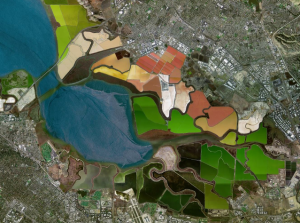 The San Francisco Bay hosts the Leslie Salt Company. Shallow areas separated by levees are filled with sea water and allowed to evaporate. This creates increasingly hypersaline environments that only specific species can inhabit. This photo from gagdaily.com shows the biological transition from algae and bacteria to Archaea. The pink pans contain Archaea producing carotenoid pigments including bacteriorhodopsin. Click the link to see more astounding photos of these man-made hypersaline habitats.
Read about Halobacterium salinarum
Read about bacteriorhodopsin structure and production.
Okay, so what exactly is a carotenoid?
Much of our inquiry relies on synthetic biology— find out about this field.


