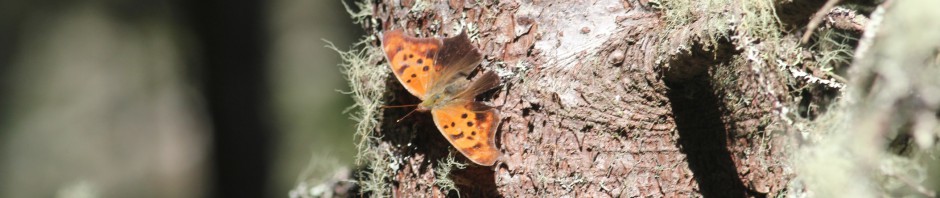
The time between May 15 and June 8 is prime time for elfins in Maine. We know that our records of elfins in the state underestimate their abundance. Because of the patchiness of their host plants, some effort is required to find some of these diminutive beauties.
The Eastern Pine Elfin uses various species of pine as host plant. Suitable pines include White Pine, Jack Pine and Pitch Pine.  Eastern Pine Elfins occur broadly in the vicinity of pines but never at high density. Keep your eyes on nectar plants in the vicinity of pines. We have 330 records of Eastern Pine Elfin.
We do occasionally get Western Pine Elfins in New England. The 30 records we have come from northern Maine and the western mountains of Maine.
As the name suggests, bogs are the place to try for Bog Elfins. This species is similar to Eastern Pine Elfin but 20% smaller. Bog Elfin females lay eggs on Black Spruce, a conifer restricted to peat bogs.  The 136 records we have of this species are mostly from southern York County (Saco Heath is a good spot for these elfins) and Washington County. Black Spruce are found throughout the state. I expect lots of township and even county records for Bog Elfin are there for the taking.
Peat Bogs are a good place to look for Brown Elfins as well. This species uses various species in the heath family as host plants. Suitable host plants include blueberries, huckleberries, Labrador Tea,  Sheep Laurel and Leatherleaf. Brown Elfins occur in upland habitats as well. Barrens and other dry habitats with sandy, acidic soils are usually dominated by heaths, just the ticket for Brown Elfins. We have 243 records of this species in the Maine Butterfly Survey database.
Two other species of elfins are worth looking for. Although we have few records, I think a little diligent looking could turn up new records for Henry’s Elfin and Hoary Elfin.
Henry’s Elfin has a broad distribution along the eastern seaboard from central Florida all the way to Maine. South of us, the primary host plants are redbud (Cercis canadensis) and hollies (particularly Ilex opaca, an evergreen southern holly). Neither of these shrubs make it as far north as Maine. In our part of the world, Henry’s Elfins use buckthorns (an aggressive, introduced species) for ovipositing. Some have suggested that mountain holly (Nemopanthus mucronatus) may have been the original host plant in the northern part of the range of Henry’s Elfin. Checking patches of buckthorns may pay off. Mountain holly is very common on the margin of peat bogs so is worth checking as well if you visit a peat bog to look for Bog Elfins and Brown Elfins. We have only 30 records of this species in our database.
Hoary Elfins have a more northerly distribution than Henry’s Elfin. Hoary Elfin females use bearberry (Arctostaphylos uva-ursi) for their host plants. Bearberry is a member of the heath family with a trailing habit. I have a suggestion for a place to search for Hoary Elfins if you are close to Acadia. The trail across the summit of Penobscot and Sargent Mountains passes through a massive bearberry heath. I’ve hiked this trail many times but never in May or early June. If you decide to give this trail a try, you can reward yourself with tea and scones at the Jordan Pondhouse after you return!