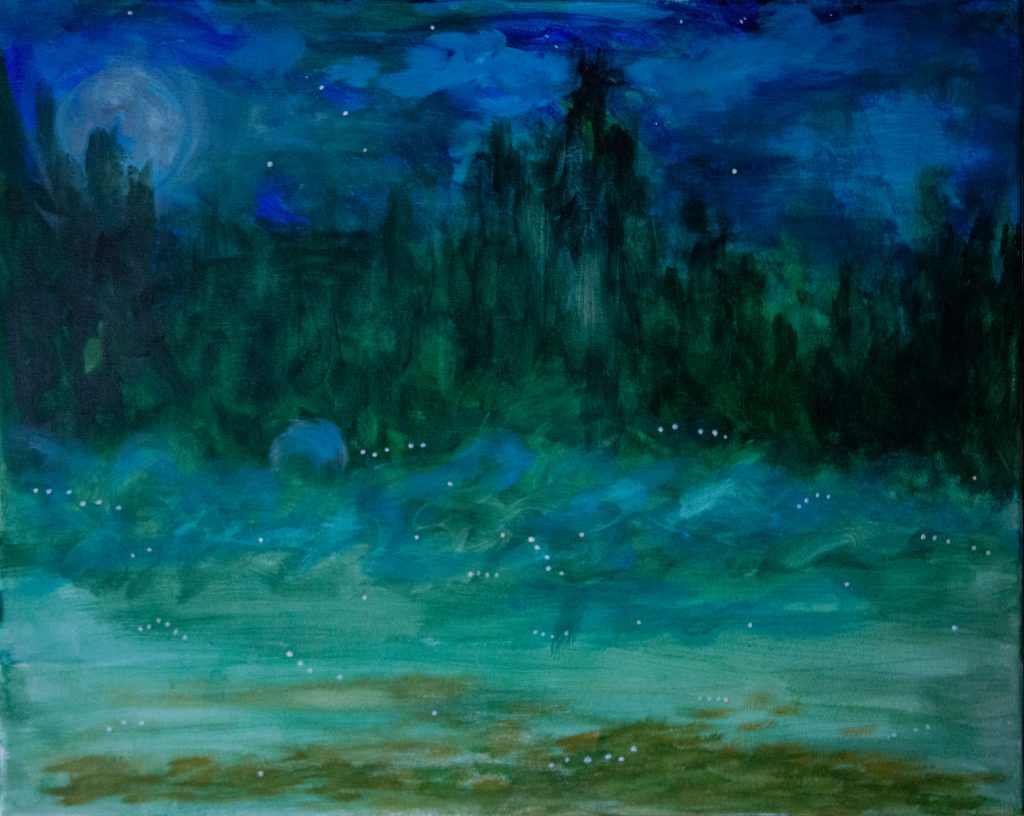
My concerns about the preservation of dark skies has always been in regard to the starry firmament. In 2022, I was asked to present on the topic at the Appalachian Mountain Club’s Medawisla Lodge as part of their annual See The Darkfestival. It was there that I met Sara Lewis, professor of biology at Tufts University. She broadened my understanding of the importance of darkness beyond the realm of astronomy. Sara studies fireflies. She presented an inspired talk about the importance of darkness for fireflies. She gave me a copy of her book Silent Sparks, The Wondrous World of Fireflies. Her descriptions are magical, her science impeccable—it inspired me to photograph fireflies—but it was autumn, the wrong time of year. So, I picked up my brush and attempted to combine astronomy (the moon) and biology (the fireflies) into a painting suggesting that perhaps small lights need the darkness to be noticed.
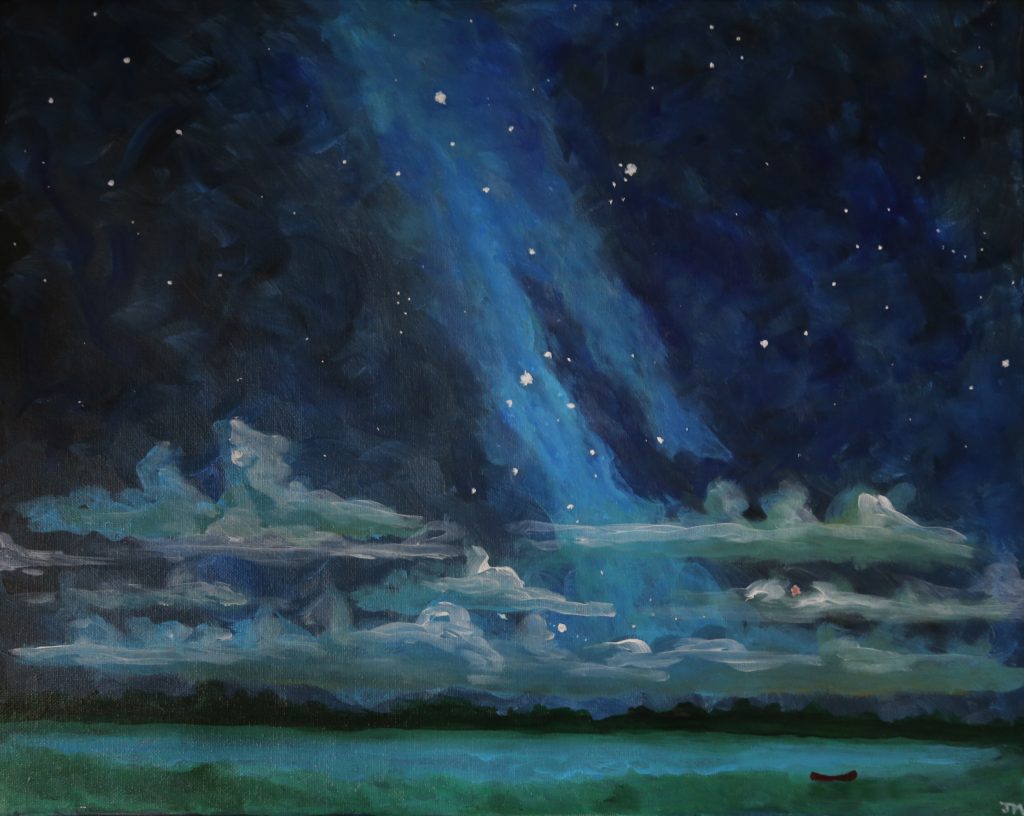
Nahmakanta Lake is in Maine’s 100-Mile Wilderness. During COVID, my wife and I took a canoe trip there, camping on its shores—a reprieve from the world of masks and social distancing. Each night, the Milky Way seemed to climb out of the water and arch across the sky. It felt like a bridge of light, symbolizing that there is a way forward, a stellar promise that this too shall pass; a reminder of the immensity of the universe and the smallness of our woes. The canoe symbolizes humanity, set peacefully on the cosmic shore. Its graceful lines suggest that despite our diminutive place in the greater universe, we are worthy.
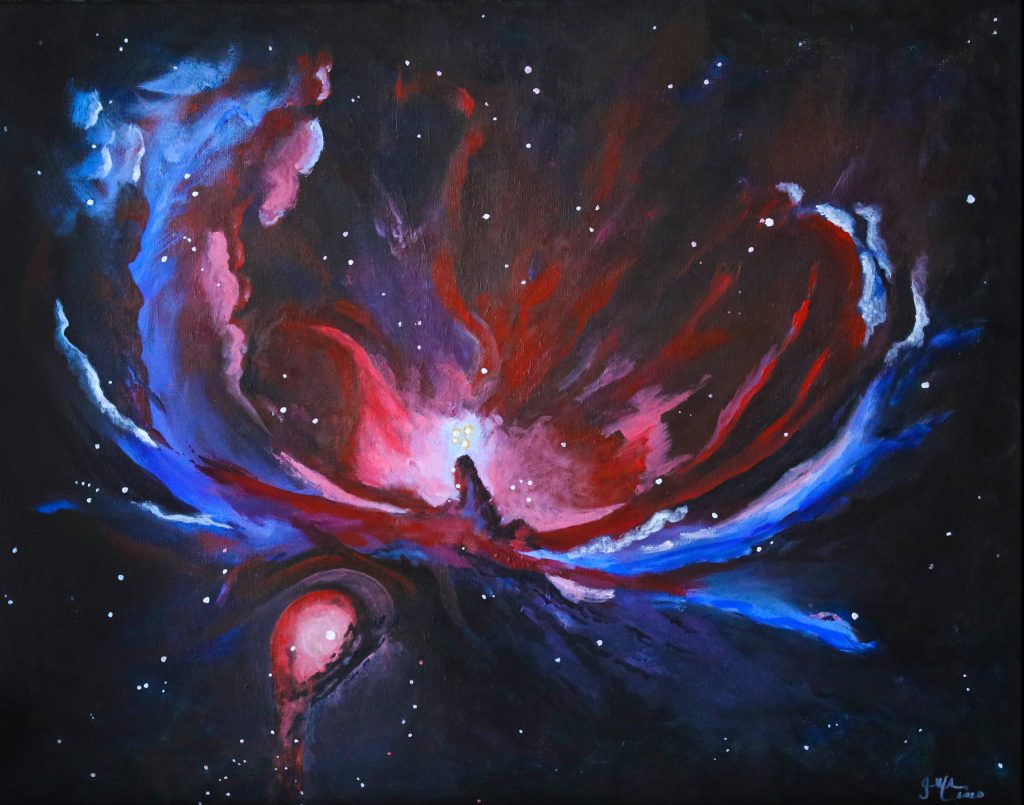
Everything we know about the stars comes from light. This nebula is a stellar nursery in the sword of Orion the Hunter, a brilliant wintertime constellation. The hydrogen cloud spans 40 light-years, with young stars at its heart. The red color comes from glowing hydrogen atoms excited by the energy from those stars. The blue color is also hydrogen, not energized enough to glow, but simply illuminated by the light of the same stars. This nebula was one of the first sights I ever observed through a telescope, to me it represents my beginning of a life devoted to astronomy education.
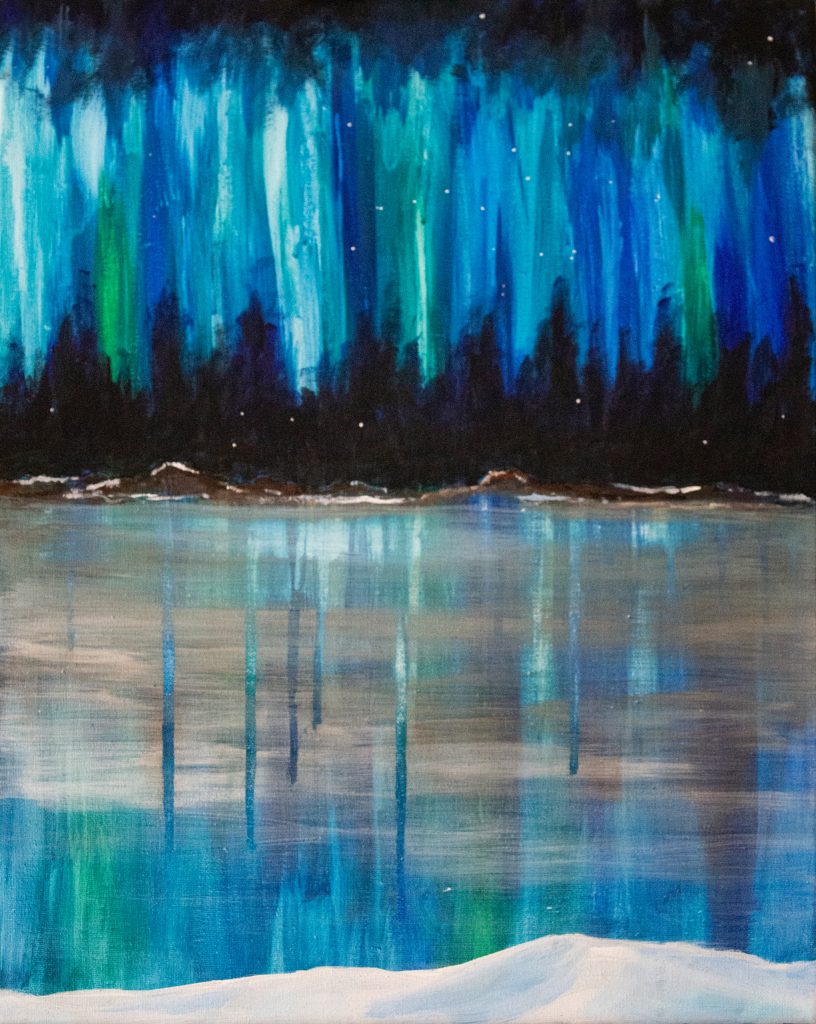
Aurora Borealis means “northern dawn.” I love the dance of the aurora in the night sky. It is truly awe-inspiring—the earth and the sun making art together. While I have never seen the aurora reflected off ice, I imagine when the conditions are right, it would be a spectacular light show. This painting is me looking forward to an event that I will do my best to see one day. The dance of the northern dawn unfolding both in the sky and upon the frozen reaches of an icy lake.