Artist’s Statement
Relying on stone, beeswax, wood, and leather, my scholarship is defined by historical research, material experimentation, performance, and film documentation. I am interested in the sculpted object’s potential to refer to the pre-industrial past as a critical alternative to contemporary mass production. I speak in a range of critical voices, borrowing from the monolithic forms of prehistory, material craft of period wares, and ruins of ancient societies. Rather than reflexively defining my practice in terms of the work of artists or movements, I look to cultural form as inspiration for my drive to make. Serendipitously, I believe that my study of ancient cultural form aligns with the theme of this exhibition, where a record of activity is found by the “tracks and marks [that] are at the core of art-making.”
One commitment within my studio practice involves the carving of stone. The medium itself, a byproduct of geologic time, temperature, and planetary pressures, presents a curious record in and of itself–calcium carbonate being pushed into a specific density known as marble (rather than its other formations of chalk and limestone), created by the layering of shells, fossilized snails, shellfish, and coral over millions of years. The bedding and mineral deposits common to marble demarcate a buried physical record that, once exposed by the stone carver’s chisel, provide a new aesthetic. In looking to the marble motifs carved by ancient Roman artisans, whose work adorned architectural facades and monuments, I consider the stone aesthetic of that epoch when the motif exists today as a remnant or ruin. I question the implied endurance of cultural vernacular found in the ancient built form, when the carved motif remains strewn about in various Roman works, while marble statuary of that era often resides within the care of the museum establishment.
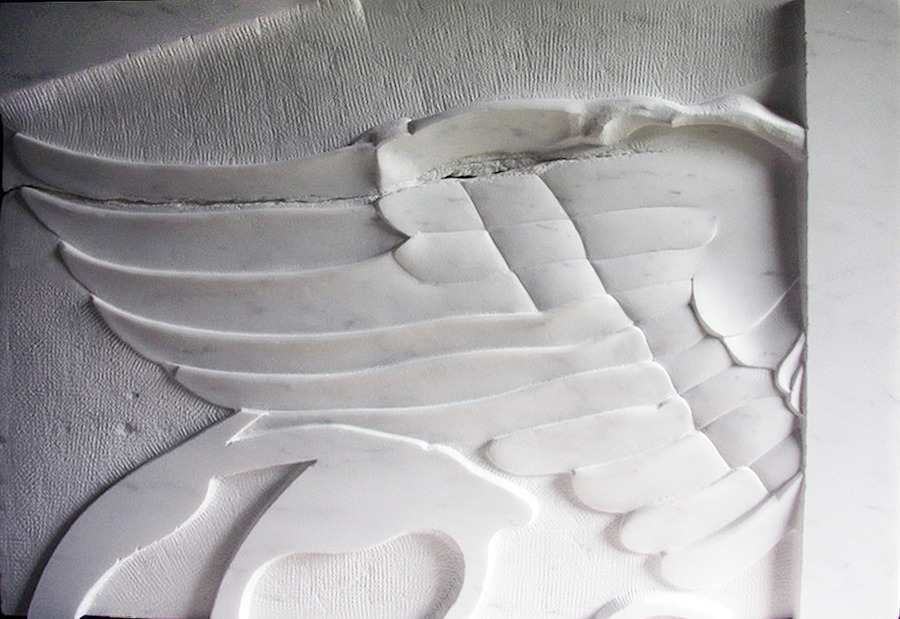
For this exhibition, my work consists of a simple slab that is cut from a block of Vermont Olympia White marble, carved in bas-relief to capture a fragment of an eagle’s wing that once adorned the marble walls of the Ara Pacis in Rome, Italy. The Ara Pacis Augustea (Altar of Augustan Peace) was built for Emperor Augustus in 9 BCE and consists of a sacrificial altar at its center. Within the structure’s entablature, a continuous frieze wraps the entirety of the external walls—from within the remains of this frieze, I represent the eagle’s wing as a symbol of civic bearing that has long disappeared despite the reach of empire. As was customary of the time, the frieze would have been gilded and painted to further embellish the narrative. The carved surfaces of the Ara Pacis captivate me by both the minute details that remain intact and the traces of the mundane, where highly focused moments in stone carving intersect with the marks made to efficiently level an adjacent surface. To a stone carver, the Ara Pacis is riddled with the evidence left by those who were skilled in mimicking the natural world and by those anonymous souls who prepared the foundation of an empire’s façade. Given the enduring marks made by hammer and chisel, there is a vastness and a beauty bound to this small altar that tend toward the sublime in their capacity to inspire both awe and nostalgia.
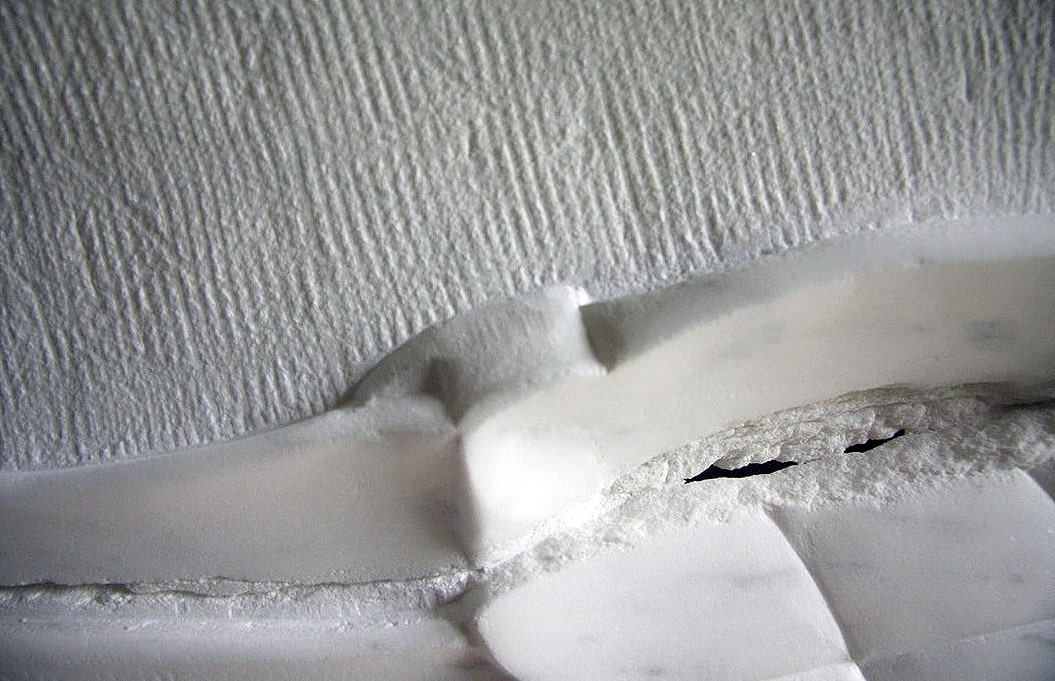
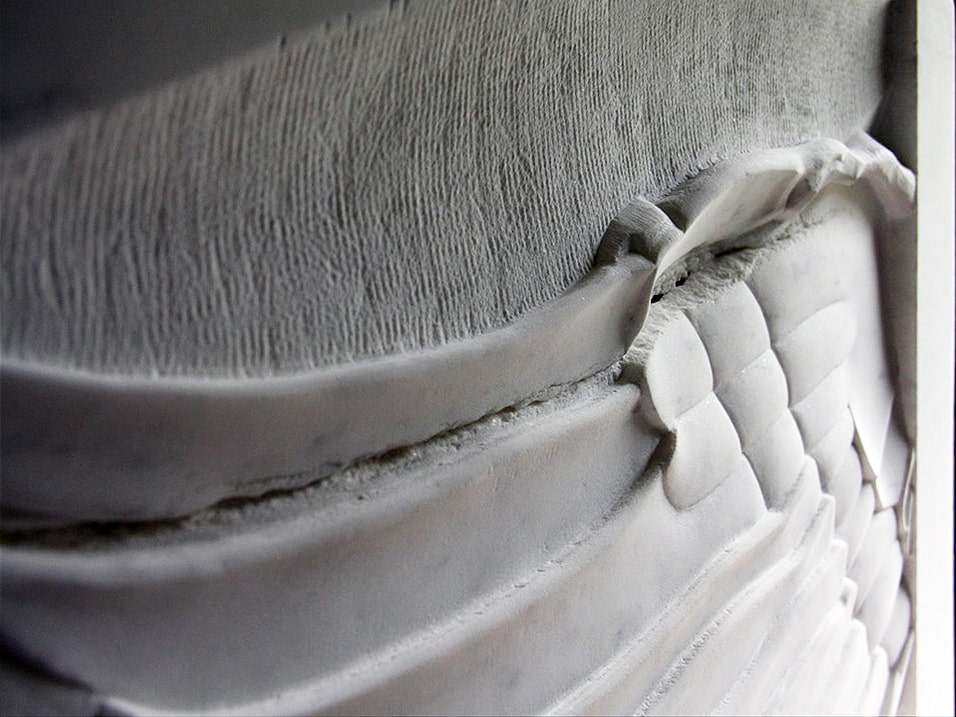
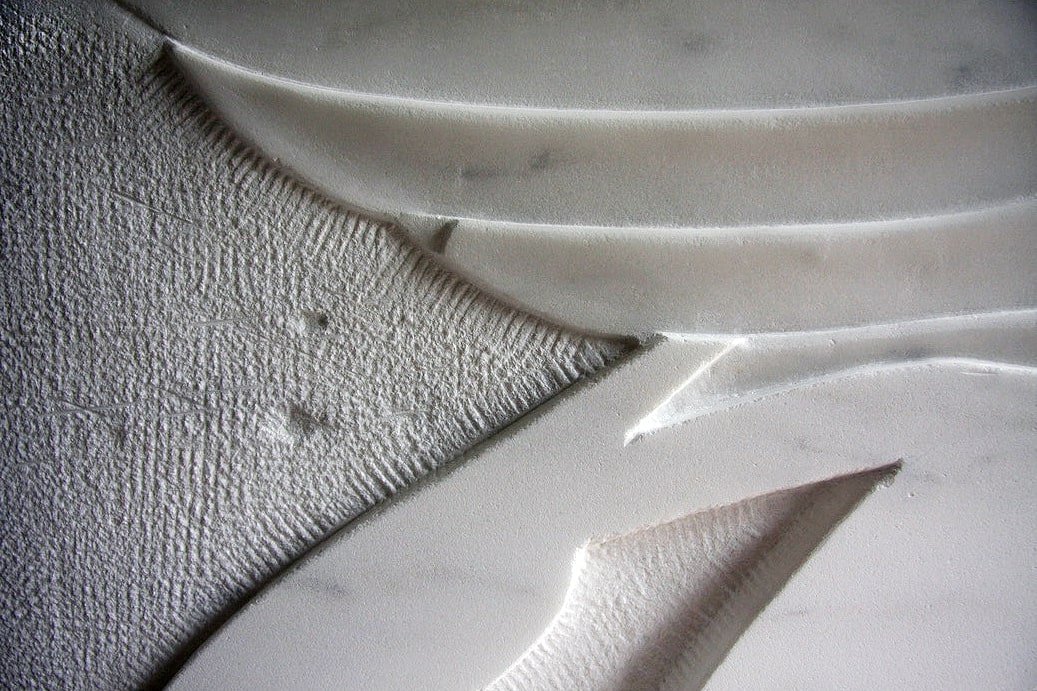
Details of Bradley Borthwick, Ara Pacis, Vermont Olympia white marble, 20.5 x 31 x 1.5 in., 2021.