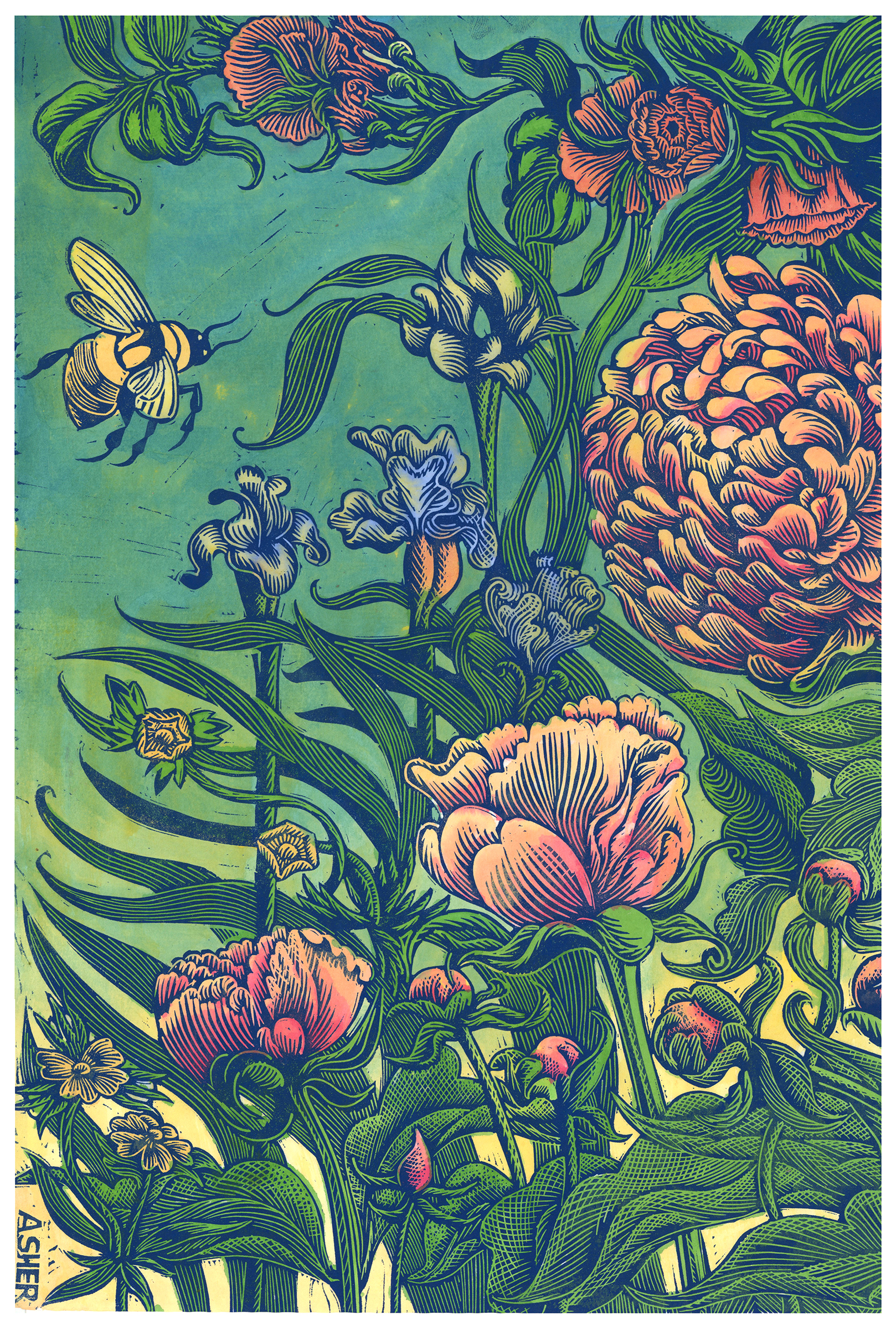
Asher Briant, Big Peonies, linocut print, 18 x 14 in., 2021.
This hand-colored print has special meaning for my family.
The blooming of the peonies in our yard is a significant annual event. For a few days in the middle of summer, it seems as though everybody’s problems are sidelined. The flowers are right in front of our kitchen window, and our table conversations revolve around prognosis: How long will they last? Will the next heavy rain obliterate them? Are they as big as last year’s?
They are certainly impressive. The biggest among them span a good eight inches, and make the neighboring (and fading) irises seem tiny. However, within this image, the real main character is the bee. I’m not a bee expert, so I can’t say which species she belonged to, but while we were out walking the dog she had managed to find a way into my art studio and had stranded herself there.
I promptly selected a suitable sized piece of cardboard and a wine glass. I like a wine glass for trapping bees. Somehow holding the stem seems to give better control over the “bowl” of the glass, and not having your hand actually on the glass means that your hand doesn’t cast an intimidating shadow.
After a couple of attempts, I managed to trap the bee in the glass, slide the cardboard underneath, and walk her out to the garden. Once there, I released her on top of the biggest of the peony blooms. She stumbled around for a few moments and then got to work doing her bee-thing.
Watching her work, I realized that I should be working too. I rushed inside for my drawing book and pencils, then went to work drawing “her” peony, plus some surrounding tea roses, and the poor irises heading into their own oblivion. I tend to lose patience with a drawing after an hour or so, but on this occasion, I was so fascinated by what was going on that I kept drawing until sunset. The next day, I cut a large sheet of linoleum, and began working on the print.
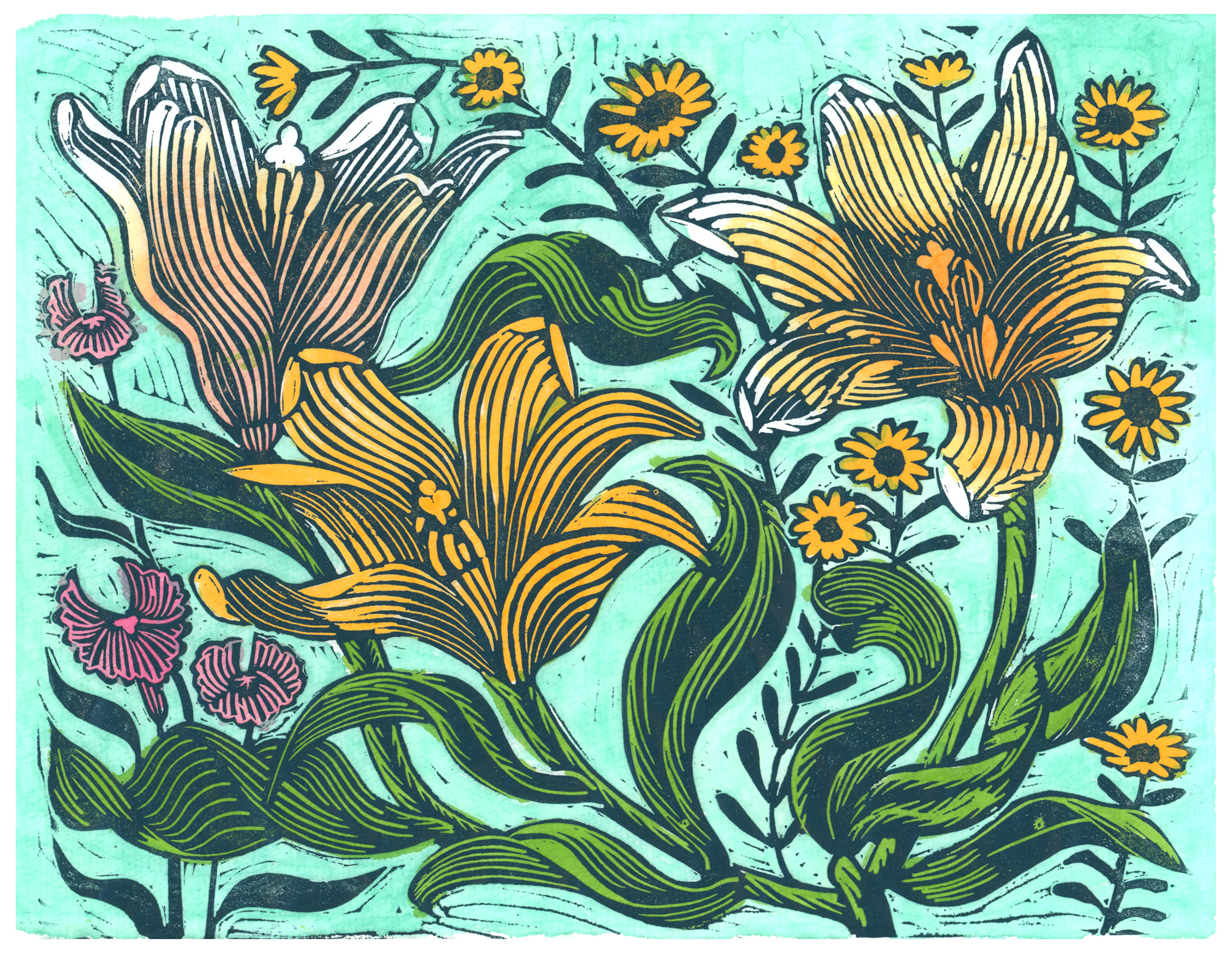
Asher Briant, Day Lilies, linocut print, 9 x 12 in., 2021.
From The Rubaiyat of Omar Khayyam to Sandra Cisneros’ Monkey Garden, literature overflows with beautiful and meaningful metaphors that connect flowers and gardens to our temporary place in the world. For me as a reader, these works bring great delight but, for me as an artist, a garden is simply a garden.
A place where we don’t so much ponder eternity, as a place where we can unravel the extraordinary qualities of a natural world that we often notice, but seldom study.
I begin all my flower art by sitting in front of the flowers and plants, looking closely, and trying to capture the powerful and intricate shapes with a pencil and paper. I try not to idealize my subject matter. I like to include all the defects—partially devoured leaves, missing petals, and unexpected juxtapositions. All these things draw me deeper into what I witness in front of me.
I stare and notate until my eyes can focus no further. I ask myself, “Is this really what is happening in those hidden places?”
Sometimes I feel failure, and sometimes I feel success. All drawing is an attempt to unravel some kind of mystery, and making art from flowers is no exception to that rule.
With plants, I tend to separate shape and color. My drawings are monochrome, and I admit I use photography to make color notes.
I continue this separation when I begin the printmaking process, which is why I nearly always use the actual monochrome block-print to express the swirling shape and flow of the plant. Flowers move constantly. The slightest breeze will send them rocking and there’s nearly always at least a breeze. Hence, my black-and-white print is also an attempt to capture the movement in some way. Once I feel I’ve captured that motion, I cut the block, and then print. I use oil-based printing ink so that when the print is dry I can add watercolors without compromising the line-work.
I usually make twenty to thirty prints from each block and this is the beauty of printmaking. I can make many attempts to get the colors right. I think this print of the day lilies is one of my most successful efforts.
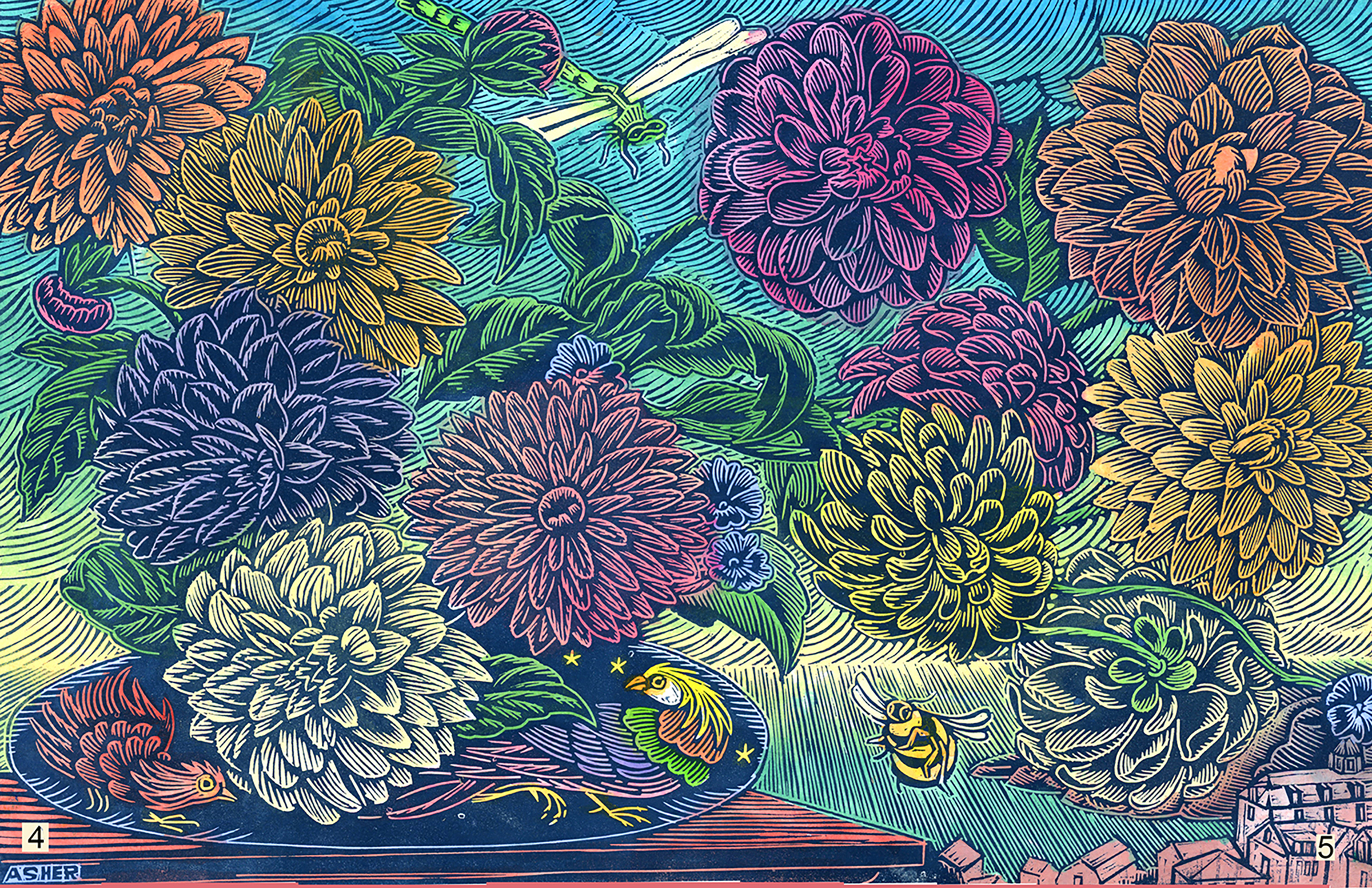
Asher Briant, Dragonfly and Dahlias, linocut print, 14 x 18 in., 2021.
This print is unusual for me in the sense that I normally place my flowers in the precise place where I saw them and drew them. It’s a kind of environmental honesty.
In this case, however, I placed the flowers in a vase, and put our island in the background.
Aside from our own garden, there are a couple of other nearby gardens that have delightful plantings. The owners of the gardens put an immense amount of work into them. I have to admit they put far more work into their gardens than we do into ours.
I should also point out that I always get permission from the owners before I draw their flowers. When I say “owners” I mean the humans who own the land. In this image the dragonfly probably considered the peony patch to be her hunting territory, and the bee: her foraging territory. Territory is ownership. I have been reminded of this by several owls over the years. As per Karl Marx: “ownership is theft.” The dragonfly and the owls had quite likely stolen the territory from others of their species. Nevertheless, ownership is still ownership. These particular dahlias belonged to my friend, Pam, who owns a coffee shop a quarter of a mile from our house. In terms of shape and color, these dahlias are a challenge to draw—and to color. Within the general puffball silhouette the shapes of the petals subtly vary, but in fascinating ways. I think this is why they have always been a favorite flower for many gardeners.
These particular ones are a late summer treat, and they appear long after the irises and peonies are no more than memories.
The most difficult of all was the black dahlia. There are (I think) no blue dahlias, and I think it’s a case of the bloom trying to make “blue,” but only getting to a very profound purple color.
Once I had finished the drawings, I worked on the print for several days. The weather changed, as it is apt to in coastal Maine in September, and a nor’easter blew in. I had been planning to use the coffee shop as a background, but at this point I needed to finish the print, so I substituted the vase and the island background.