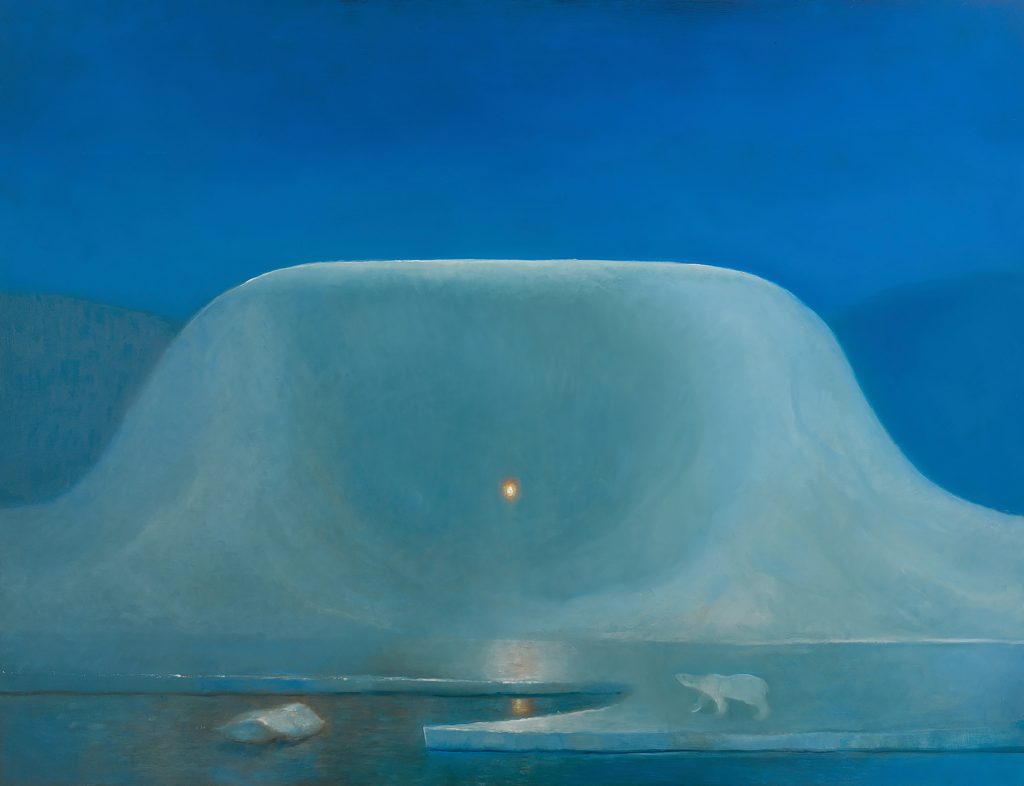
Signum was created in response to an artist residency in Svalbard in February 2015, during the period of civil twilight, a maritime term of when the sun remains within 6 degrees below the horizon. The painting is shaped by that experience of suspended light. The icy form of a mountain appears monumental yet softened, its edge dissolved by atmosphere rather than defined by shadow. Near the center of the composition, a small point of light emerges which is deliberate, isolated, and fragile.
This point of light, a radio signal I witnessed in the mountains there on a snowmobiling expedition to a distant, uninhabited area, functions as both sign and symbol. It references human presence—an insistence of consciousness and habitation in a place that feels otherwise uninhabitable. In the vast Arctic landscape, where scale overwhelms and time stretches toward the geological, the light becomes a marker of human witness: minimal, temporary, and vulnerable, yet undeniably there. Even at what feels like the end of the world, witnessed only by a lone polar bear in the lower right, human presence persists.
In Signum, light operates as both subject and metaphor. It marks time in a region where conventional markers like daylight dissolve and perception must recalibrate. The work reflects my ongoing interest in environmental issues, in the north in particular. Rather than depicting the Arctic as empty or sublime in the romantic sense, Signum holds space for another truth: that human presence, however small, leaves a signal, or an act of attention, within even the most remote landscapes.