Artist’s Statement
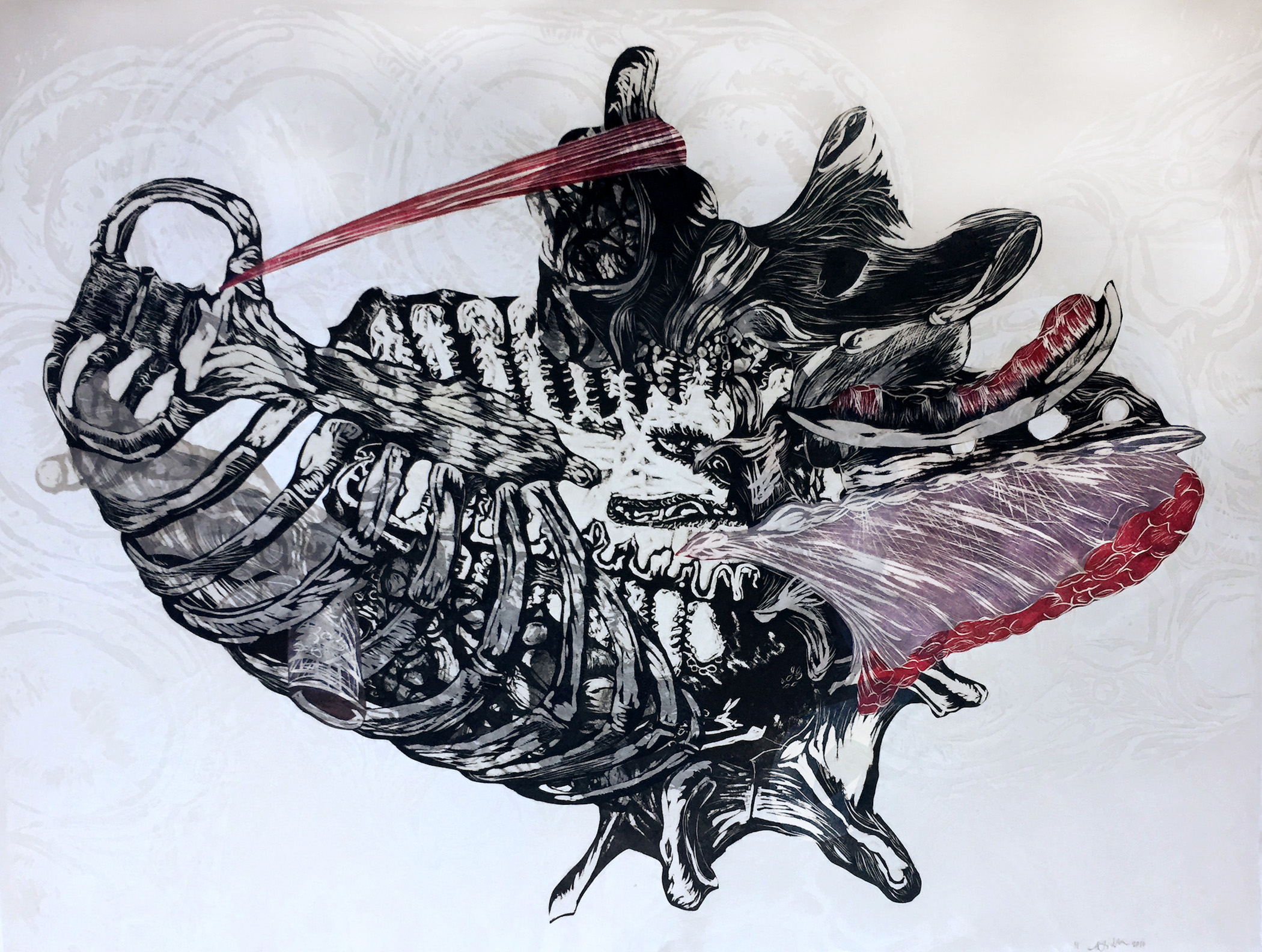
This work depicts a long and evolving relationship with anatomy, physiology, and ecology. I was trained as an ecological biologist and I see biological beings as systems that are results of interactions among chemical, physical, and behavioral processes. My work is a lens through which I view people as landscapes, discerning characteristics that indicate specialized relationships with the world. We are each super organisms; as we age, we develop unique, diverse ecologies.
Our bodies are living transcripts of our encounters with the world. For me, childhood adventures and athletic failures scar the skin of my knees and chin. Tan marks and freckles catalog years of accumulated time gardening, swimming, and hiking. Fused spinal discs indicate hard athletic wear on a young body. I have calluses on the tips of my toes from running and a hotspot in my palm and splinters on my knuckles from carving wood. A body can tell a functional story of a life. I am influenced by my experience working for the Anatomical Sciences department of the Medical School at the University of Michigan. I have seen that no two bodies are the same; our physical interactions with the world shape our morphology, sculpting our bodies into records of the routines we live and the traumas we endure. When I was working there, sometimes all we knew about a donated person was what we could observe about how their physical bodies were shaped by their lives—gradual morphological changes etched in their bodies enduring as traces of how they were in the world. My work as an artist explores the mutuality between the world and the bodies it continually shapes. Before my experience in an anatomical sciences program, I had more violent encounters with human trauma as a Wilderness Emergency Medical Technician. The experiences in wilderness medicine showed me that human beings are capable of miraculous healing, growth, and adaptability.
Printmaking is my tool for studying the compilations that we recognize as our physical beings. Biological ideas like replication and adaptation are particularly well suited to print media—the evolutionary concept of path dependence is a functional parallel between “fixing” a printing matrix and the subsequent development of a printed image, and the “fixed” structure of our DNA and the various epigenetic changes that may occur in a person’s lifetime.