Artist’s Statement
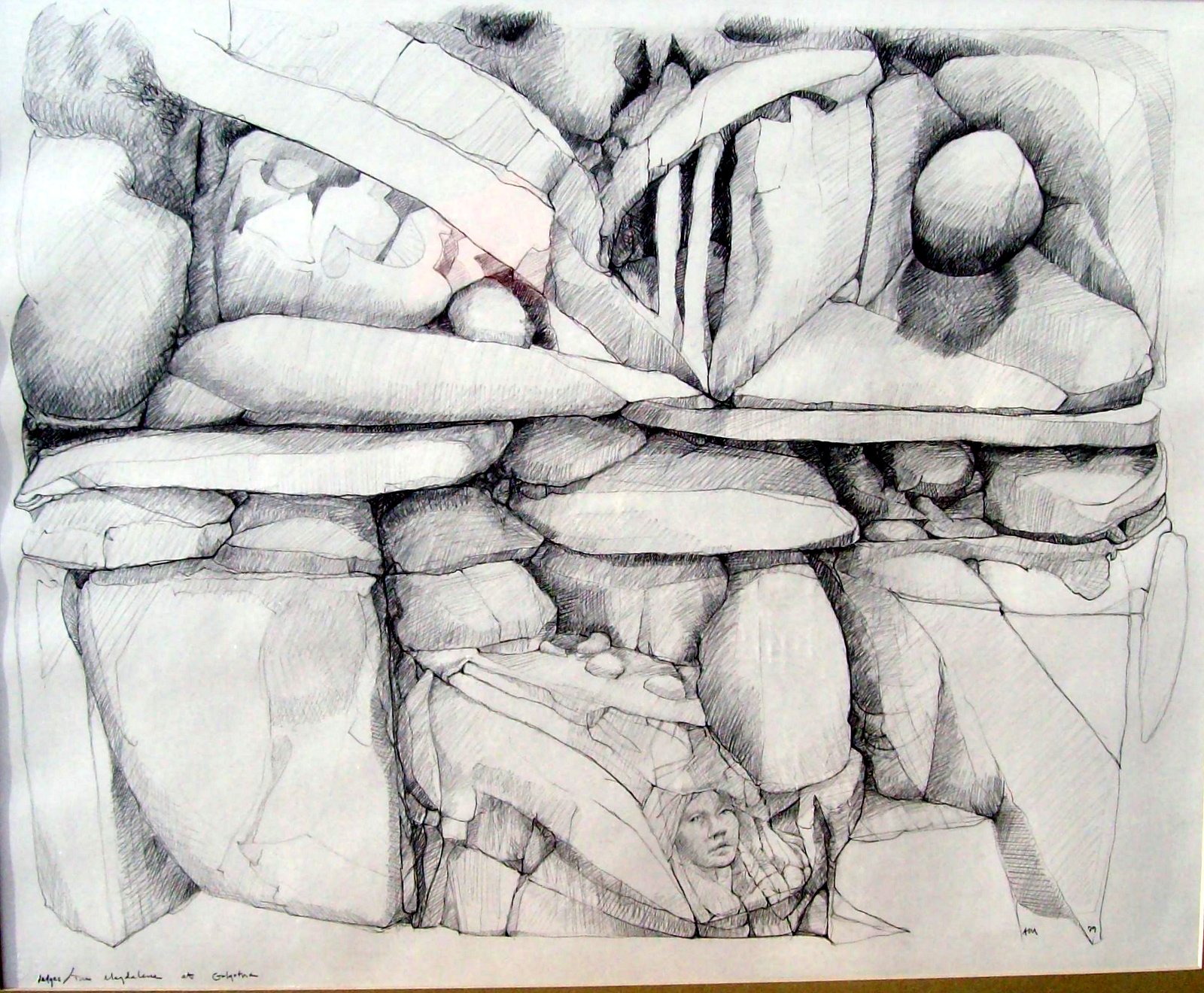
This is clearly a pencil drawing, and I wanted viewers to remain aware of that. The pencil markings are not smoothed together or blended in any manner. It is also a tonal drawing without color—not very “realistic” in these regards. When you step in closely, you see that it is made up of distinct lines: some short, some long, some light, some dark. They are isolated at times and in other areas they are overlapping and piled up in ways to create a graduating light and dark that yields a suggestion of mass. Then, if you step back three or four feet, the lines blend in the eye and the image solidifies a bit further. It seems more three dimensional. Toward the lower right there is an area that has hardly developed past a few simple lines—the way the drawing began—and throughout there are more and less illusionistic expressions of mass. There is a stone in the upper right that should fall, or is falling, but it is frozen in time. The “skull” is a gestalt found high up. Mary is easily found lower down. The drawing is an invention, and we can probably agree that it is made up of pencil marks. But the content, the meaning? That is for each viewer to decide—or not. There is nothing written in stone here.
Artist’s Statement
If you put four dots down in a certain regular placement you will see the dots, but a square will also “appear.” That is the Gestalt phenomenon—something new, more, and different than the mere sum of its parts. Our lives are experiencing this continually. It’s something we create. Grouping, building larger cohesive structures . . . Making order out of raw perception.
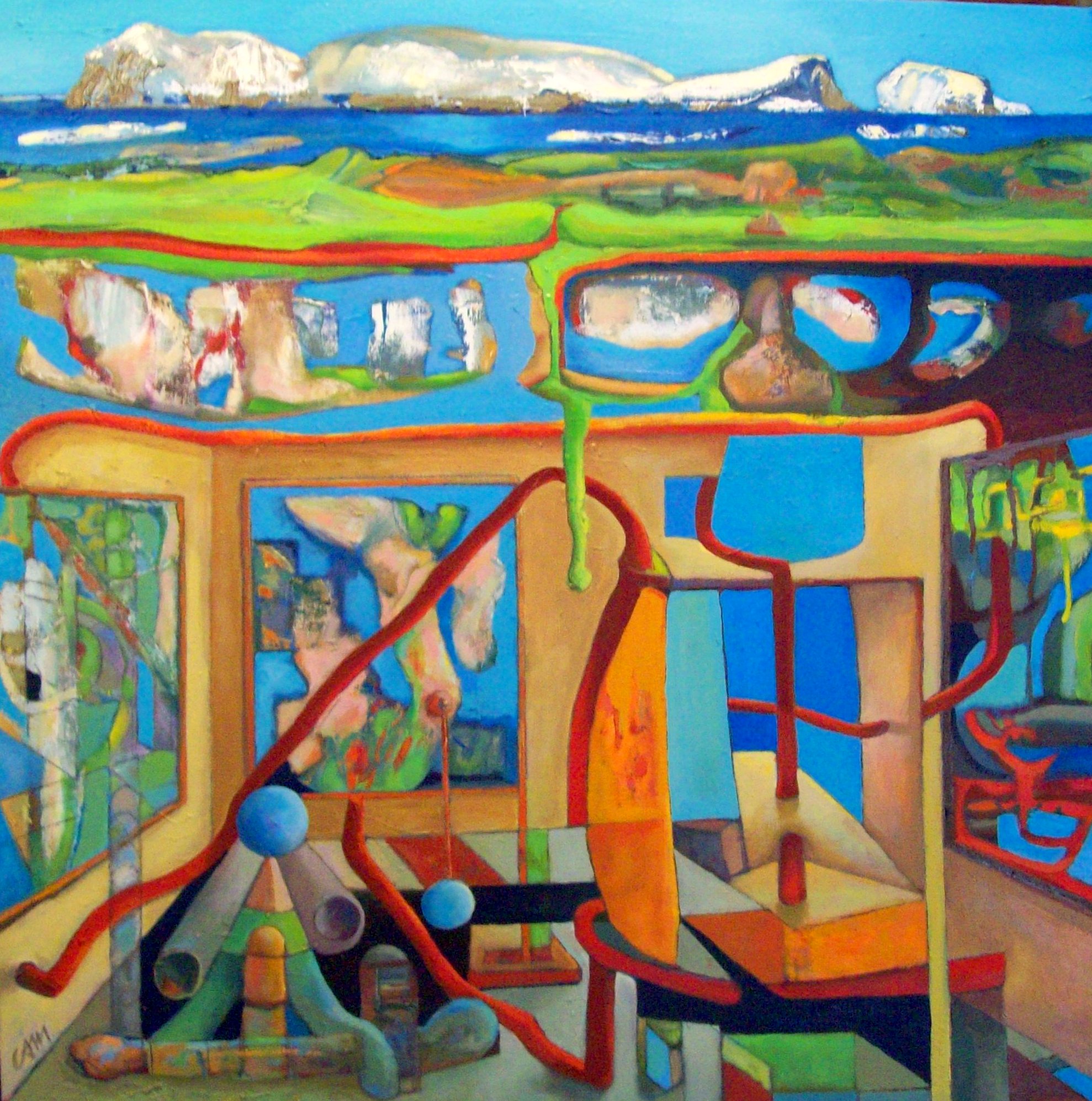
Based upon the above, would this painting be some sort of an anti-gestalt? So many parts that don’t connect; so many contradictions in the perceived space; impossibilities that lead toward chaos? And yet it struggles—that is, you struggle—to make the aggressive clutter into a whole.
In fact, the upper area, if isolated, would essentially work as a traditional cohesive image. But below, it all falls, flows, and drips into an “interior” of chaotic spaces—a claustrophobic region of mangled, Western visual art perspective projections—a cacophony of contradictions and trickery that are an assault upon logic. Yet it is also just a painting—a thing—and as such it is a cohesive whole. You can walk around in it visually and look at various parts. In fact, you can imagine cropping down into details that would work as orderly traditional images. Nice little abstractions. It’s the major lines defining this “Western Interior” that are at the root of the confusion. And what can we do about that? Is it a funhouse or a nightmare? You tell me.