
Flood wreckage. We call it wreckage, but it might also be called renewal. Change is a constant in existence. A fragment of writing by the early Greek philosopher Heraclitus is translated as “all things flow.” He, I believe, was also the one who pointed out that “you can’t step into the same river twice.” Smart!
This painting was developed in the studio based upon a small on-site sketch done after the flooding in 1987 of a small brook in Oakland, Maine near Colby College. That sketch searched out dominant elements and blocked in some compositional concerns. In the painting that followed, seen here, I sought to express more emphatically the flowing water that had been a dramatic component of my experience. Here, brushstrokes are active and many forms are blurred. Things are in flux. Edges are lost and movement and change are emphasized. Short hard edged strokes and chunks of color may suggest rubble and broken branches tumbling in the flood. The brook is seeking out new pathways here and there. Colors shift and interact. This is all something the brook has done before and will do again and again in ways both great and small.
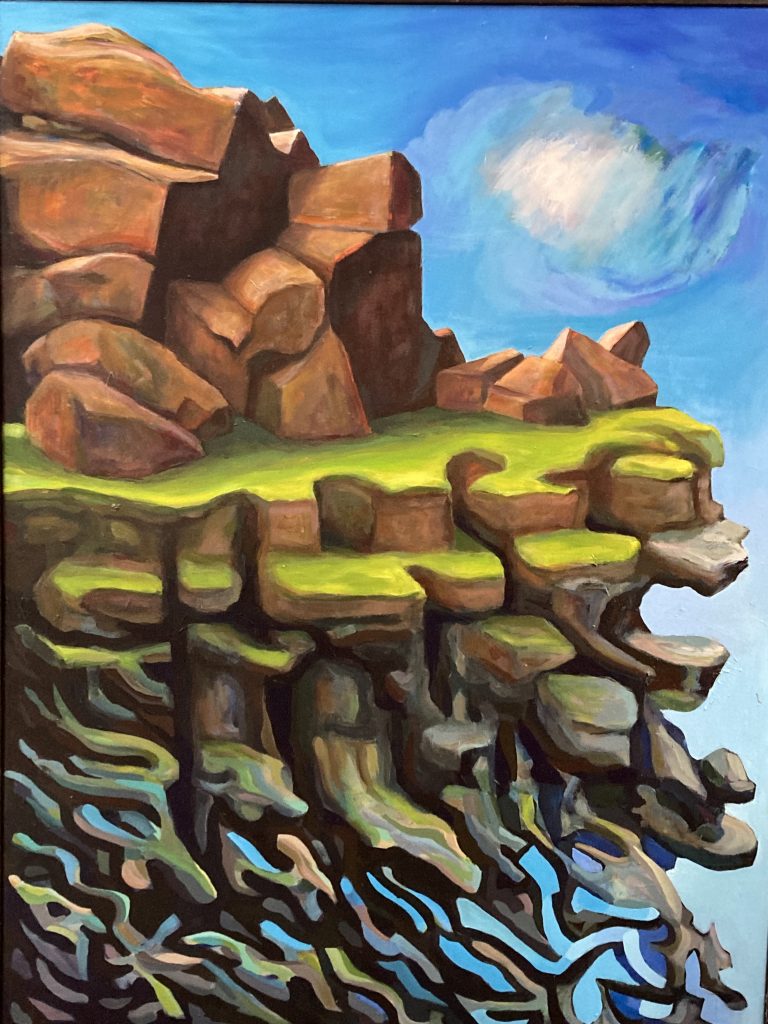
In Charles Schulz’s original Peanuts comic strip the worry-wart Lucy would criticize other kids who were running about playing games, warning them sternly to stop because they were “wearing down the earth.” Scary! But fortunately we have the Law of the Conservation of Matter, asserting that matter can neither be created nor destroyed. Nevertheless, it clearly can be transformed in many regards, and this painting visually plays with that fact. The imagery overall presents us with a variety of related shapes. The formation of rocks seen in the upper area derives from a source at Tenants Harbor, on the Maine coast. In the painting they rest upon a ledge that is somewhat simplified and abstract, below which a progressive transition of forms and colors evolves further and further away from the representational imagery seen above; and this transformation works either way—up or down. The imagery at the top compared with what we see at the base stand in stark contrast. While there has been major change overall, it has occurred incrementally—something which we, in our living, experience in myriad ways, while hardly noticing that it is happening. C’est la vie!

A return from where? From beneath us. Unfelt. Invisible. Channeling among stones of many sorts. What energy fuels this rising to the Earth’s surface, into the light, then to join with other streams and grow into a river that will, as one great thing, flow onward to the sea?
The painting is an invitation. An imagining. Is it somber? Playful? Surreal? Aspects of each? I have worked to create an arrangement of representational forms depicting stones, earth, and water, in hope of directing viewers toward certain areas of consideration and contemplation. I’ve also sought to build a structure with characteristics that may provide some aesthetic enjoyment. Rhythms. Color. Goofy stones, etc. The piece might be considered as a kind of questioning. A “what do you think of this?” And I’ll leave it at that. To each his own. Grist for the mill. And in closing I offer a thought by way of the Danish philosopher Søren Kierkegaard: “The mystery of life is not a problem to be solved, but a reality to be experienced.”

This painting is based upon what I could recall of being at this place on a gray and misty day at the coast. I also took a photo which later helped me with visual details and the mood of the day. It was chilly and damp. Nature seemed frozen up, and yet the massive fallen tree that commands the foreground had once thrived and known a long life. The broken trunk projects forward over an abyss. In and around, smaller trees, pale and seemingly lifeless, stand quietly as mourners in the stillness and the fog. Dry-ki is the name given to these standing deadwood ghosts by the Wabanaki, “People of the Dawn.” The imagery of the painting presents us with a memento mori, something to remind us of our own mortality. Standing there at the site that day I asked myself what has happened here? Destruction. The rising salt water levels? A great storm as well? Or maybe nature’s inevitable small actions over time? I stood there for quite a while, thinking. And then I took a photo and left.