Day 8 at Bermuda (Most of the blog was written last night without being posted)
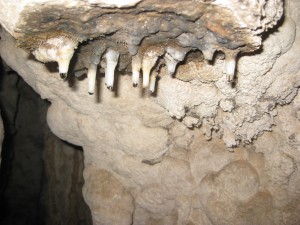
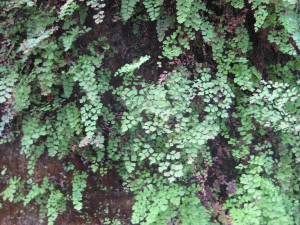
It’s been a perfect day temperature wise: we had sunshine and little wind almost all day, which is ideal for outdoor exploration. In the morning, we went to see some caves located in the Walsingham Nature Reserve, which had the oldest (and possibly the most cemented) rock unit in Bermuda. The inside of the caves looked spectacular, with long branches of rocks hanging down from the ceiling and going up from the ground. At the end of the branches, we saw some growing units of stalactites dripping little drops of water on the ground. Some calcite also sparkled at the rim of the rocks. One of the caves was filled with clear seawater, so transparent that I can see the bottom of the cave without effort. As we went in, Bruce pointed out several fan-shaped ferns that clung to the edge of the cave. It is called the Maidenhair fern and is endemic to Bermuda, usually grows on wet and shaded areas.
I’ve seen caves a couple of times before in my hometown, some of them were very deep and also hosted big chunks of stalactites inside. Obviously the maintainers had done a lot of work to make them local attractions: neat steps that led to the bottom of the caves, different colored lights flashing on the rocks and detailed explanations inscripted on the information boards. However, it looked so touristy that one became less attentive of the natural beauty the caves possess, and the jumping light spots detracted people from examine the details inside. I guess the best way to ruin a natural beauty is to leave man-made traces around it, and then to advertise it so much that it became a cliché around the area. Maybe I should take more time to walk around it and really see it by myself next time when I come home.
After a refreshing lunch, we hopped on the boat and set out to nonsuch island, a paradise for native and endemic plants of Bermuda. Its isolated location made it a sanctuary for local plant and animals to thrive without outside intrusion. David Wingate, the first conservation officer of the island, led us to tour around the island and told us about his experience in restoring Nonsuch island to its pre-colonial condition. At first, he pointed out many native plant species around the area: Bermuda cedar, snowberry, yellowwood and sedges. Some plants that used to be prevalent were almost driven into extinction due to the invasion of introduced species.
Mr. Wingate also explained the complexities of the ecosystems in Bermuda, and how seemingly irrelevant plant and animals relate to each other. An example is the Bermuda sedge, a grass-like plant that used to spread across the island. It suffered after the introduction of mammals (especially rats), because rats eat its seeds and prevent it to reproduce. Also, it requires a particular kind of nutrition that comes from the endemic cahow’s excrement. As the cahow almost went extinct on the island, the Bermuda sedge also died off massively. I wouldn’t know that sedges depend on cahows for a living without hearing his explanation.
It’s hard to find the connection between the factors that play out during the conservation of native species. It takes much observation and testing to discover the connections, and even more work to supply the missing links in the local ecosystem, as David Wingate had done. To prevent tropical birds from flying inside cahow nests and eating their cubs, Wingate dug cahow houses on the ground and blocked the opening of the houses with a piece of wood board. The wood board has a hole in the middle that is big enough for a regular cahow to squeeze in, and too small for a tropical bird to get in and harm the cubs. Wingate had to test and change the size of the hole on the wooden plank until it reaches the ideal effect, and cahow cubs get to live and grow up. Also, after kiskadees are introduced, they competed with the cahows for food and encroached their living space. Wingate had to come on the island and shot as many kiskadees as he can, which takes very much time and energy.
The conservation works seem like a huge experiment located in a laboratory (the island), but much more difficult to carry on, because far more factors play out in it and many of them harder to control. What is worse, the ecosystem is not exactly a closed setting, especially for flying things. For example, some birds from the continents fly into Nonsuch Island in their migratory routes, carrying insects and pests that doesn’t belong to the island. These introduced species may reproduce quickly and spread over this pristine land, fighting over resources previously allotted to native species. It is almost impossible to prevent this, and once it happened, the endemic species might receive a heavy blow and even become extinct. Though the size of Nonsuch Island makes it possible for Wingate to control most of the native species, similar disasters still happen, and sometimes he had to admit that things can be out of his power. However, I admire his sharp insight in adjusting the living environment of the local species, and his persistence to do what he can, without being disheartened by the defeats.
So that is the end of the day and we headed back to biostation by half past five. I still kept thinking about the endemic species at Nonsuch Island, and the struggles people made to preserve them. Sometimes I wonder if the efforts payed really make a difference. Though the endemic species are delightful, their weaknesses make them uncompetitive compared to other invasive species. Throughout natural history, many notable species had come and went away, so maybe it is only natural for them to be replaced by others. Struggling to keep them in the original condition seems to be an already lost battle against the tides of time. However, after this tour, I think the existence of these species alone has meaning, just like I can’t imagine a planet dominated by a few ‘strong’ species. That would be a boring world to live in. In this sense, I really want to thank these people who fought to make our world more diversified and more beautiful.