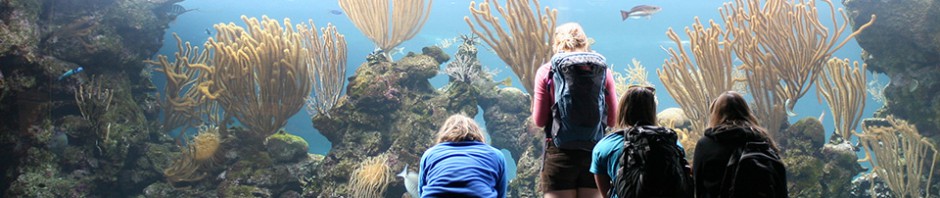
So not wanting to retire after my last post, I wanted to think about some lighter thoughts and light in general.
Looking back over the past week, I think we have had some incredible experiences. We have learned how to drive our scooters and today we traveled the length of the island. In addition to the distance we experienced sun, wind, cloudiness, salt spray, cold and rain. All arrived back in time for dinner.
Traveling to the south shore beaches and the dockyard took us to some new spots with new geology. At Warwick Long Bay, we took a look at the coarse sand grains in the lag left behind by the wind. We tried to determine the diversity of the organisms out in the water by looking at the fragments left behind in the sand. We came to the conclusion that one of the missing components in the sand was coral and realized that most of the grains we were looking at were too small to have easily identifiable coral pieces in them.
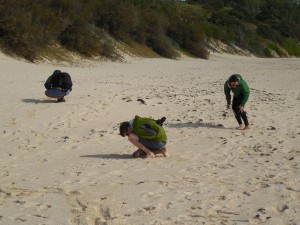
Identifying carbonate grains in the beach at Warwick Long Bay
We also tried to do a point count on the number of Homotrema rubrum (the foram that make the sand pink on Bermuda) and found that there were anywhere from 30 to 60 grains per square inch.
From there we travel over to nearby Stonehole Bay and did the same thing there and found that the grain-size was a little bit smaller and there were more gastropods in the sand. We also found more chiton fragments in the sand along with some larger coral fragments that were easy to identify.
At Stonehole Bay we also talked about the development of the cross-bedding in the rocks exposed near the water. From there we went to the back of the beach and looked at the dunes that were developing there and made the connection between the sediments and rocks.
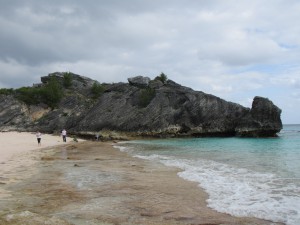
Dune cross-bedding at Stonehole Bay
From there we headed southwest along the South Road to Church Bay. At Church Bay we were able to see the boiler or cup reefs close to shore. Had we not gone out on the boat to see some off Tucker’s Town, we would have thought about doing some snorkeling here today (the weather was also not so conducive to snorkeling either). So we looked at the boiler reefs and looked at the sediment and found much bigger pieces of coral and pieces of the cup reefs. From the fragments of the cup reefs we could readily see the constituent organisms, red algae and vermetid gastropods.
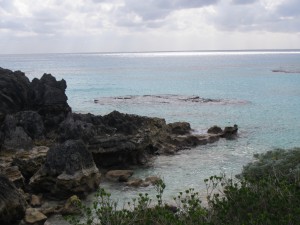
Boiler reefs close to shore at Church Bay
Church Bay (and most of this section of the coast on Bermuda) has exposures of some of the youngest rock on Bermuda, the Southampton Formation. The Southampton Formation is just barely a rock! It is only about 80,000 years old and is very crumbly. That is because the dune sediment that makes up the unit is not very well cemented. We are learning that one of the ways to identify the five units on the island are by how “hard” the rocks are. Basically all five units are pretty much the same, but the older they are, the better cemented they are and are “harder”.
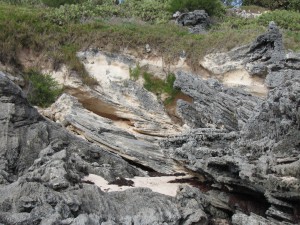
Southampton Formation at Church Bay
From Church Bay we headed on a more northerly course into the wind to Boaz Island. Boaz Island has an outcrop of a fossil boiler reef that is exposed on the west side of the island. In the outcrop on can see the very porcelain looking red algae and the brownish vermetid gastropods that grow within the algae. These two organisms make up the majority of the reef. We also realized from our snorkel that the top of the boiler reef was pretty much at sea level. If we were standing on this one, it meant that sea level in the past (about 125,000 years ago) had to have been about a meter and a half higher than today.
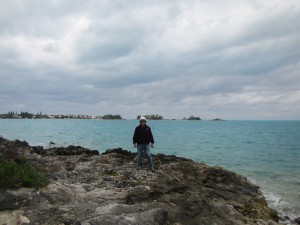
Fossil boiler reef exposed on Boaz Island
I continue to be struck by the enthusiasm of the students on this trip. They are eager to learn and everywhere we go, they are crawling over the rocks and have their hand lenses out and are looking at the sand and chasing the organisms around in the tide pools (the chitons and gastropods are not much of a challenge). We are having a great time traveling the island and learning about the geology and the organisms responsible for producing the majority of the sediments.
Tomorrow we are heading to Walsingham to look at some native and endemic plants, karst landscape, mangroves and caves in the morning and then to Nonsuch Island in the afternoon.