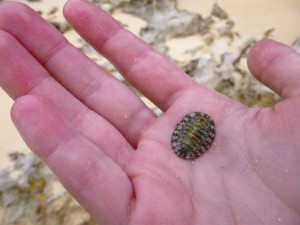
Chiton on my hand.
Chitons are polyplacophorans protected by 8 hard shell plates on their back. These plates are made of aragonite. The outer ‘girdle’ that circles around the aragonite back plates likely evolved as a means of camouflage from predators. It is very difficult to pry chitons off from the rocks without injuring them.
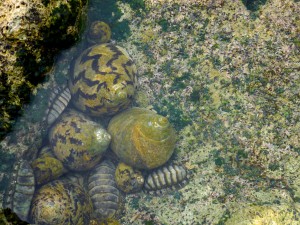
Chitons and Cittarium pica gastropods in a tide pool.
I came to Bermuda really wanting to see a Cittarium pica snail. They are also known as the West Indian Topshell or magpie shell. From what I’d read online, it seemed like their population on Bermuda was small and struggling. I was excited to see even one.
It seems as though C. pica is actually making a comeback in Bermuda, though! I’ve seen a number of them at every beach we have visited so far. This is encouraging since they are an important economic resource (they’re edible) and they also provide most Bermuda’s land hermit crabs with shells.
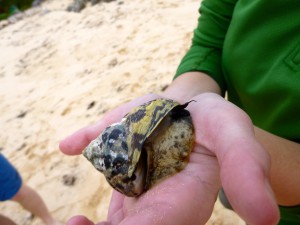
C. pica snail walking on my hand.
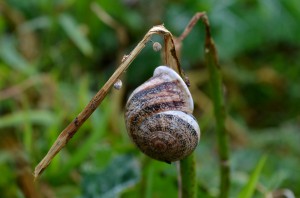
Land snail.
This snail had gotten a bit too far above the tide and dried out. After we put him in the water for a few minutes, he perked right back up and started walking on my hands!
I’ve also seen many land snails on Bermuda. They seem to be a garden pest in some places, and can be found by the hundreds in some places.
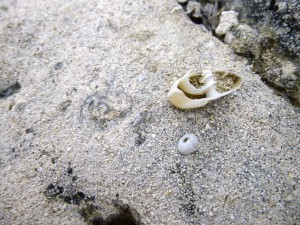
Fossil land snail shell.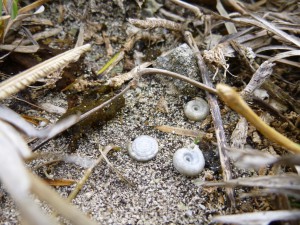 Fossil land snail shells eroded from the limestone.
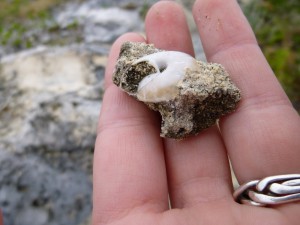 Fossil land snail in limestone.