In a land of pristine beauty, it’s painful to see such a waste of talent. The beaches of Bermuda, like many throughout the world, are littered with garbage. From an aesthetic standpoint, the plastic bottles, caps and fragments, along with buoys, shoes, sandals, personal hygiene products, clothing, and anything else that will float, are all downright disgusting.
Before you go cursing a poor Bermudian for wrecking their beach, ask yourself this: is that my toothbrush? This speck of an island in the wide Atlantic may contribute some of the trash that litters its beaches, the majority comes from far, far away.
Our current residence, the Bermuda Institute of Ocean Science lies at 32.370531 N -64.696158W. This location makes it the only land mass with in the Sargasso Sea, an area in the Atlantic Ocean of about 3.5 million square kilometers (860+ million acres). It is named after its vast accumulations of the seaweed Sargassum from an ocean gyre, or vortex.

This is not an anomaly. There are five major ocean gyres in the world, one in the Indian Ocean, and one per hemisphere in the Pacific and Atlantic Oceans. The Sargasso Sea just happens to include Bermuda.

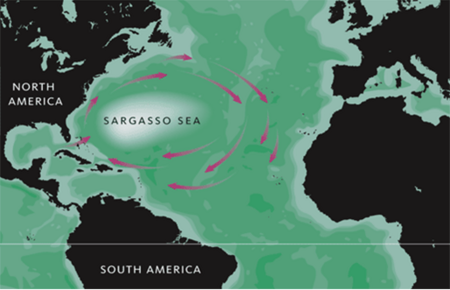
What happens in the gyres is a product of human wastefulness and natural processes. Light waste products like plastics escape the constraints of land, and much like man, head to the sea for adventure. It is in the ocean, where they meet their demise.
This waste accumulates in the vortex like lull of the gyres and begins to degrade. The plastics are the worst offenders, starting as shampoo and water bottles, shoe soles, toothbrushes, and more, and becoming a micro plastic, some the size of plankton.
The ramifications of the issue extend beyond the ecology, the aesthetics, or the ethics. We are allowing our waste to go wayside, to venture out sea, and to infiltrate the shores of a beautiful place that many call home: Bermuda.