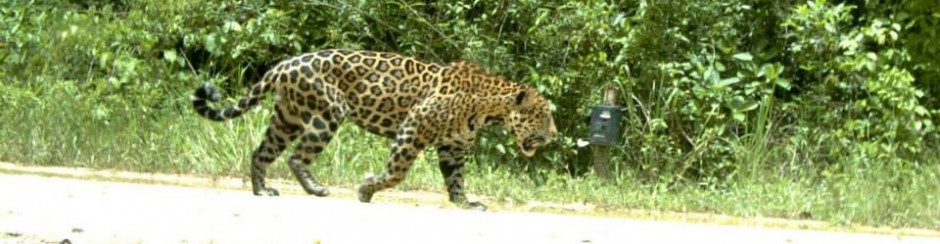
On our 5th full day in Belize and first full day at La Milpa we woke up and went bird watching around the La Milpa campus. We saw dozens of new birds!!! A couple that we saw were the olive-throated parakeet, the white-crowned parrot, the red-lored parrot, and a chachalaca. There was one tree that all of these birds loved to visit and enjoy its fruits. We have all become great birders, and while some are better than others we are all starting to spot birds on our own and identify them. We also saw a caterpillar that dangled from the top of a tree on a web-like substance, giving it the appearance of flying. We then enjoyed another wonderful breakfast outside on the patio. Even while eating, we enjoyed being surrounded by rufous-tailed hummingbirds that flit from the hanging feeders surrounding us, eagerly slurping the nectar.
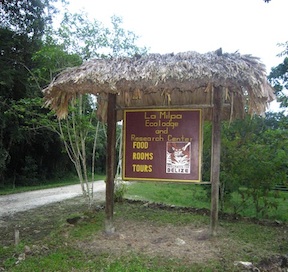
Sign leading into La Milpa Research Center
After birding and breakfast we traveled on our faithful bus to La Milpa. Upon exiting the bus, we spotted spider monkeys swinging from tree to tree in the canopy overhead, including a pregnant mother monkey that made a particularly remarkable leap from a low-hanging branch to a neighboring tree. After several minutes of observation, we decided to stop “monkeying around” and begin our short hike to the hidden Mayan Ruins of La Milpa. Our short walk in the woods lead us to several unassuming mounds, that upon closer inspection and some help from our guide Melvis, were revealed to actually be piles of rubble and overgrowth that were hiding the ruins from our view. Unlike the ruins of Lamanai, the remains at La Milpa still are, for the most part, unexcavated. Excavation has been slow because when the ruins were first discovered looters built tunnels and raided the temples for artifacts that could be sold at high prices on the black market. Recently a surprising discovery was made. A strategically placed boulder and many layers of brick hide an underground tomb from the raiders, and archaeologists and anthropologists were startled to find that it held not a Yucatan Maya, but an Aztec, covered in a jade necklace and surrounded by fine pottery, suggesting that he had been honored as a king in the region. We also saw two chulton, deep holes in the ground that go as deep as 15-20 feet, that the Mayans used as “refrigerators” or preserving rooms for maize, beans, drinkable water, and other goods.
We were sure to be wary of the large columns of army ants that would descend in swarms, causing even the largest of wolf spiders to flee from their path. While leaving the site, we took a different trail and noted a large lantern bug and its young slowly crawling up the grey tree trunk.
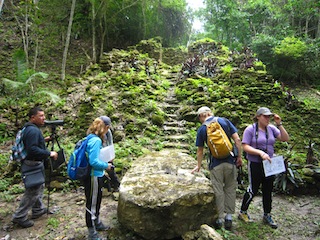
Temple 2
After lunch we went on a hike on the Bajo trail. Bajo means short in Spanish. This trail wound through the lowland transitional forest and swampy thickets. We saw species such as the chicle tree, which provides not only locals, but also people around the world with the material to make gum!! The canopy was a lot lower than what we were used to seeing and the path was muddy from the afternoon showers and very buggy. Near the end of the trail we saw a Mayan well that once supplied water to the reserve. Our hike was quite an adventure.
Following dinner, we broke into two small groups and either went on a night hike or piled into the back of a pick up truck for an evening drive through the forest. Various birds, spiders, and critters were spotted before we finished for the night, and we all arrived back at the reserve ready for a good nights sleep in preparation for another fun-packed day.
Until next time!
– Maravilla and Sara