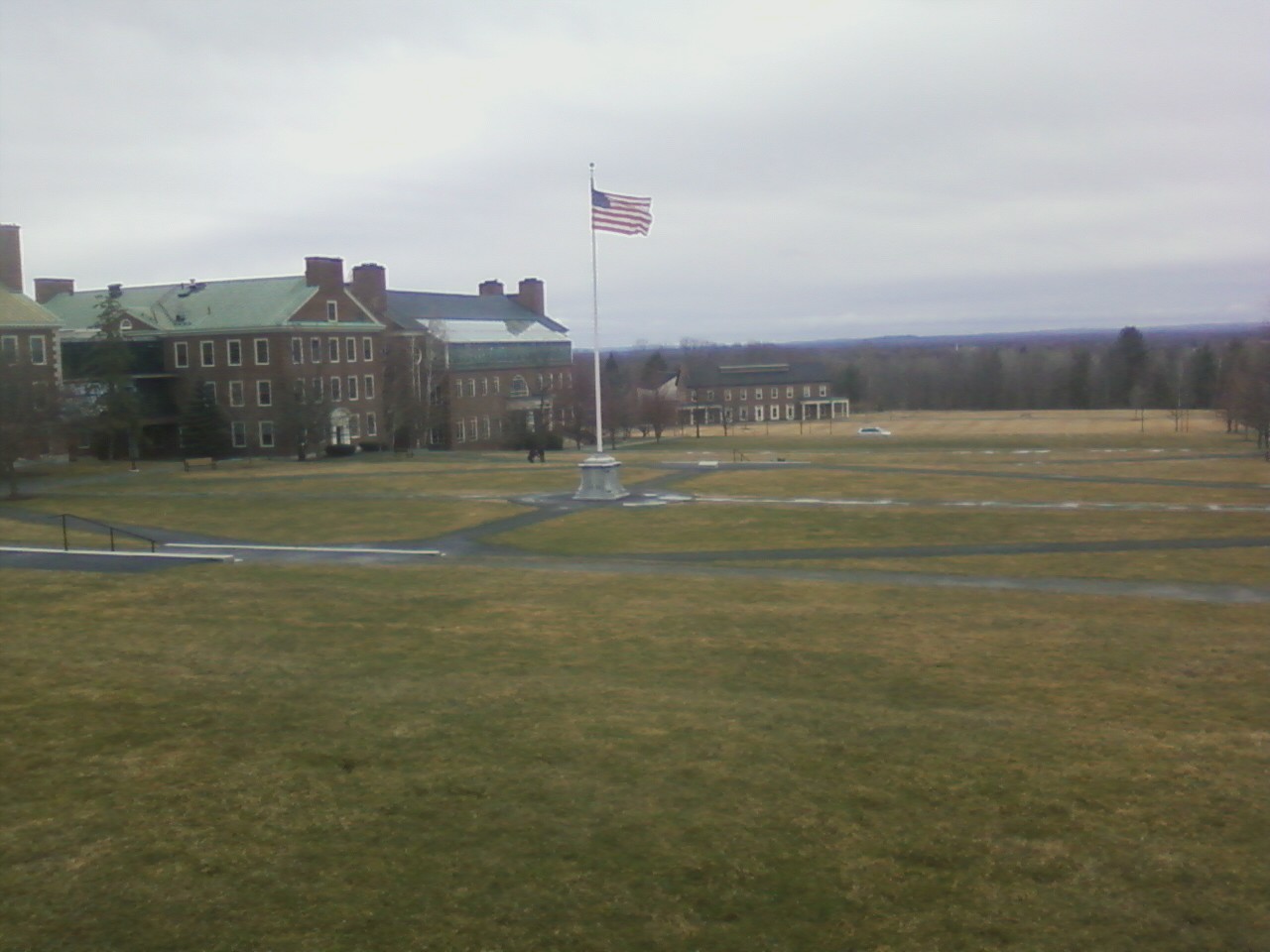
 The lawn in front of Miller Library is located at the physical center of Colby College, and its crisscrossing pathways provide routes between the North and South sides of campus. The asphalt paths cross directly between five of the major academic buildings—Lovejoy, which houses a variety of humanities departments,; Mudd, Arey, Keyes and Olin, which hold the Science departments; and Eustis, the administrative building. This grassy area, known most commonly as “Miller lawn,” “the quad,” “the academic quad,” or “Miller quad,” is well known and beloved by the student body. It is a picture-perfect space, organized into five tiers of grass, connected by central stone steps. A flagpole resides at the center of the middle tier; carved into its base are the names of Colby alumni who died in the Civil War, World War I and World War II. Benches and trees line the edges of the quad, and Miller Library resides at its apex. When standing on the quad itself, one’s sight is pulled in two directions. The tiered levels, the central staircase and the tower atop the library focus attention on Miller, while the Maine woods and mountains draw the eye down, towards the horizon.
When I began speaking to various members of the Colby community about the quad, it became immediately apparent that Miller lawn is a space defined by contrasting ideas and associations. Many of the interviewees spoke about the quad as a place where the campus comes together as a community. This was described as occurring during the warm weeks, when students gather to enjoy each other’s company in the sun, as well as on Doghead, an annual St. Patrick’s Day tradition when a large portion of the student body gathers at the top of the quad after a night of drinking to watch the sun rise together. Indeed, a recent Colby Echo article described the fun of Doghead as being derived not from the partying, but from the sense of camaraderie in gathering on the Miller steps as a community. On the other hand, interviewed subjects also spoke about events on the quad that deeply troubled the sense of community at Colby. For instance, Allison Ehrenreich, a Senior who studied abroad in Seville, described a now infamous incident among students who were here in the spring of 2010, when a group of male students sat on the quad with signs and a rating system regarding women’s outfits.
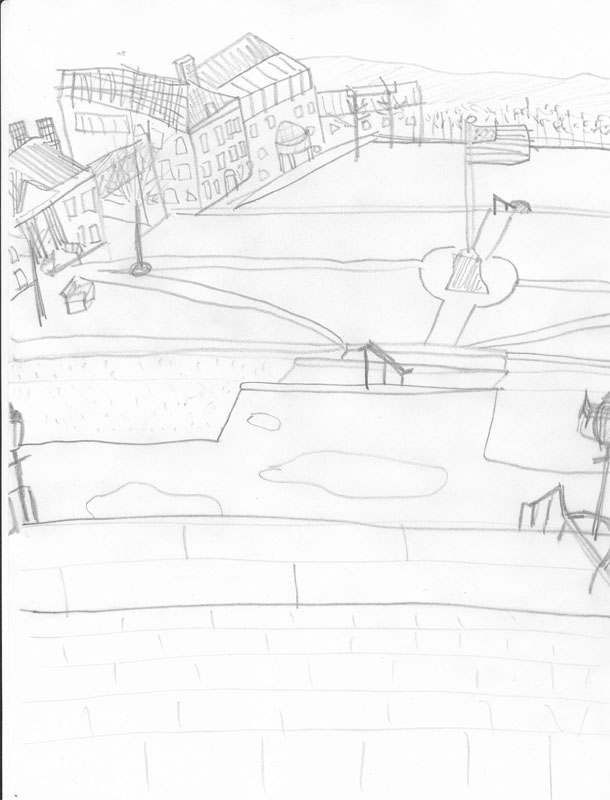 Similarly, students described both very joyful and quite tragic associations with Miller lawn. Most interviewees talked about enjoying the space as an outdoor gathering space for fun and relaxing. Ehrenreich mentioned the hearts on Valentine’s Day, anonymously placed all over the quad in a now yearly tradition. However, she and Meigs also spoke about darker associations with the quad, including the flag being lowered to half-mast to honor a death, and the September 11th memorial ceremony, held by the flagpole.
Another realization that became evident was that Miller lawn is a space highly impacted by outside forces. While students seem to view it as “their” space, they actually play a very small role in its appearance and use. Temperature and season have a direct impact on how students use the lawn: when it is cold, as it often is in central Maine, the quad is used simply as a commuting path, with a solely functional value. When the weather is warmer, it becomes a space to appreciate for its aesthetic value. Similarly, the use and value of the Miller quad is drastically changed by time. At 9:20am, unless the sun is beaming, the quad is completely deserted. Thirty-five minutes later, the space is full of students and professors walking to and from classes. Finally, Colby’s administrators have had a large impact on Miller lawn. As Mike McGuire, a Systems Librarian, pointed out, “you can tell a lot of time was put into designing it.” McGuire also spoke about the lock box that the college placed on the base of the flagpole, preventing students from continuing the ritual of “flag-poling,” or swinging from the flagpole ropes.
Indeed, the adults with whom I spoke offered a very different perspective than the students. They spoke more broadly, and with a wider perspective. Lyn Mikel Brown, a professor in the Education Department, spoke of Miller lawn as a space “that people go to educate, celebrate, demonstrate, mourn and socialize.” She talked about the now-banned Champagne on the Steps senior tradition and the graduation ceremony, as well as demonstrations and activism that have been limited by the administration. McGuire also spoke about past traditions, including seniors sleeping on the quad before graduation. He also discussed all of the work used to  maintain its aesthetic appeal, as well as how the image of the quad is used on postcards, websites and calendars that are sent to alumni. The students I spoke to seemed to have a fairly superficial relationship with the quad, whereas both Brown and McGuire seemed to have a much better idea of the space’s potential, as well as how it has been controlled and exploited by the administration.
Miller lawn is a center of campus, both physically and in a more figurative sense. The quad is defined in the mind of Colby community members by opposites and extremes—community and strife, joy and tragedy, busyness and desolation. Indeed, we are a campus that seems to always be at a lull or in a frenzy. Not one of the individuals that I interviewed spoke about the quad that I observed as I sat on the Miller steps on a Wednesday morning—quiet and mostly empty; pretty, but a bit dull. In addition, the fact that “outside” forces, including the school’s administration, have the greatest impact on the quad is reflective of the Colby community, where students often find themselves more as passively participating in, rather than actively creating uses for, spaces on campus. Finally, the limited vision of students regarding Miller lawn is indicative of the student body’s inability to fully engage in our community, especially when contrasted with the broader scope of understanding offered by the adults at Colby.