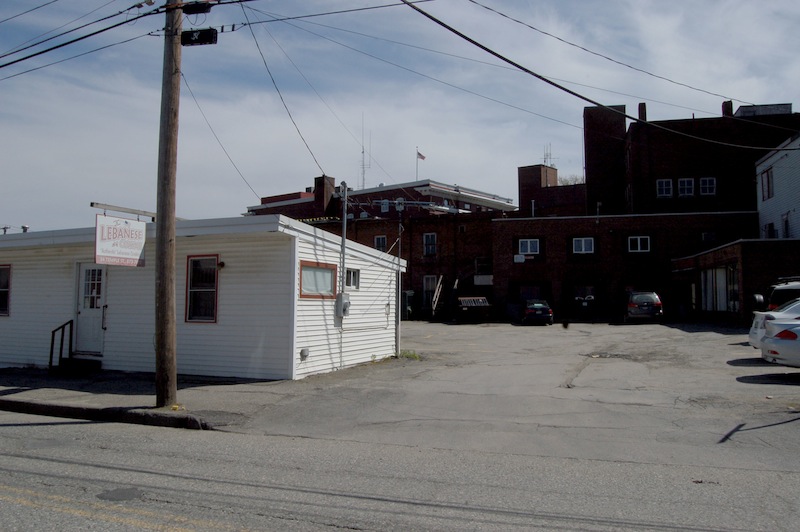
Walking down the block from the intersection of Main Street and Temple Street, there is shift in the landscape that becomes immediately noticeable. While the entirety of Waterville’s landscape has suffered tremendously from the loss of industry that plunged the city into poverty starting in the 1970s, the area on the Kennebec River once known as the Head of Falls appears to be in worse condition than anywhere else. Looking at the history of the city, the dilapidated nature of this small section of waterfront real estate stretching several blocks north from the end of Temple Street comes as no surprise, as for a long time it housed the working class families of the Lebanese American community in Waterville. It is no surprise that these properties are in such disrepair because when the factories left Waterville in the last half century, the jobs that supported the families in these houses left too. Walking past Main Street, one of the dying city’s last attempts at revitalization, and down Temple Street towards the restaurant, one cannot help but notice where the only Lebanese restaurant in town resides.
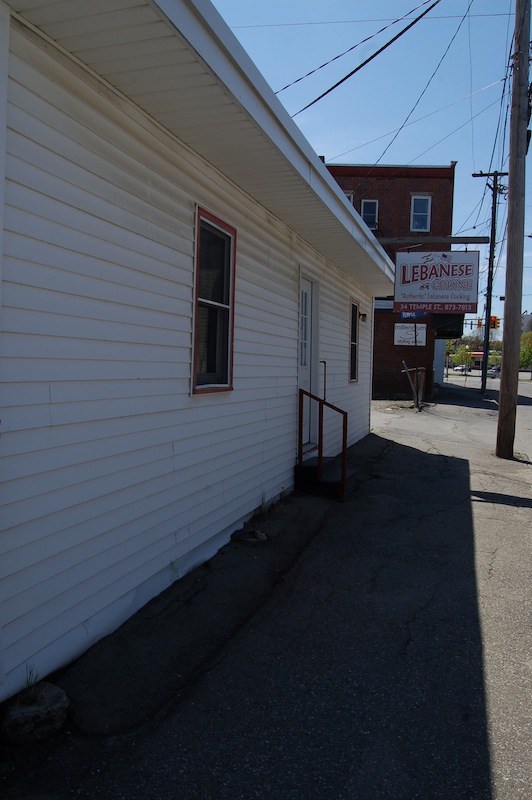
The building sits on a property that was clearly once designed as a parking lot for a larger business. It is not even clear that the word building applies to the structure however. It stands about ten feet tall and maybe sixty wide, with a depth of about twenty feet, appearing more like a trailer than a building. The drab white exterior has been colored a slight yellow by the car exhaust that floats down the half block from the traffic on Main Street, red outlines around the windows and door are the only source of color to be found on the paint job. Hanging a couple feet from the door, the sign reading “Lebanese Cuisine” sports the same red and white color scheme as the rest of the structure’s exterior. The building is nondescript, fitting in easily among the buildings that populate Waterville’s downtown area, and the rest of the property is the same. Cigarette butts and empty beer cans litter the far end of the property, giving it the same run down feel as the rest of the city.
Once one gets to the front door of the Lebanese Cuisine however, the experience almost immediately changes. After taking a couple steps into the trailer-esque structure, one finds his or her self inside an environment that could only be described as home-like. Entering the door, the first thing that one sees is a small room, filled with folding tables and chairs, its walls covered in wallpaper one might expect to find in one’s grandparents’ house, somewhat dimly lit as the light struggles through white curtains. The first thing that gives away the fact that you are indeed standing in a Lebanese restaurant (other than the incredible smell of spices and cooking ground lamb and beef) and not a small family home in a trailer, is the stack of books and pamphlets sitting on a table directly in front of the wall facing the door. Sitting on top is a book picture book about Lebanese culture and in a neat stack next to it is a pamphlet from the Saint Joseph’s Maronite Catholic Church that stands one block over on Appleton Street. Looking up from the table and to the right, the restaurant half of the structure presents itself. Sitting behind a counter that houses a variety of baked goods from spinach pies to meat rolls, is a small kitchen set up, that much like the dining room looks like it could be found in any house in Waterville. In fact, if it weren’t for the menu board featuring the Coke logo and stock shots of falafel, shawarma and hummus taken decades ago, the two large display coolers filled with soft drinks, and the counter, one might wonder if they mistakenly wandered into someone’s home instead of a restaurant.