As a student of Colby College, I would say that my experience represents that of most small liberal arts attendees. Sunday college brunch is no longer a chance to catch up with the grandparents while downing a fresh New York bagel with lox and cream cheese…Sunday brunch is when reality is shoved in your face and the illusion that a weekend of partying creates is rudely shattered. You are back to the grind. And to most students of elite, prestigious colleges (or so we believe them to be), the grind is as follows: Monday- class, Tuesday-class, Wednesday- class and pub night. Thursday- class and bar night. Friday- library and party. Saturday- library and party. Sunday- brunch then library till 2 am.
http://youtu.be/8Ge4qLA7PlE
This is generally how our life goes and the way in which we perceive our weeks. And this how we feel about brunch (aside from the fact that going out to eat also means real eggs, not the ones from a carton…a major culinary plus). In order to understand the path we take from our campus to the American diner, we must picture ourselves in a car, at the intersection of Main Street. It is important to keep in mind however, that this is Waterville’s Main Street, thus its extent is rather limited due to the rampant poverty of rural Maine and the fact that the city has been in decline ever since the closing of the mills and factories in the 1950s. It is here that we are in limbo. We are not on Kennedy Memorial Drive- what we like to call the fast food capital of the state- nor do we sense the small town feel that is promised to us by the admissions office. We are surrounded by run down houses, parked cars, and signs for auto- repairs and hardware shops. We are in the in-between- where no one stops to stay, but always passes through.
As Main Street disappears, growing faint into the distance, we are faced with the old factories located on the reservoir. What used to be the engine of what propelled Waterville’s economy now lays abandoned, aside from the gourmet chocolate boutique that has recently opened up in one of the lots. We next cross the Kennebec River Reservoir through Bridge Street. The bridge itself is something to be admired- made probably of steel- its structure representing the industry that Waterville once represented. In a matter of minutes, endless farmland is all that is in sight. There is only quiet and the expansiveness of snow. Finally in the distance is our destination, my destination every Sunday, the only standing structure around: Bonnie’s Dinner, a small quaint white house with red stairs and a hand painted sign. It is here that students come to escape the bubble that is Colby, get a little fresh air and a reminder of the real world, and enjoy brunch with friends.
Bonnie’s Diner is the definition of an American Diner, made physical. The room is small but always filled with energy and local customers, despite its early hours of operation (the diner is only open till noon). The smell of fresh brewed coffee greets you at the door in addition to an elderly friendly Mainer. The tables are lined next to one another so you always end up eating elbow-to-elbow with a stranger. Though some may not approve of this cramped environment, it establishes an odd sense of community or shared experience. The flatware does not match but rather consists of a collection of personal mugs and plates- I have, on numerous occasions, been 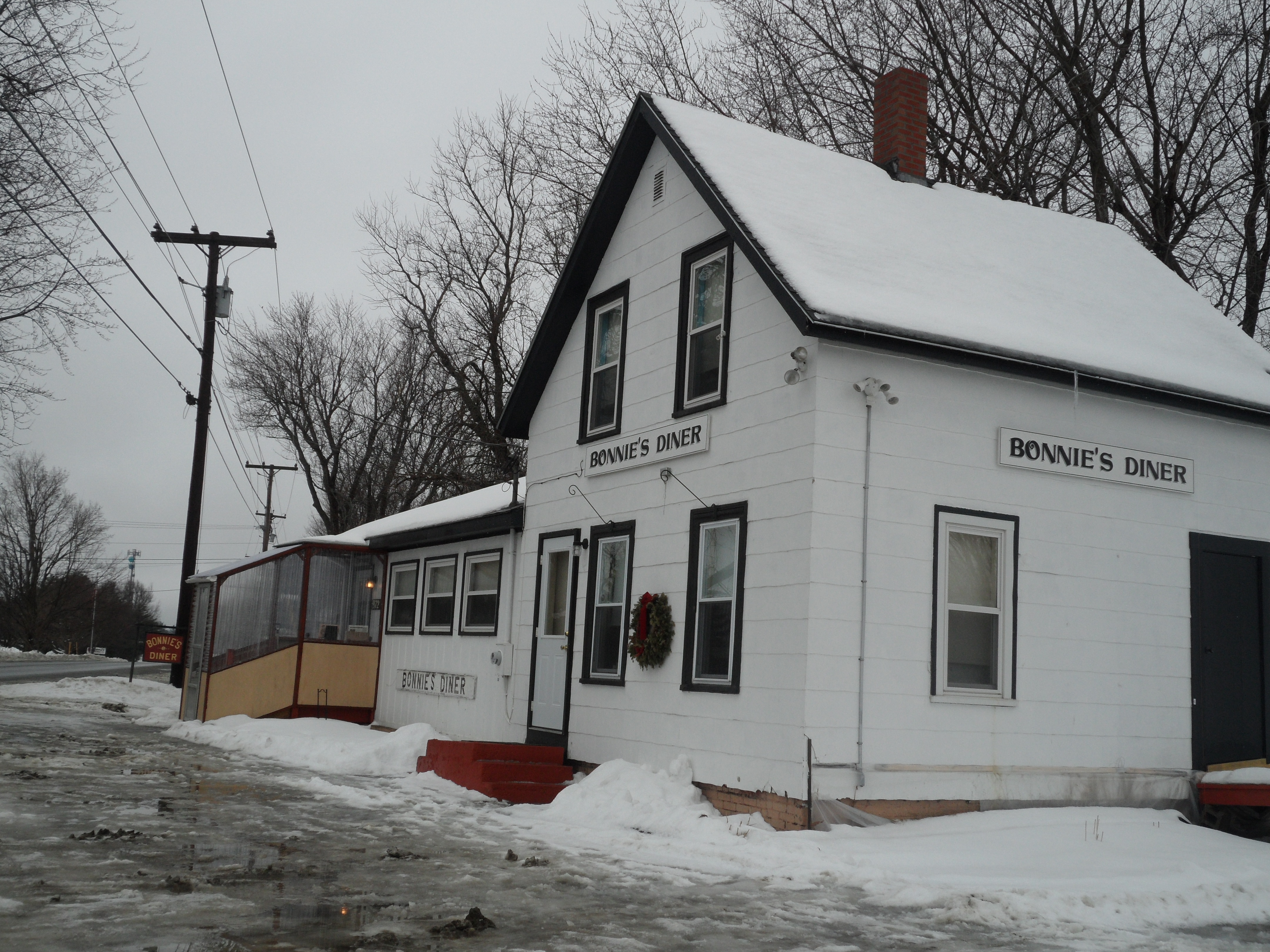 served tea in mug inscribed, “I Love My Daddy.” There are round, plastic covered stools at the counter and though its 2012, you can still only pay in cash. The portions are big and the staff is friendly. In fact, the employees are all older women from the area who have been cooking and working there for a generation, if not more. It’s a family business where even us customers are treated as members.
Bonnie’s Diner represents not only what the college sells, but also what Waterville used to be and what small town American life is like. Bonnie’s Diner is a blast from the past yet its survival and continued existence gives us hope that in such a digital era of impersonality and chain franchises, you can still find a place that reminds you of home (and even better, a place that can serves the best eggs, bacon, and home-fries you’ll ever have).