
Before this course on the history of the book, before reading McKenzie and his philosophy that “forms effect meaning”, it was easy to look past the presentation of a text and consider a book holistically. But, as new knowledge replaces naivety, it becomes impossible to ignore the fact that the verbal text of a book, just the words and their meaning, is impacted by its presentation and its physical form, or paratext. Summarized by Gérard Genette, “the paratext is for us the means by which a text makes a book of itself and proposes itself as such to its readers, and more generally to the public.” Martin Brimmer’s Egypt: three essays on the history, religion, and art of ancient Egypt constitutes a verbal text presented through paratext in three major ways: the organization of the work into three essays, the layout of the page, and the form of the text itself.

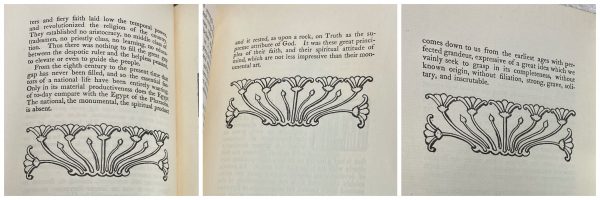
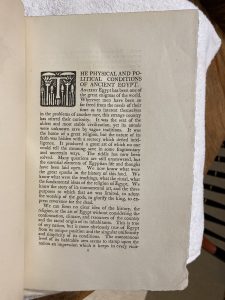
The first layer of paratext in this book is the overall organization and delineation of three separate essays. Each essay begins with an illustrated initial. The essay titles, “The physical and political conditions of ancient Egypt”, “The religion of ancient Egypt”, and “The art of ancient Egypt”, have a parallel structure that enables a unity in the paratext because each essay begins with the same letter and can begin with the same illustrated initial (figures 1-3). Each essay also ends with a tail-piece of papyrus flowers (figures 4-6). This paratext organizes and distinguishes the three essays while also unifying the separate parts of the book. The imagery of papyrus blooms in the initial and tail-piece further serve the purpose of this book by including important Egyptian symbolism. Papyrus symbolizes nature and its source, the life-giving Nile, a crucial component of Egyptian history, religion, and art. As Brimmer states in this book, “…truly the worship of nature in its multitudinous forms was the origin of the Egyptian religion” (34-35). The purpose of this book, as explained by Brimmer in the preface, is to collate information on ancient Egypt to give background to art historians studying Egyptian art. The symbolism of the papyrus flower is at the heart of this, and its inclusion in the initials and tail-pieces is an example of what readers can gain from this book: an understanding of Egyptian symbolism in art.
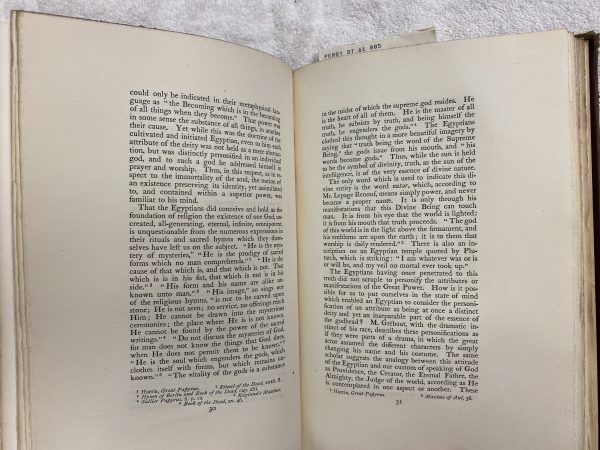
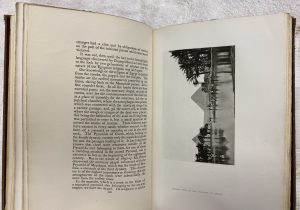
Moving down in scale to look at the layout of one page, the paratext includes the margin size, paragraph indentations, footnotes, and page numbers. The pages of Egypt: three essays on the history, religion, and art of ancient Egypt have very large margins (figure 7), decreasing the amount of words on each page and impacting how the text is read. The paragraph indentations are small but help organize the page by showing where new paragraphs start. The footnotes are another important aspect of paratext that allow the reader to gain further information on parts of the verbal text.
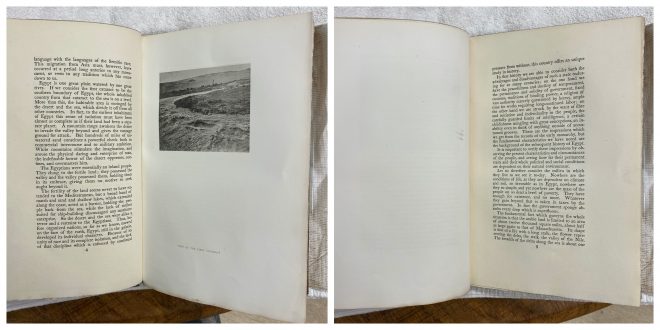
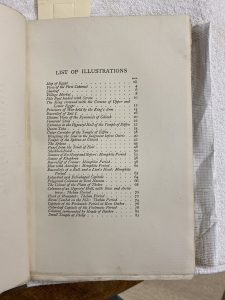
Page numbers can be found centered at bottom of the pages of text. However, the photograph pages are not numbered and are skipped in the count (figures 8-9). This maintains continuity by keeping the odd numbered pages on the right; otherwise the photographs, which are only printed on one side of the paper, would disrupt this uniformity. This is interesting because the book contains a list of illustrations with page numbers (figure 10), so the page numbers in this list are based on the page of the text immediately before the photograph. This still makes the book navigable, although in a different way from what we’re used to today with books that have photographs and text on the same page.
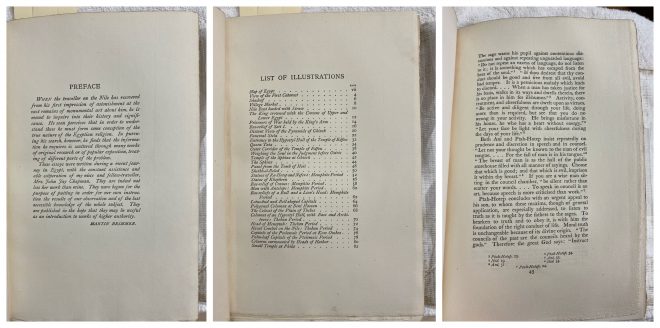
On the smallest scale of paratext, the font of the text itself effects its meaning. Excluding the cover and title page, the text of Egypt: three essays on the history, religion, and art of ancient Egypt is written in the same, simple font. Within this same font, text sizes, italics, and capitalization are used to separate different parts of the text. Italics are used for the preface, the list of illustrations, and footnotes (figures 11-13 respectively), of which the footnotes also use a smaller font size. The preface, list of illustrations, and footnotes are all components of paratext themselves and therefore their presentation in italics keeps attention on the more important verbal text. The essay titles are written in all capitals to emphasize this key part of the verbal text (figure 14). Lastly, the illustration captions use a different font, most likely due to the different technology used to print the pages with photographs (figure 15). These aforementioned fonts are simple in form, effecting functionality and legibility for the majority of the text.

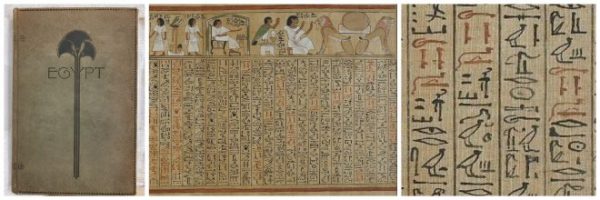
In contrast to the standard fonts used for the bulk of the text, the title uses an elaborate typography to evoke a specific reaction from the readers (figure 16). Typography is an interesting type of symbolism, it’s hard to pinpoint why these specific letter forms help evoke a feeling of Egyptian culture. Does this typography just match a western point of view regarding Egypt, or are there real connections to ancient Egyptian culture? The curling form of the G and vertical, upward motion of the letters seem to evoke plant-like forms, such as the important Egyptian vegetation along the Nile. Or perhaps the verticality of the letters alludes to the vertical organization of hieroglyphs. In the example of hieroglyphs from the Book of the Dead of Hunefer (figure 17), one can see similarities between their slim nature and curvature and the letterforms of this book. Some of the hieroglyphs even resemble the ‘P’ used in the typography of Egypt.
In the title of this book, I find the way the ‘A’s are drawn to be of particular interest. They remind me of how the fifteenth century German printmakers Albrecht Dürer and Heinrich Aldegrever (among others) signed their prints (figures 19-20). This shape for the letter A therefore has its roots in art and might have been chosen to help establish this book as a resource for art historians. Written by Martin Brimmer, the first director of the Boston Museum of Art, I assume he would have recognized this allusion and his decision shows us how he wanted to present his book and how he wanted it to be perceived by his colleagues.

Regardless of exactly how the typography alludes to Egyptian culture and western art, the font of the title of this book gives the reader more information than just the verbal words they give form to. This paratext, along with the other fonts, layout of pages, and organization of the book, all effect the meaning of the verbal text of Egypt: three essays on the history, religion, and art of ancient Egypt.
Sources
Brimmer, Martin. Egypt: three essays on the history, religion, and art of ancient Egypt. Cambridge, MA: Houghton, Mifflin and Co., 1891.
Gerárd Genette, “Introduction to the Paratext,” trans. Marie Maclean, New Literary History 22.2 (1991), 261-2.
McKenzie, D.F. Bibliography and the Sociology of Texts. Cambridge, MA: Cambridge University Press, 1999.