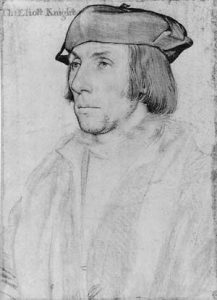
The castell of helth was written by Sir Thomas Elyot. Elyot was a British writer born around 1490. There seems to be records of Elyot’s early education but it is unclear whether he attended university. In the preface of Elyot’s Latin-English Dictionary (1538), he implied that he did not receive a formal college level education and that his interest in liberal studies and philosophy was self taught. However, both Oxford and Cambridge University claim Elyot as a student due to various spellings of ‘Thomas Elyot’ being on both registers. Elyot spent many years working closely with government officials. His political career first began in 1523 when he was appointed to senior clerk to the king’s council during the reign of King Henry VIII. Through this work, Elyot was eventually knighted. From his experience on the council, Elyot gained a wealth of political knowledge which he then used to write The Boke Named The Governour. This text focused on political theory as well as the education and ethical values that Elyot believed the governing class should strive to uphold. This text became quite popular and is one of the reasons Elyot was regarded as a prominent writer and philosopher during this time period. Throughout his career as an author, Elyot wrote texts on a wide variety of topics, never seeming to stick to one field. The castell of helth, which is the focus of this project, is one of Elyot’s later works. This was first published in approximately 1541. The castell of helth focuses on the teachings of Greek and Roman physicians. The focus on medicinal practices and healthy living completely diverges from Elyot’ previous works with political theory and linguistics. It seems that Elyot’s goal when writing this text was to make aspects of medicine more accessible to the public in hopes that people would change how they approached their health and wellbeing. Many medical texts during this time were only accessible to doctors. Elyot took what was regarded as complicated teachings and translated them into everyday vernacular.
When I first examined the copy of the castell of helth I would be working with for this project, I realised that this text had a colophon detailing where it was imprinted. I thought this would make researching the origins of the book a bit easier however, the colophon brought more questions than answers. The colophon states that the book was imprinted at ‘Fletestrete’ by Thomas Dowell. However, during my research I found that the book was imprinted at ‘Fletestrete’, now spelled as Fleet Street, but by Thomas Berthelet. Berthelet worked with Elyot to print a number of books so it is no surprise that he also played a part in the making of the castell of helth. Another connection between Elyot and Berthelet is that they both worked for King Henry VIII. During Elyot’s time as senior clerk to the king’s council, Berthelet worked as the king’s printer from around 1530 until King Henry’s death in 1547.
Further research revealed that several printers worked on the castell of helth. In the later versions of the text printed in the early to mid 1570s, the printer is listed as Thomas Marsh. Marsh is also listed to have worked at Fleet Street. It is not clear whether these three printers all worked for the same printing shop or they were all separate printers working along Fleet Street. Fleet Street has a long history of printing in London that began in the early 16th century and is still prominent today. While there is information about Berthelet’s life, Thomas Marsh and Thomas Dowell seemed to have no record of their early life and career. However, it seems likely thatThomas Dowell and Thomas Berthelet might have worked at the same printing shop. This copy of the castell of helth states that it was printed in 1541 by Thomas Marsh. Records online state that in 1541 versions of the castell of helth were printed by Thomas Berthelet. Perhaps, Marsh and Berthelet worked together, or maybe they are one person using an alias. After all, even though Berthelet’s career is well documented, there is not much known about Berthelet’s early life.The first record of this name being used in Fleet Street, London is when Berthelet applied for a marriage license in 1524. Just a year before the name Berthelet is associated with his first printing job.
References
ProQuest. Early English Books Online. https://search.proquest.com/eebo/results/A253357B5A684041PQ/1?accountid=10198
Oxford Dictionary of National Biography. Sir, Elyot Thomas. https://www.oxforddnb.com/view/10.1093/ref:odnb/9780198614128.001.0001/odnb-9780198614128-e-8782?rskey=jJa8Fi&result=2
Oxford Dictionary of National Biography. Bethelet [Berthelot] Thomas. https://www.oxforddnb.com/view/10.1093/ref:odnb/9780198614128.001.0001/odnb-9780198614128-e-37187?rskey=rRRqfz&result=1
The Culture Trip. The History Of London’s Fleet Street In 1 Minute. https://theculturetrip.com/europe/united-kingdom/england/london/articles/the-history-of-londons-fleet-street-in-1-minute/