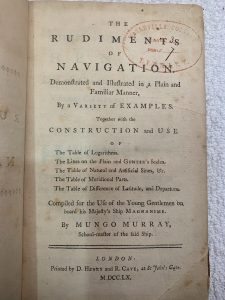
For my Pet Book, I have chosen The Rudiments of Navigation by Mungo Murray, printed in London by D. Henry and R. Cave in 1760. The book is a manual for basic navigation at sea, specifically for use aboard ships of the Royal Navy. It contains a very short introduction to the arts of navigation, and then the remainder of the book deals with the mathematics of navigational calculations, for which purpose are included a number of engravings detailing geometric planes. While the majority of the contents of the book are not exactly light reading, the character of the book has much to offer.
I was captivated by the book from my first interaction with it. I am a bit of a self-professed history nerd, with a particular emphasis on naval history, and for this reason upon first glancing at the title page I was wholeheartedly drawn in. The book is specifically “Compiled for the Use of the Young Gentlemen on board his Majesty’s Ship Magnanime.” I was immediately intrigued by the fact that a particular ship was listed on the title page, and even more so by the fact that Murray writes that he was the schoolmaster of that same ship. The book is dedicated to Henry, Earl of Gainsborough, whom Murray had the pleasure of teaching. This specific and very personal connection to history was enough to convince me to choose this book.
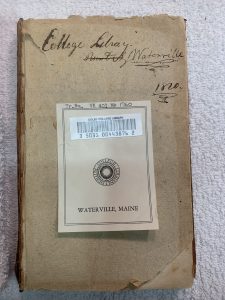
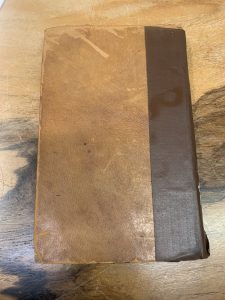
The book is in a relatively poor condition, with the front cover missing and the first few pages tearing in places. The spine of the book is covered in tape, probably intended to help hold it together. The back cover is undecorated and consists of paperboard covered in an inexpensive and thin leather. The first few pages show some embrittlement where the cover has gone missing, exposing them, and there is some foxing within the first ten or so pages. Beyond the cover, spine, and first few pages, however, the book has generally held up well for its apparent wear. The paper is of good quality, robust and pliable, although not extremely expensive or fine. The book shows signs of light and dirt exposure on the top but not the bottom, indicating it likely sat upright for much of its life. The wear on the book, as well as its size, befits its intended function as a textbook on navigational calculations.
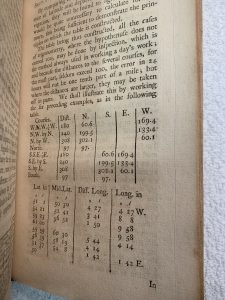
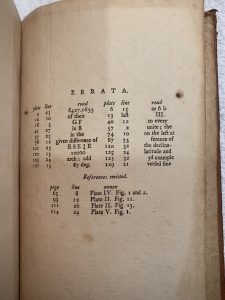
The book is printed in black ink and features a title page, dedication, table of contents, introduction, and an errata at its close. The book also features running heads, section markers, page numbers on the upper and outside-most corner of each page, and at the bottom of each page it also features catchwords. It features a number of foldout engravings detailing geometric planes, and pages of calculations of sines, cosines, and tangents.
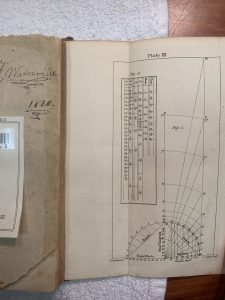
The book contains a library bookplate of Colby College, included in which is the call number for the book. Above this and written on the front page of the book itself is “College Library. Presently Waterville, 1820.” This indicates that the book has been a part of the college collection since its founding. On the title page is a stamp of Waterville College Library, and then a call number along with the date December 9, 1938 is stamped on the following page. Otherwise the book is absent of any markings.
For my future studies on the book, I have a number of questions, mostly relating to the book’s history as well as how it arrived to the College:
What can I find out about HMS Magnanime? About her midshipmen, the “young gentlemen” for which the book was written? What about Henry, Earl of Gainsborough? How did this book come to the Colby Library? Certainly it had to have spent time at sea, given its printing information, but was it there for an extended time? And Murray? How long did Murray serve on board HMS Magnanime? What more can be found about him?