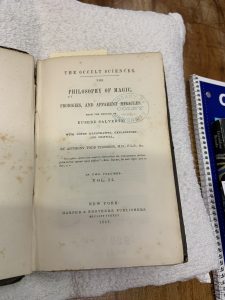
The book that I have chosen for my Pet Book Project is The Occult Sciences: The Philosophy of Magic, Prodigies, and Apparent Miracles. This edition of the book was written from the French of Eusèbe Salverte and published by Harper and Brothers Publishers (a New York based publishing company) in the year 1847, and is volume II out of a two volume set. I knew going into the project that I wanted something quite old (a given due to the nature of the assignment) and something that had compelling content (I wanted to work with a book that I found interesting). Somehow I managed to stumble across this title in the Special Collections catalogue. With words like “Occult” and “Philosophy of Magic” in the name I was instantly intrigued.
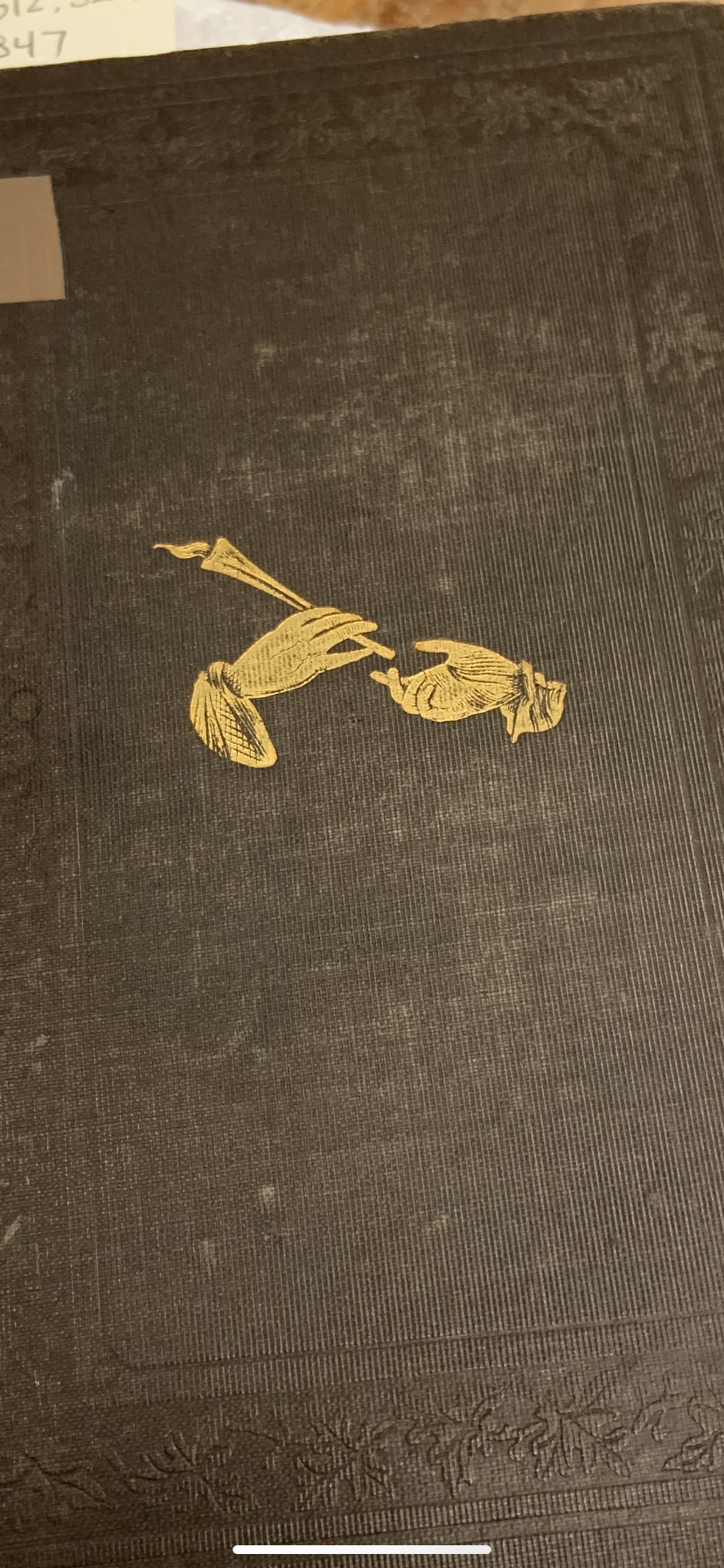
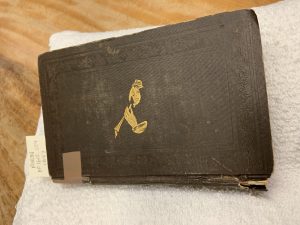
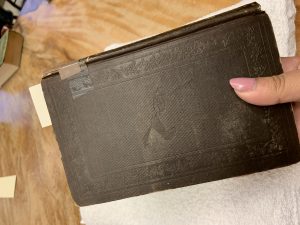
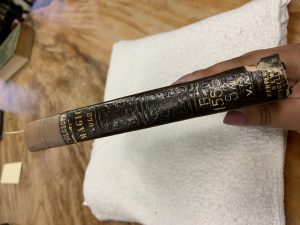
My first physical meeting with the book did not go exactly as planned. Initially, I had wanted to work with volume I of the set. But interestingly volume I is currently missing in action, with several of the Special Collections staff struggling to find it. While I was a little disappointed at first, it almost feels fitting for a book about the occult to be the one to go missing. So with volume I escaping my clutches, I turned to volume II. The book’s appearance does little to convey what the contents inside hold. The brown front cover sports a small gold colored vignette surrounded by a faint border. The back cover has the same design, minus the gold. The spine of the book has a good amount of wear and tear. The top of the spine is taped together and a chunk from the bottom is missing. The only hint to what the book is about are three small words at the top of the spine reading: “PHILOSOPHY OF MAGIC”. The significant damage to the spine leads me to believe that this book was either heavily used or not properly taken care of. The lack of visually striking details on the outside covers and spine implies that this was not a book meant to be decoration on someone’s coffee table. So as you can probably guess, I was not exactly drawn to this book because of its outward/physical appearance.
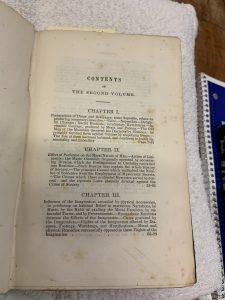
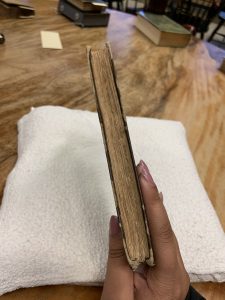
Inside of the book is when things start to get interesting. In the beginning of the book there is a title page detailing the title, author, contributors and publishers (which was to be expected). But the thing that stood out to me on the title page was a quote that appears to be in Latin. The quote states: “non igitur oportet nos magicis illusionibus uti, cum potestas philosophica doceat operari quod sufficit”. After putting it through a few online translators, I am still uncertain of the meaning of the quote (since each translator says something different and none may be reliable). So for now, it remains a mystery that I will hopefully solve (perhaps the translation is lost with volume I!). The title page is followed by a table of contents detailing what each chapter is about. The font itself is not especially large, but not incredibly small either. The margins were larger than I was anticipating, leaving a significant amount of space between the writing and the ends of the pages. At the back of the book is an index, and after that are what appear to be advertisements for other works by the Harper and Brothers Publishers. The pages themselves are also quite interesting. The majority of the pages are foxed, but are relatively in good condition considering the book’s age. So far I can only find one page that has a significant rip in it. Some of the pages also appear to have deckled edges which I am not sure is from the paper making process or if it is a stylistic choice.
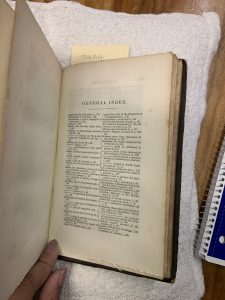
What I find most interesting about the book is also what I have the most questions about. The content itself is very academic. The writing is written in an academic tone, the word choice is not something that would be in a children’s book, many pages have footnotes with further explanations, and the index is quite extensive. The Occult Sciences: The Philosophy of Magic, Prodigies, and Apparent Miracles does not give any indication to being a fairy tale of any kind. This makes me wonder who was the intended audience? Who used this book? Where would someone find it?
My hope is that through more interactions with The Occult Sciences: The Philosophy of Magic, Prodigies, and Apparent Miracles, I can answer some of these questions. Hopefully I’ll be able to find out the translation of the Latin quote, and get to interact with volume I. Regardless of what I am able to find out, I welcome new discoveries with open arms!