Alexandra Ferri
2/15/20
Pet Book Introduction
The book labeled as The Holy Spirit was published in 1677 under the name as “A discourse concerning the operations of the Holy Spirit : with a confutation of some part of Dr. Owen’s book upon that subject : in three parts.” I had elected to pursue a text conveying spiritual content because it would create a connection of considerable dimension between myself and the previous owners and readers. It could fit in a pocket, but it is saturated with annotations, marked passages, and responses to the text from a previous owner. Though it appears to be an ordinary Christian text with typical relic leather covers, the book has an intimate quality that gives it the human aspect I was seeking.
The author, William Clagett, was a preacher who challenged other belief systems, even Christian ones. The second edition book’s initial appearance is straightforward; the covers are leather, neither of which contain any text. It has deckle edge yellowed pages, imprints on the spine from where it was bound, and a handwritten label taped on the spine, saying in all capital letters, “The Holy Spirit. Clagett”. The book noticeably displays its many years of shelfware, as the covers have rounded edges that are crusty and peeling, and the binding is worn from being pressed against books on either side. The binding is in relatively good condition, although the stitching on the bottom is falling apart, further implying that it was both well loved, and stored upright for extended periods of time.
I was not particularly enticed by the book’s physical presence; I merely picked it up when I read The Holy Spirit on the spine. I perceive its simplicity as a draw because I recognize that spiritual texts are frequently designed to direct focus towards the content of the language, rather than material qualities. However, I recognize that this could sacrifice richness in subject matter for bibliography. Regardless, I’m sure I will discover unique characteristics along the way.
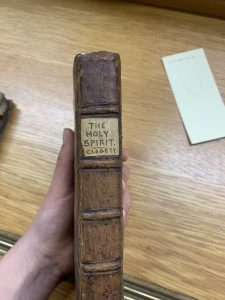
The text itself is printed in black ink with very small inner margins, but immense outer and lower margins. The author also had phrases typed in italics throughout the book, at least once in nearly every line. The script is packed with semicolons and colons, along with capitalized letters, which are typical in Christian scriptures and publications. There are page numerals in the upper right hand corners, although there are nineteen unnumbered pages. The pages also display direction lines and running heads throughout the text. The binding has worn in a manner that separates groups of pages into individual clumps, which are difficult to peel apart from within. When flipping through, the paper renders a deep crinkling sound that must be the result of contact with water, or merely the aging process. While it has been preserved well, the book was clearly used substantially in its day. The plain leather covers are ridden with apparent water damage, showing darkened matte speckles which contrast the otherwise smooth, shiny finish. It could have been exposed to rain, aging the leather in this fashion. The edges of the feathered pages are darker brown than the once white, textured insides. The difference in pigment indicates use of the book, a likely driver for discoloration. There are also a handful of ripped pages, especially in the front and back sections of the book, probably because the owner referred back there frequently when he took notes or referenced page numbers.
Upon opening the book for the first time, I was immediately engrossed in the calligraphy on the first few and final pages. On the first page, “No. 32” is written in faded brown ink in the upper right corner. Also written on the page is some calligraphy that I read as something like “Dr. Owens Book. I aprove not so fore as the Gods hold the nativel.” It’s safe to say that this individual wrote all of the notes throughout the book. The ink has bled extensively, so there is another line of writing which I will have to study closely to decipher, but at the end, the writer indicated “the spirit of god.”
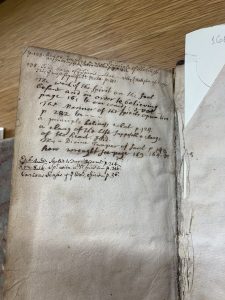
What I find to be the most intriguing aspect of the work is the page of notes in the back of the book. The writer inscribed page numbers, along with reflections about the text. There are x marks on the corresponding pages. Some phrases I could make out from the annotations were “implying a new principle of Holiness,” “to be born of Spirit -what- why metaphor used, this is most signficant,” “the word of the Spirit on the Soul before and in order of believing,” and “Thy Divine temper of the Lord.” The purpose was probably to briefly summarize why each page number provided was significant. I found this aspect compelling because, not only do I have the same practice when I read, but I now can break down the text itself in the referenced pages.
I’m enthused about my choice because I’m driven by curiosity about the faith of others, and how their beliefs relate to my own. The notes and citations allow me to form a connection with a previous reader whose religious beliefs from hundreds of years ago have probably been forgotten, if ever known by others. I can delve into the language that the reader found to be intriguing amidst my study of bibliography, and the book itself. I also look forward to deciphering the notes, finding little mistakes if there are any, learning what elements have weathered the book, and discovering all of its quirks.